The Shenandoah Valley, Part One - Numbers 13 and 96 on my life list.

Go to Part: 1, 2, 3, 4, 5, 6, 7

I try to keep my life simple. I’ve managed to avoid most of the responsibilities that tend to ride shotgun with adulthood: marriage, children, a career with even the slightest potential of upward mobility, or any measurable role in the community. But even without those things, ordinary day-to-day life can still keep me distracted from the simple relaxing moments I crave.

Staying on top of requests at work and merely maintaining a clean healthy home and body, so they don’t end up like a post-Chernobyl event, is a daily grind. So even a simplified life can bring with it some short frantic days and nights where you don’t even realize you’re tired until your worn out body hits the pillow.


Often, when I try to relax or spend time on something I enjoy, my mind drifts onto those chores and errands and a tiny pang of guilt seeps in for not working on them. I can't imagine how parents and people with more responsibilities handle it. You must have to be sick to get a guilt-free break from your to-do lists. Fortunately I have a solution that doesn't require being bedridden with the flu: a combination of solitude, a trail meandering through the natural world, and a bare minimum of necessities on your back.

Picture your own to-do list, and imagine for at least a week, that seemingly endless and ever-growing list has been simplified. Now it only contains (and when your transportation is miles away, it's noteworthy to say, it can only contain) one item: take another step. 


You don't think about laundry or mowing the yard. Nobody is going to call asking you for a favor, nor will a deadline at work even cross your mind.  No sense in feeling guilty about it, you are in the woods miles from a vehicle, there is nothing you can do but move forward. Soon you find that your mind unclutters and relaxes.  You can breathe easy.  The important decisions of the day are relegated to where to walk, where to eat, where to sleep, and where to poop. It just doesn’t get any simpler than that.

I know I often romanticize my time in nature and mostly remember the good things, but I want to be honest and not leave the undesirable moments out of my journal. John Muir once said it takes at least two weeks alone in nature to truly learn what it can teach us. I think I know what he was getting at, but for me, at least on this particular adventure, it took about five days. Don’t get me wrong, I enjoyed nearly every moment I spent in Shenandoah, utterly joyful and exhilarating moments, but there is a threshold. A threshold that once crossed, it’s hard to imagine ever returning to that busy normal life.

But let me start from the beginning. Early in the trip, let’s just say, small mistakes were made and frustration ensued.


Part 1: Saturday, the First Night

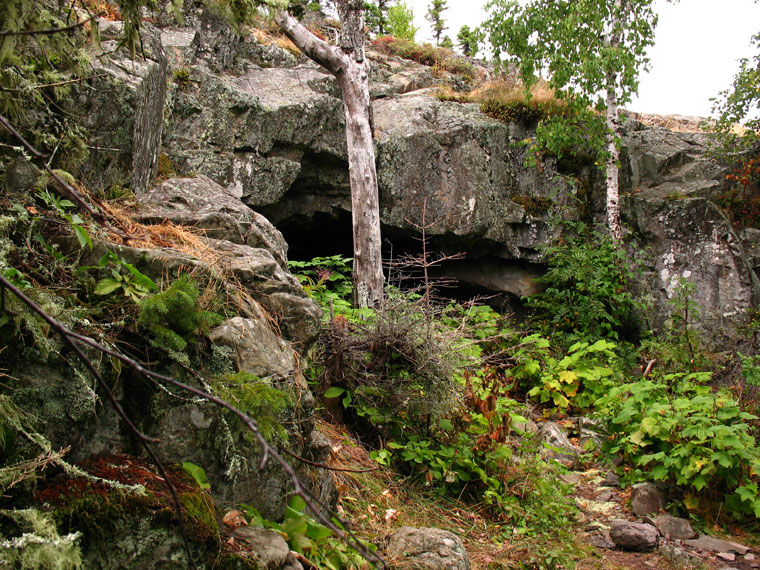
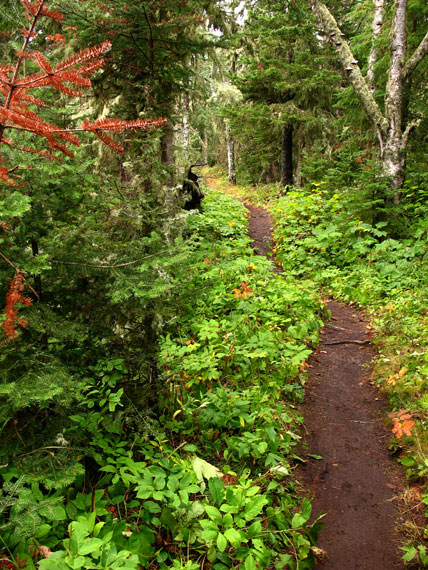
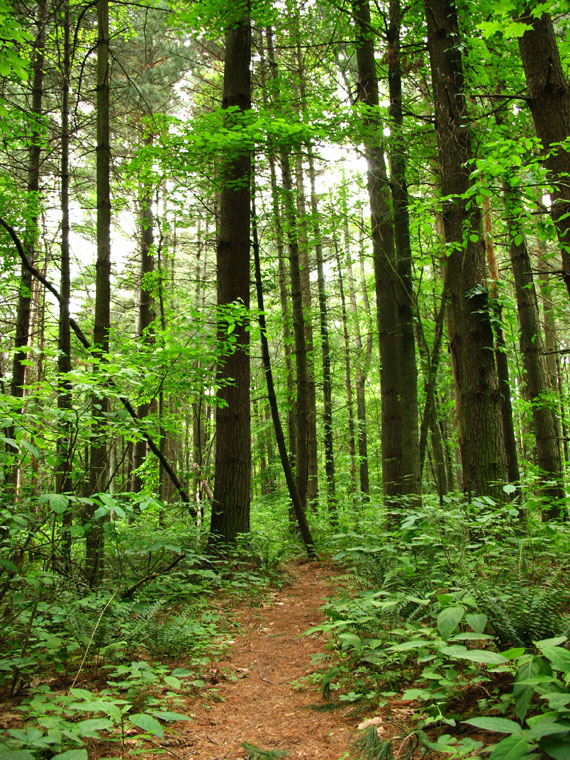
“Shit, I think I missed my intersection.” Nearly getting lost didn’t take long, always a good sign at the start of a solo backpacking trip. I’m on a trek through the Shenandoah Valley, paying more attention to the soggy autumn leaves under my feet and the parallel running creek than my location on the map.

I consider turning around, so pull out my map. Yellow highlighter ink zigzagged along to some of the best features in Shenandoah National Park, but I left plenty of opportunities to change course like this, or venture down side trails. Going ahead will only add a couple miles, so I continue.

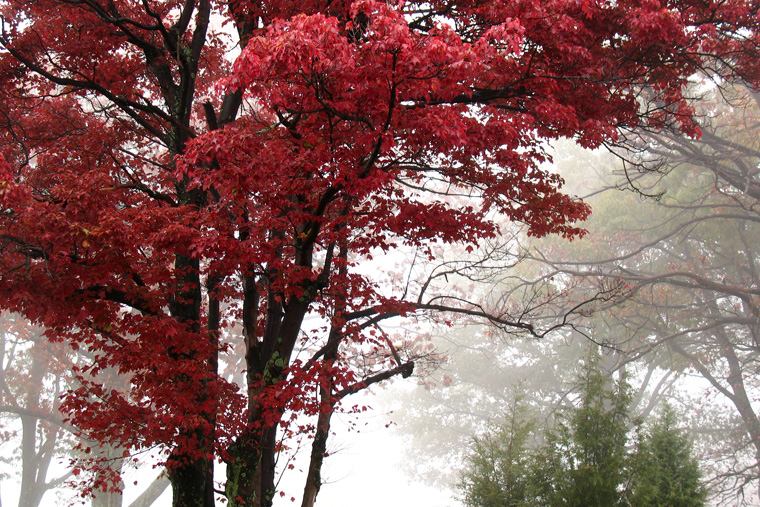
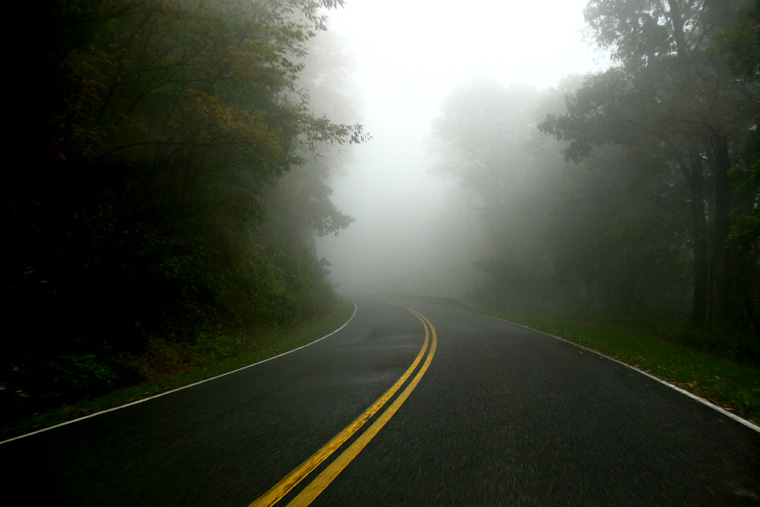
This morning, as I drove into the mountains on the normally scenic Skyline Drive in the fall of 2009, the wintry conditions worried me. As my altitude increased, ice encased tree branches and thick curtains of fog concealed the turnouts’ views. I checked the weather daily before driving out and expected mid-40s for the low. I asked the man at the gate, who glanced over at the backpack in my seat, what the low was suppose to be tonight.

“They say about 29 degrees,” he said in a tone of “better you than me." 

The temperature concerned me. I wasn’t exactly prepared for it. Everything was frozen or wet and the sun was behind thick gray clouds. I would be sleeping outside in a thin hammock tent and sleeping bag that is far from cozy in freezing temperatures. I should have been better prepared. Forgive me Les Stroud, for I have forsaken you.


Back on the trail, my modified route proved to be more challenging than the one planned. The last three-quarter mile ascended over a thousand feet. I pushed as fast as I could to get on top of the chilly wind-facing hill before nightfall, but didn’t make it. With the sun almost set, I had to stop.

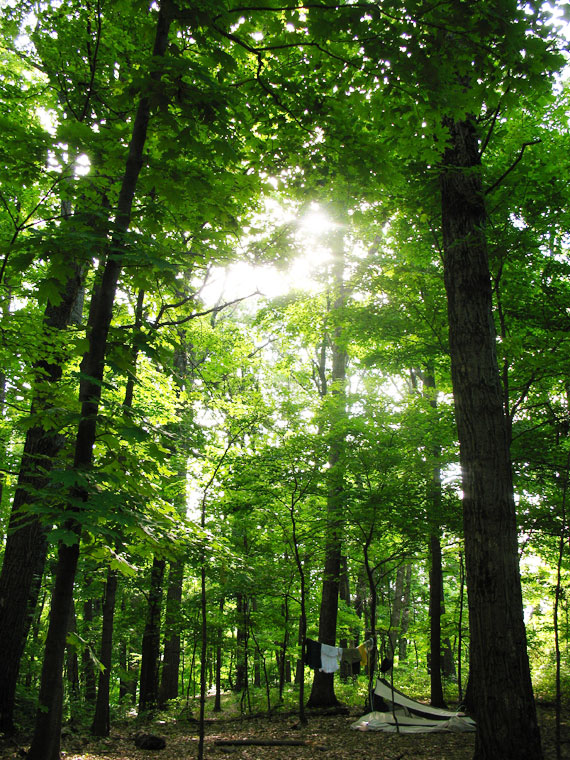
The last hour’s scramble covered me in sweat and the temperature fell below freezing. Even with my new vapor-wicking clothing, the sweat didn't help my comfort. I found two strong trees a good distance apart to hang my hammock. There wasn’t enough daylight left to setup camp properly, and my cold pale-purple hands refused to cooperate when tying the knots for my hammock and bear bag.

With the sunlight gone, I finally settled in for the night. I struggled to get into my sleeping bag, which isn’t easy to do in a hammock tent. It swings and you can’t lift much of your body up at the same time to get the bag underneath you. Until I nailed down a method, it was frustrating and exhausting like trying to take your winter coat off in the car while driving.

If you're having any trouble picturing it, I imagine it looked really similar to me being tazed while attempting to try on pants in a crowded bouncy castle. I hope that helps.

Finally I was settled in, then I realized I forgot to hang my toothpaste, deodorant, and other scented non-food items that bears often mistake for nighttime snacks. Shivering and irritated, I slid on my headlamp and got back out in the cold wind. I stuffed the items into a mesh bag tied to the end of a rope, and tossed it over a tree branch. I knew it would be easy pickings for a large bear with even a small amount of effort.

Strong winds rocked the hammock and whipped through creaking branches. Sharp undergrowth and thorns prevented me from lowering the hammock onto the ground for the warmth and stability. Now, I know none of this would hardly show up on any cable specials about harrowing tales of wilderness survival, but the point is, getting adjusted to leaving the comforts of home can take a bit of time. 


As I lay in my hammock bed, mild paranoia swirled through my brain. Did I do a thorough enough job checking for dead branches above the hammock? Would the wind send one careening towards me? Is that bear bag high enough? Would it get even colder? I wanted to slip into a blissful unconscious slumber, but I was far from sleepy.


Ahead of me were twelve long hours before sunrise. I searched for my book to help pass the time. Dexter. Brilliant. To top it off, I brought a book about serial killers.

Part 2 >

Go to Part: 1234567

The Grand Staircase, Part Ten - Numbers 27, 47, 93, 111, 130, and 131 on my life list.

Saturday 
Click Here for Part One

On our final day, we drove out of Zion through two long tunnels carved into cliffs. We passed a herd of big horn sheep and pulled over. Since my point-and-shoot camera can’t zoom in any closer than the naked eye, I slowly moved toward them for a picture. The largest and clearly dominant male never averted his eyes away from me. A stare I didn’t want to get too close to. I got back into the car and we went to Bryce Canyon to finish our Grand Staircase tour, but first we stopped for breakfast at Ruby’s Inn, a western diner near the entrance of the park.

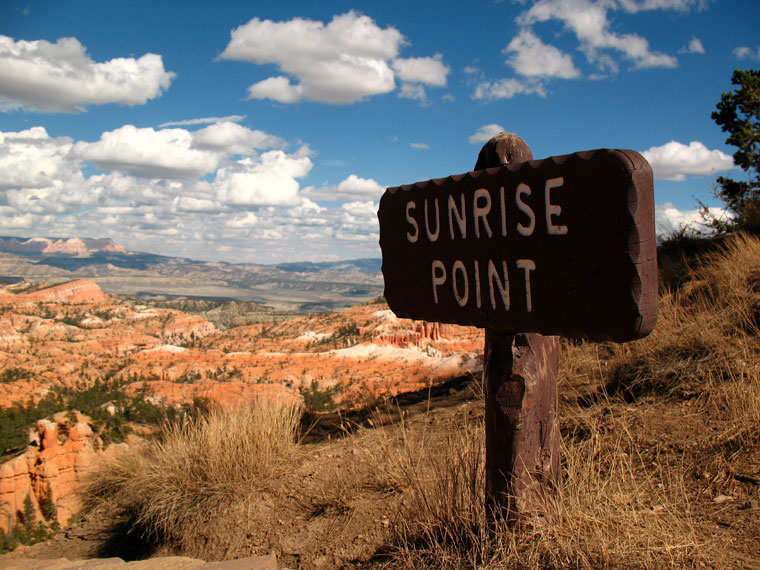
The waiter covered our table with plates of mouth-watering breakfast foods. After eating, we stopped at the Sunrise point trailhead and filled our hydration packs for a long hike into Bryce Canyon. 

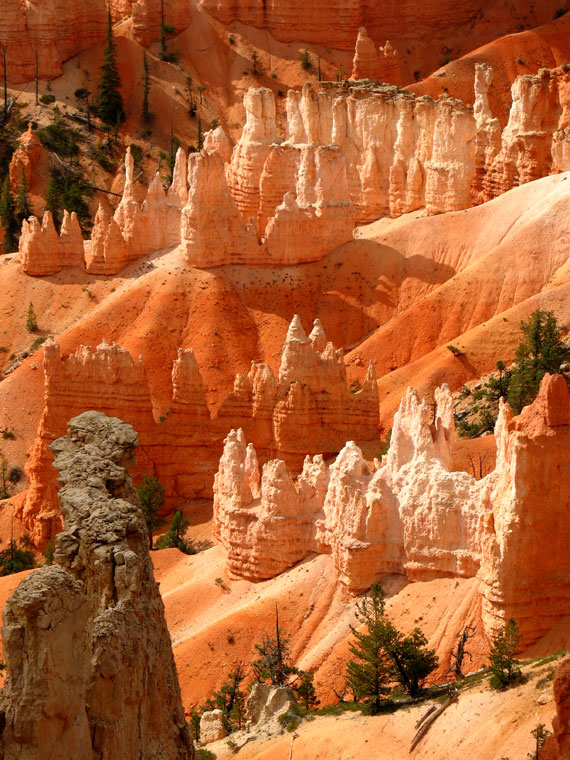
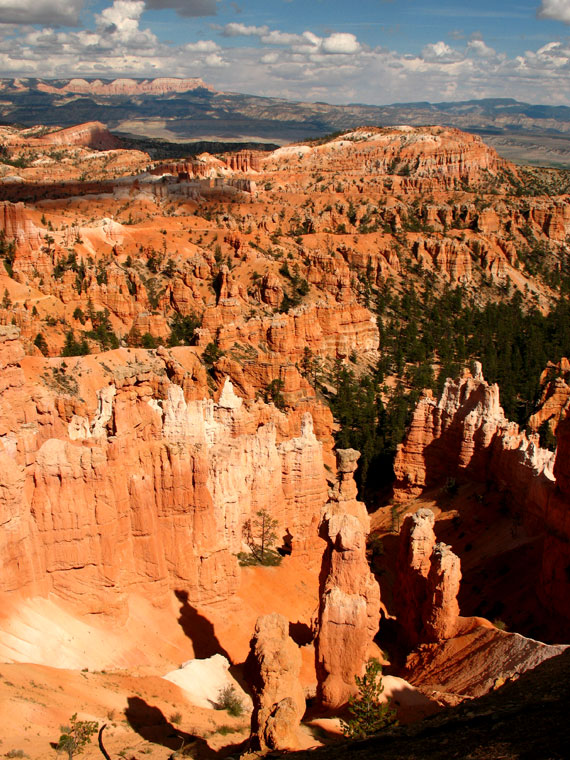
The early settler, Ebenezer Bryce, called it “a helluva place to lose a cow.” He was right. It certainly would be. We wandered through a labyrinth of multi-hued and impossibly thin pillars of rock called hoodoos. Some of which, it seems, a stiff breeze could knock over.  

We meandered over miles of curling trails slowly towards the canyon floor. Storm clouds moved in an out. For a short time, cold raindrops came down and a chilly breeze forced me to put on a sweatshirt. Quickly as it came, the rains were gone and it warmed back up. 

Shadows and colors at Bryce change between sunrise and sunset, making it look a little different every hour of the day. It was so beautiful that no matter where your camera pointed, you could get a great shot. This meant I had a hard time putting my camera away, taking well over three hundred pictures on this day alone.

We hiked a few miles back out of the canyon, then along the rim to the car. Number 131, Hike at Bryce Canyon, was off the list. I successfully crossed off all six of the plan items on this trip, a very productive nine days. We began our drive north to Salt Lake, neither of us ready to see it end. My plane would leave in the early afternoon the following day.

Sunday 

Randy dropped me off at the SLC airport in the late morning. It was busier and more chaotic than my arrival, but everything went smoothly. As my plane lifted me out of the Salt Lake Valley and back towards home, I again stared out at the view from above. As usual with these trips, no part of me was ready to be leaving. I hadn’t been away from Indiana long enough to care to see it again so soon. 

I have to find a way to have more weeks like this one. We did a lot, in such a short number of days, yet I still have over a hundred things to experience on my list. We walked down the Vegas strip and saw one of the great engineering marvels in all of human history, but as impressive as those enormous human endeavors are, they pale in comparison to the things created by nature. You only have to think of how you feel in both places to know what I mean.

The action and thrill of Vegas can’t compare with the feeling you get perched on the edge of the Grand Canyon gaping at a forever-long landscape, stumbling upon wildlife on a trail, looking up dizzying cliff walls from the canyon floor, or to the thrill of riding on top of a powerful uncompromising river.

We knew our planned destinations would be incredible, so we had certain expectations on the trip. One of the best things about it, however, was all the small details we hadn’t really thought of. The early morning drives passed sunrises, a bumpy ride into an infamous canyon in an old elementary school bus, a beaver dam holding back the emerald waters of a canyon sculpting river, waking up under bright starlight to a silent and peaceful night, the delicious food at never before seen restaurants, experiencing the day in the life of interesting strangers, laughing and conversing with an old friend, and just seeing anything, no matter what it was, for the first time. 

The Grand Staircase, Part Nine - Numbers 27, 47, 93, 111, 130, and 131 on my life list.

Friday 
Click Here for Part One

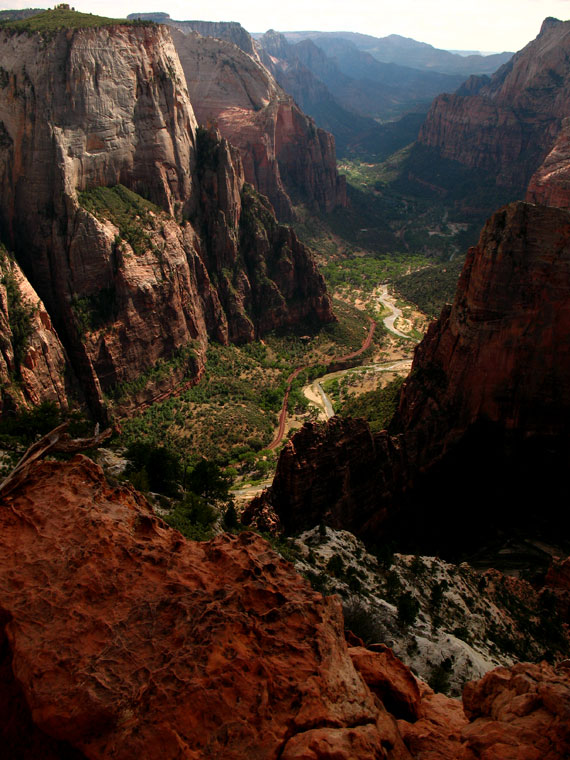
We rose to our final full day at Zion. We agreed on a hike to Observation Point, high on the east rim, 2,148 feet above the canyon floor. First, we got off the shuttle at Zion Lodge and crossed the street to hike to the Emerald Pools, three small ponds that reflected emerald green with trickling waterfalls.

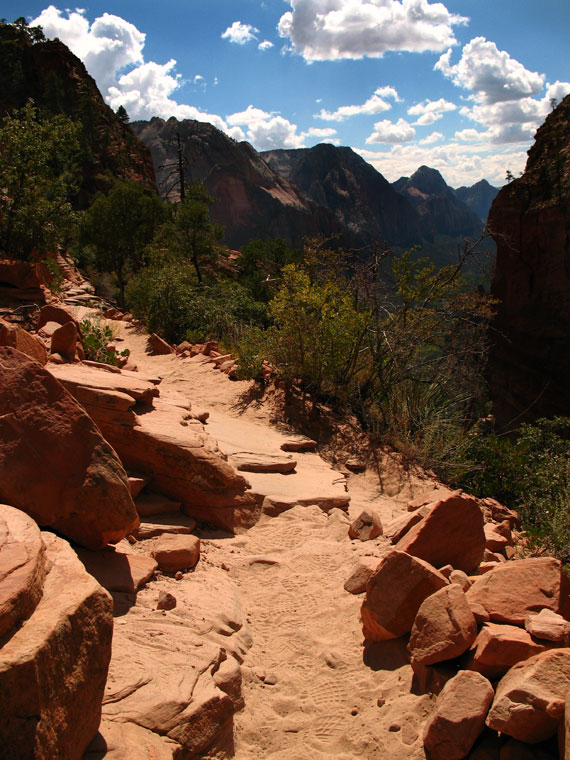
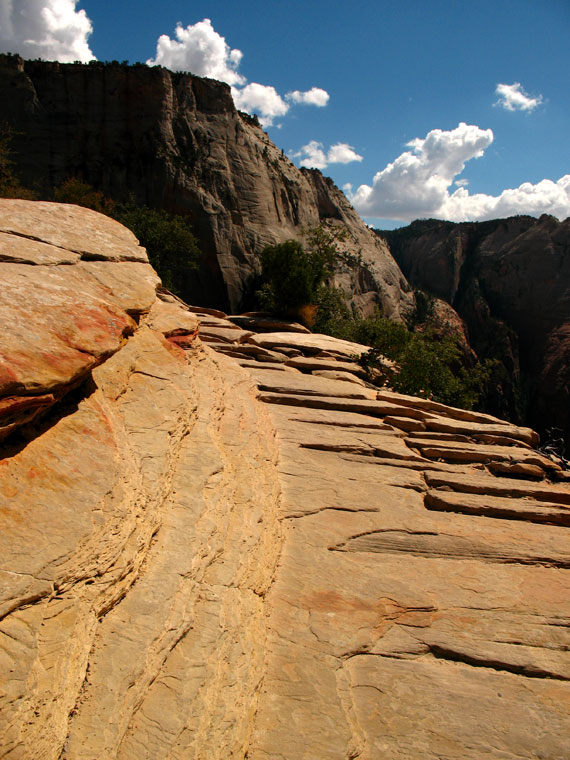
The trail to Observation point begins near Weeping Rock, an eroded cliff face where water seeps out nourishing hanging mosses, ferns, and wildflowers. The path is steep, gaining elevation quickly, making it one of the most strenuous of the popular hikes in the park. Most of the trail is on carved slickrock in full sun.

Every few minutes of hiking, we’d look around at a gradually higher view, slowly increasing in magnificence with each step. The trail was nearly always gaining in elevation. Knowing of Randy’s exhaustion, I told him I thought we were getting close. I wasn’t positive but it seemed like we had to be nearing the end of the 4-mile hike up. Soon I came to a sign that said 2 miles to Observation Point. I thought about not telling Randy, but I did, and he proceeded to shit a brick (his words). 

The trail flattened out through Echo Canyon, probably the most beautiful section on the trail. That is saying a lot when you consider where we were. The trail coiled around ensuring we’d see every angle.

Much too soon, we were leaving Echo and winding our way up once again. When stopping for a break, a fit middle-aged woman was hiking passed me at a quick pace, breathing heavily. “We’re almost there,” I said thinking she’d be relieved. “I wish we weren’t,” she said, reminding me that the journey, not the destination, is where we find happiness; effectively putting me in my philosophical place. We reached the top at Mount Baldy, the trail flattened out on an outcrop of land with shear drop offs on three sides overhanging the canyon. 

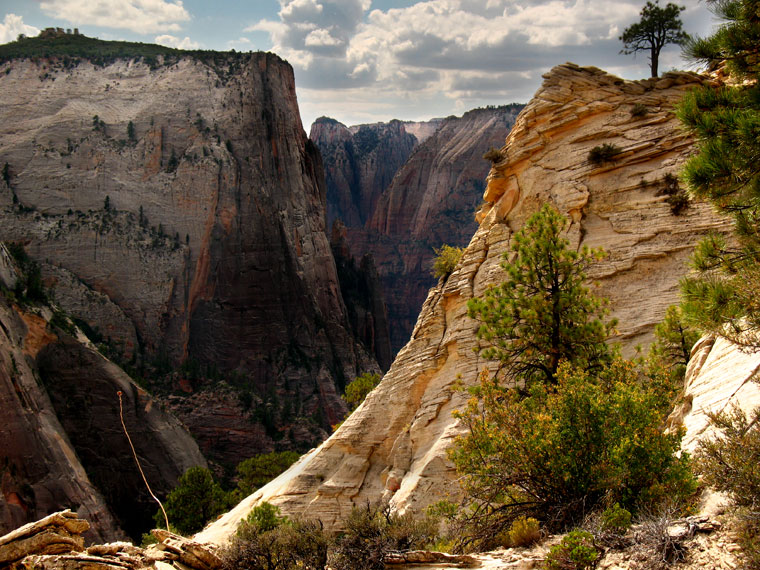
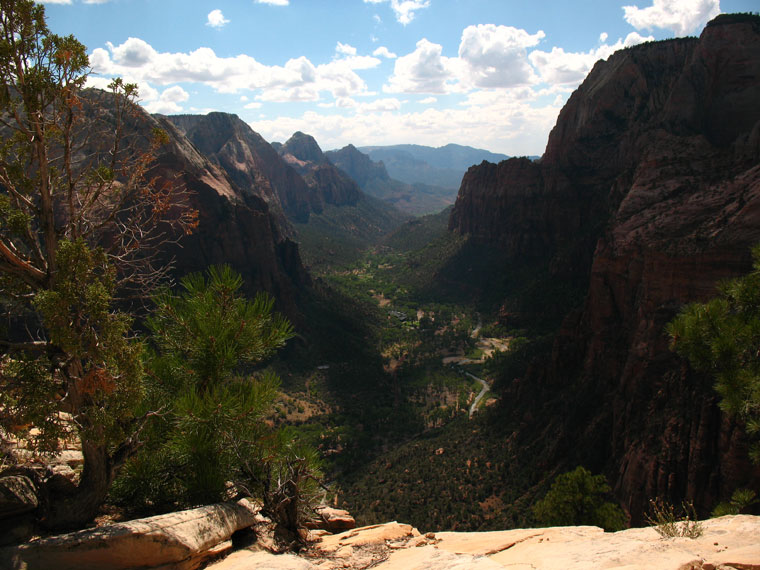
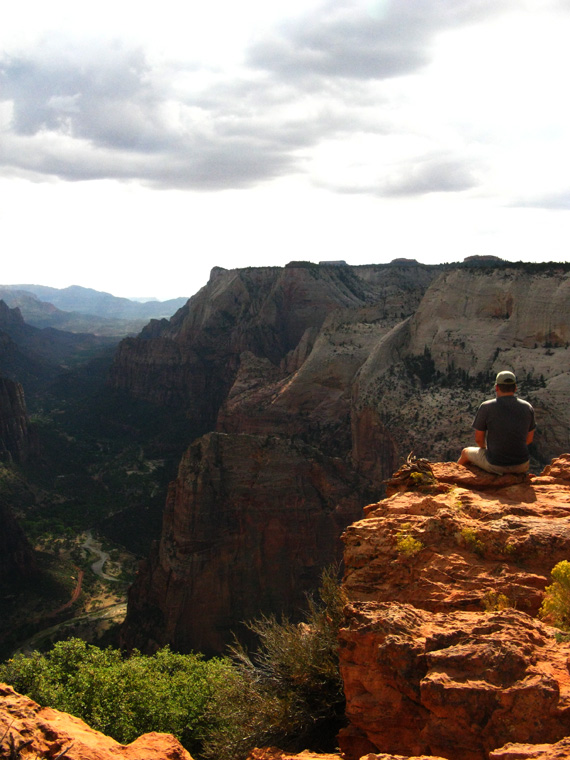
The view up here rivaled any other in the country, even those seen just days ago at the Grand Canyon. Angel’s Landing was visible at a distance and six or seven hundred feet lower in elevation. We sat on the deep-red rocky ground near the edge, looking straight down Zion Canyon, feet dangling 2,148 feet above its thin winding creator below, the Virgin River.

After dozens of photos, we both found a spot to pull out our packed lunches. We ate while gaping at one of the best panoramas we’ve ever seen. Zion is my favorite place that I’ve ever been to, I decided while sitting atop this, another scratch in the blue cue ball’s surface.

The four miles back, going downhill, was much less strenuous. I hoped to get a photo of observation point from the canyon floor before the sun went down but I was running out of time. I went on ahead, jogging down the trail, and got my photo with only a sliver of sunlight still shining on it. 

At the end of the trail, a mother Mule Deer was leading her young around, as we waited for the next shuttle. We got off at an area with scattered picnic tables called, the grotto. Randy was ready to call it a day, so he went back to camp and headed into town for another pack of Nathan’s hot dogs for later that night. After realizing we forgot another hiking pole at the grotto, I got on another shuttle heading back north to retrieve it and to hopefully get one last hike in before sundown. I was happy to see the shuttle heading south to pick me up, was Jim’s.

< Part Eight | Part Ten >


The Grand Staircase, Part Eight - Numbers 27, 47, 93, 111, 130, and 131 on my life list.

Thursday 
Click Here for Part One

After breakfast, we went to the base of Angel’s Landing. Switchbacks snaked their way up hundreds of feet, foretelling a strenuous hike ahead. I wasn’t used to the altitude, Randy wasn’t used to hiking this much, but we made it without any complications. The steep but straightforward section of trail ended and the final ½-mile push to the top was along a narrow scramble with nearly 1,500-foot vertical drops on either side. Randy decided to stay behind. A chain bolted into the rock helped people get to the top without a terrifying freefall. I very much appreciated this addition.

At a far distance, this narrow ½-mile section to the top resembles a rocky serrated dorsal fin, with people hiking along its edge. Some steep sections required all fours to traverse safely. It wasn’t too difficult, with the help of the chain, unless you have a fear of heights. A couple of times, I had to duck under and move to the other side of the chain, millimeters from a lethal drop, to make room for oncoming traffic. As long as the chain held, and I didn’t do anything stupid, I would be fine. Even though most people could make this hike if they felt motivated, I still felt a feeling of accomplishment when I got to the top. 

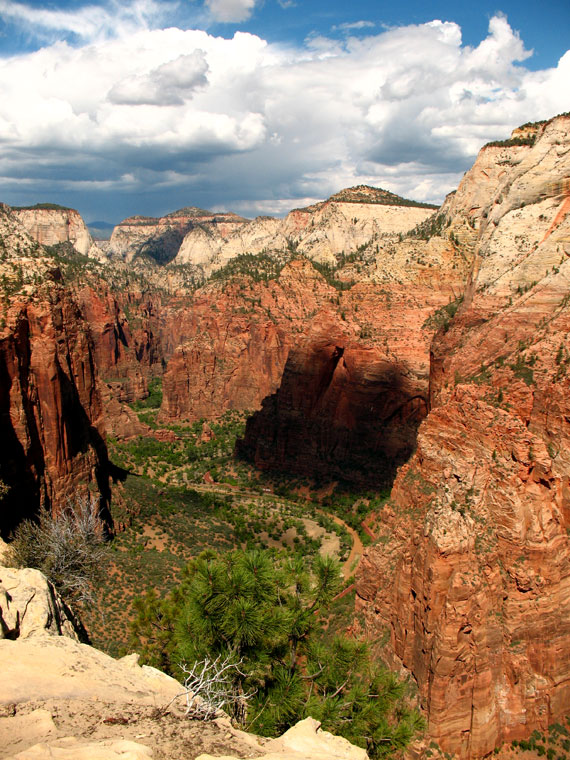
The 360-degree view was spectacular. A few people scattered around on the cream-colored smooth stone surface. A girl sat a few feet up on a rock to write in a journal. An older couple sat on the ground too weak in the knees to stand. They asked a person they didn’t know to take their picture. He backed up slowly to frame them in, nearing the edge, which added some drama to the simple picture taking. Another girl in clothes displaying her college’s initials stood at the edge and looked out at the view. The canyon road and Virgin River were now thin wavy lines surrounded by mammoth jagged red cliffs topped with forested mesas. 

I captured several photos myself and made my way back down about twenty minutes later. I loved every step. A ranger was hiking close behind me. I decided to let him pass. “I’m going to let you go around me since you’re faster and know the way better than I do.” A minute later he started to go one way, changed his mind, and chose a different route. “See I’m glad I let you lead,” I said. “Oh no you can go that way if you want. It’s just that a guy fell to his death over there a little over a year ago, and I wanted to avoid it,” he said in the same tone he’d use if he saw a pile of dog shit and was telling me to watch my step. “Oh, does that happen often?” I asked. “Uhh, we had three die in the past year or so, one was from a heart attack. But, you know, that’s out of tens of thousands of visitors a year.” 

The unfortunate hiker was fifty-three year old Barry Goldstein of St. Louis. Hiking up Angel’s Landing with a family wedding party, he accidently fell to his death in June of 2007. Rangers estimated that he fell about 1,000 feet. An eyewitness who called 911 said, “It was a sheer drop-off. There were no second chances when he went off. We could see him fall…. Just like that, he was gone.”

Just days before, a canyoneer fell to his death around Upper Emerald Pools. The park received a lot of press with such an upsetting week, but this didn’t stop the flow of day-hikers aspiring to reach the top. I’m glad I didn’t hear these stories before beginning my hike up. Fear tends to generate boring lives. I’d rather not know. 

After making my way back down, I found Randy and we started down the long switchback decent to wait for the next shuttle. At Zion Lodge, we decided to get a sandwich at the Lodge restaurant, before going back to camp. Few things in life are better than a nice fattening cheeseburger after a grueling hike. 

After finishing our meals, I saw taps for natural Zion spring water on the side of the restaurant. All day we had been drinking bad tasting well water from a spigot near camp. We promptly dumped our hydration packs and filled them with the refreshing cold spring water, free of aftertaste. 

Once back, we got in the car and drove to the adjacent town of Springdale for firewood. At the campsite, we again got a campfire crackling and sat at the picnic table, talking and playing poker with headlamps on for the remainder of the night.

< Part Seven | Part Nine >

The Grand Staircase, Part Seven - Numbers 27, 47, 93, 111, 130, and 131 on my life list.

Wednesday
Click Here for Part One

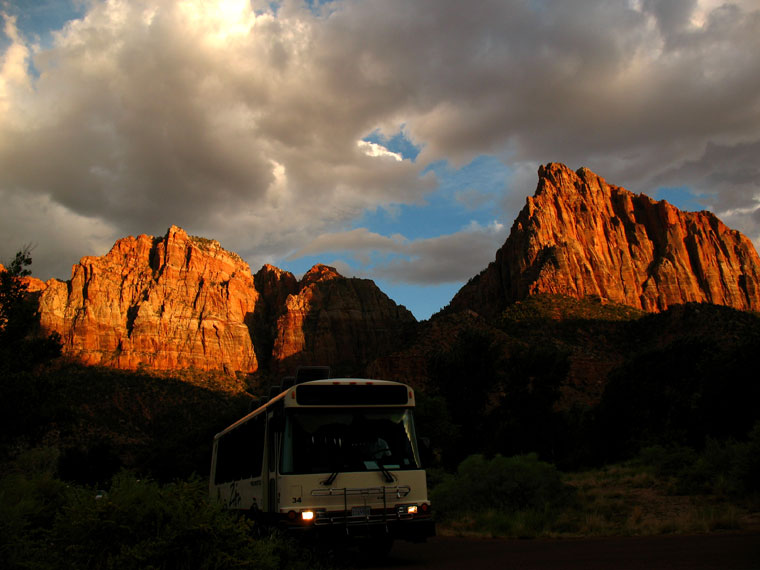
Alarm buzzing, the snooze bar within reach was a challenging temptation. If the park was full, we had to make sure we could get there early enough to get a backcountry permit or the next available campsite. “No Vacancy” remained posted, but we could clearly see a sparsely filled campground. There was a small spot, not too close to other campers, with a picnic table, fire pit, access to a river, and a spectacular view of the 6500-foot high Watchman cliff side. We pulled out our tents and staked them into a hard dusty red ground that coated our shoes.

Zion in Hebrew means sanctuary, a perfect name for this walled desert oasis carved by the Virgin River. The river took 13 million years to sculpt its masterpiece, molding the Colorado Plateau into cliffs and towers. All while giving life to numerous plants and providing water and food to diverse wildlife. All the life in this safe-haven, including us tourists who enjoy it, owe it all to this unaware but persistent river.

Zion Canyon Road, recently repaved to match the red hue of the canyon, is accessible only by shuttle. Stop at one of several bus stops and in less than 7 minutes, they will be there to pick you up. This has done wonders for the park. Traffic jams are now due only to the abundance of wildlife that has returned since the shuttle program started. Plants and wildlife can more easily take shelter and flourish in the park.

We waited for our approaching ride to the Zion Narrows, my most anticipated region in the park. After a screech of the breaks, the doors opened. We climbed aboard the shuttle, captained by Jim.

Other passengers filled the seats so I remained in the aisle standing in a Y holding onto two rings for stability. Jim, a man in his early to mid sixties, drove us up through the red forested canyon toward our destination. He spoke in a loud assertive whisper, reminiscent of Jack Boyer or Clint Eastwood. It had a weight that demanded your full attention. It worked on me. I listened to every word.

“The other drivers will just play the same recording over the speakers,” he said holding a microphone to his mouth, steering with the other hand. “It’s called an M-P-3 player. They do it because it’s easy, but then you hear the same thing on every shuttle all day every day. Not me, I want to try to give you something unique.”

The Virgin River came into clear view from the shuttle windows. “Some people ask how this tiny river can form this big canyon,” he said, displeased with anyone who might speak ill of his beloved river. “It looks small now, but when storms strike, flash floods will flow down the river blasting out log jams and hurtling boulders. Trust me. The Virgin River is no pup.”

My steadying grip tightened on every turn, as we winded up the canyon. “Rain water from thousands of years ago soaked through the sandstone cliffs and is used after all those years by these plants today. That’s why even in the middle of the desert you see Fir, Cottonwood, aspen trees, and… the Ponderosa Pine,” finishing with emphasis and a lower tone on the last one in that Jack Bower voice that Randy and I couldn’t stop mimicking on our whole trip. Actually as I write this, I’m saying “Ponderosa Pine” in my best assertive whispered Jim voice.

“Right here on your left, you see that slope? A flash flood from the Virgin River caused a massive mudslide that dammed up the river and washed out the only access road, trapping a couple hundred visitors at the Zion Lodge. Like I said, the Virgin River is no pup.”

“All the major news networks: ABC, CBS, NBC, CNN, Fox News,” he read in quick rehearsed succession, “for some reason had reporters here for a month. Probably because they never seen this place and wanted a paid business trip. The headlines said ‘200 People Trapped at Zion Lodge’. Trapped? Hmmph. They got a free night’s stay in the park at a beautiful lodge with food and drinks paid for.” He lowered his voice slightly and scoffed, “I’m sure it was horrible for them,”.

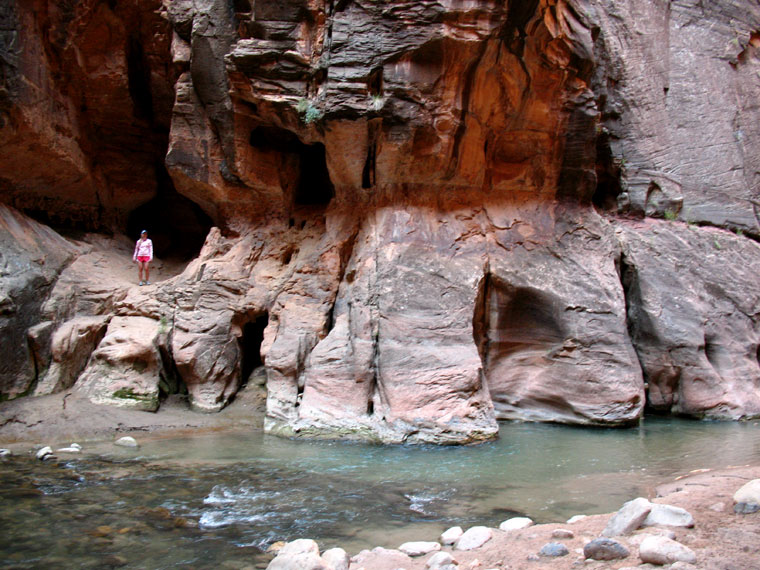
Jim’s shuttle arrived at the Temple of Sinawava. We walked down the short paved Riverside Walk that ended at the river. Here the canyon converges into the 16-mile long Narrows formed by the Virgin River. The trail actually is the river, nearly running canyon wall to canyon wall at all times. With our aqua shoes on, we sloshed into the 57-degree water.

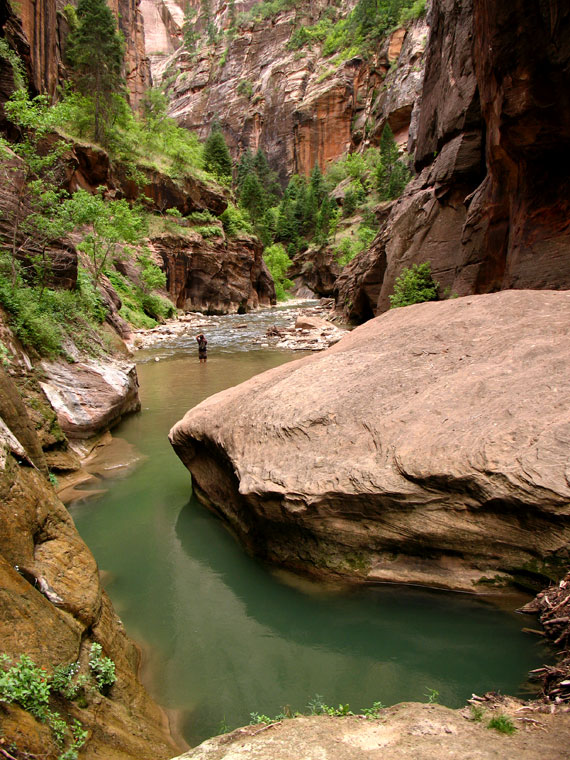
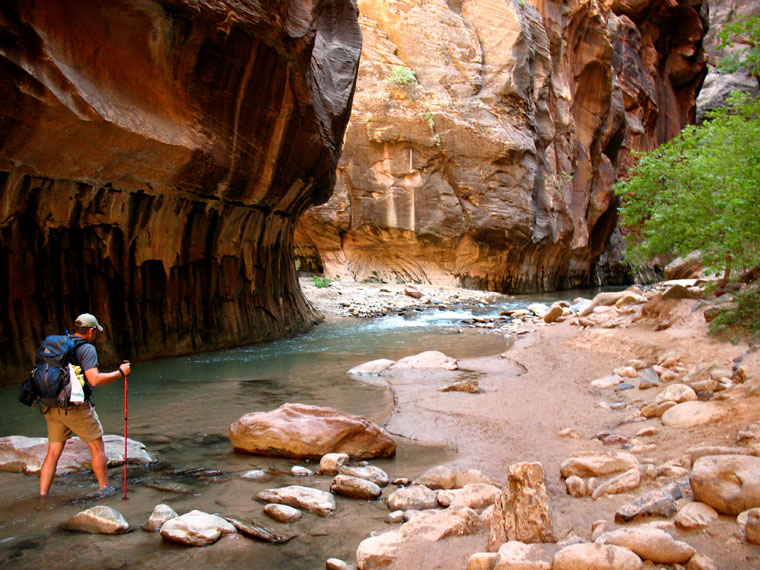
Some of the hike was along the sandy shorelines, but most was through water ankle to knee deep. That is, if it’s clear enough to see where you’re stepping. Fortunately, today the water was clear. The deep sections were clearly visible as a darker emerald green. If storms upstream dirtied the river, hikers might suddenly find themselves swimming in several feet of water.

Our legs soon acclimated to the cold temperature as we made our way through the narrowing cliff walls. The trail was, at first, crowded. Barefoot people posed for photos with long hiking sticks in hand.

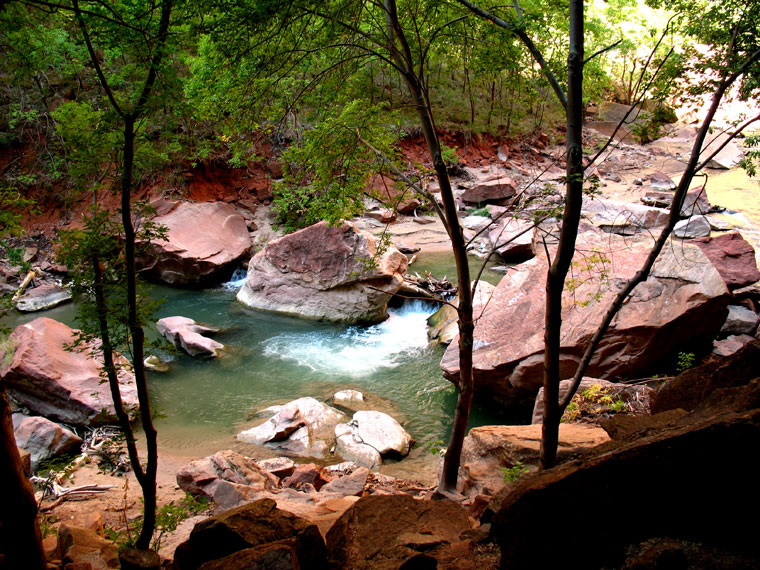
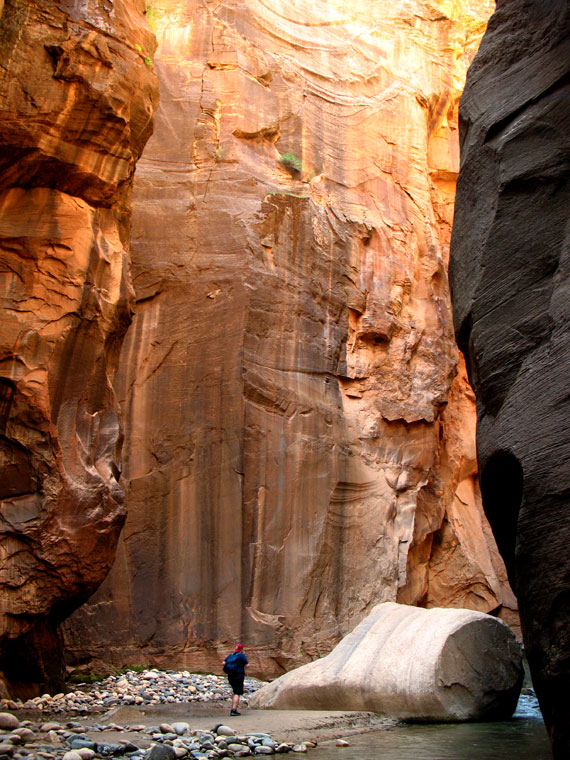
The narrows are unlike any place I’ve been. The cliff walls loom over you, soaring 2,000 feet overhead and come together as close as thirty feet apart. Water weeps out of red-hued sandstone giving life to hanging gardens of moss, ferns, grasses, and wild flowers. Deep emerald water flows around fallen boulders, getting louder in spots, as water channels through narrower spaces, causing white caps to surge though. This is undoubtedly one of the most stunning places on earth.

Once again, the further we hiked, the less we saw other people. “I feel like a kid at Christmas, every turn reveals another unknown gift,” Randy said as we neared a sharp bend in the trail. We hiked within an arm’s reach to the walls, on sand bordering the river’s edge, and over slick algae-covered boulders. Our path zigzagged back and forth, as we looked for the best place to make our next step. Swift flowing water occasionally made crossing difficult.

We climbed on top of a large boulder to have lunch. Other hikers sloshed by below us. This trip (like this blog post) seems to have lasted forever. It was hard to believe it had only been five days. Months after the trip I still sometimes close my eyes and try to imagine being back at this spot. I so desperately want to go back.

At what looked like a sizable beaver dam about five miles in, we stood for a few minutes, admired the view, and made the hard decision to head back before nightfall. Surprisingly, the hike in the other direction wasn’t very familiar. The new angle made it a new trail.

Less than a mile from the Riverside Walk, we passed a young family of four. “I wish we could keep going, but it’s getting late. Are we going to miss anything great if we turn around now?” the mother asked us. “Well, more of this,” I said. “So… yes,” Randy added.

The Zion Narrows still stands as my favorite hike. It’s conceivable that I’ll be lucky enough to find one that can even come close, but this will be hard to top. Number 130, “Hike Zion Narrows”, was technically off my list, but I hope to return one day when I have more time to hike the other two-thirds that we missed.

We arrived at the bus stop and were happy to see Jim’s shuttle waiting there. I put my hiking poles in the crack between the seats, slid out of my pack, and sat down. Jim passed the time with stories about the park’s wild turkeys, in that Eastwood whisper. “Come back here at about eight o’clock and you’ll see the wild turkeys all turning in for the night. They fly to the same tree, in the same order, one at a time, the alpha male always going first. Turkey’s can’t control themselves when they are in the air. If another turkey gets in their way, they’ll just crash into each other and hit the ground hard, so they go one at a time. They get to that tree there and then one at a time will fly to other trees where they will stay for the night.” Suddenly he stopped the shuttle. A Blue Herron stood tall by the river. Jim made sure everyone got a look.

As we slowed for the next stop, Jim said, “If you want to see a mountain lion, this spot is your best bet. I’m not guaranteeing you’ll see one but your chances are better if you come back here… after sunset… and come alone.” After a second pause, everyone laughed.

Jim reminded everyone when they got off, to not leave anything on his shuttle. “If you do, I have to take it to the front office at the end of my shift. When I park the bus, I can either, walk 50 feet to my car, or 300 yards to the office to fill out paper work. How many of you think I’m gonna do that? No, it’s going in my trunk. I’ll look at it in the morning and see if it’s worth keepin’. If not I’ll get rid of it… eBay.” When it was our turn to get off, I left behind my hiking poles still standing between the seats anyway. The next day I went to the visitor center’s lost and found, but Jim kept his promise.

Back at camp, we marveled at the view, got a fire crackling, prepared dinner, and played poker by the light of headlamps until retreating to our tents. The sky was clear. Billions of stars were out. Other than muffled voices from nearby campsites, the night was quiet. I shimmied into my sleeping bag and pulled out my camera to look at photos from today. I scrawled a few sentences about the day in my journal and put everything away in the tent’s pockets next to my headt. With ease, I feel asleep.

My subconscious projector lit up to replay a familiar dream. Often my dreams are disturbing in ways only David Fincher could direct, but none are more mentally exhausting as ones that put me back to my old closed-down pet store. The store is always dark and I struggle trying to find a way to get the lights on as customers flood back in. They were intensely stressful years that I’m thrilled to have behind me. In the dream, however, I’m led me to believe that all the hard work successfully getting out from under those years is the dream. The retail aggravation is back, only confusing, dark, and noisier.

Lying in my tent, I forcibly jolted myself awake. A million specks of starlight comfort me overhead. Blue moonlight scatters onto the ground and across the Watchman cliff sides. The frustration of the dream melts away, as though reality dunked my head into pool of cool blue water, instantly silencing the noise.

I thought about how glad I am to have that all behind me. To be in a location I could only daydream about a few years ago. This moment helps justify that stressful past. Without it, would I know the luxury of silence, the value in being able to leave thoughts of work at the office, and the importance of unruffled simplicity?

I tried to force attentiveness, to make this time last, but was too tired and eventually succumbed to heavy eyelids. The next morning I woke up and continued admiring the view of the Watchman until I could hear that Randy was also awake.

< Part Six | Part Eight >

The Grand Staircase, Part Six - Numbers 27, 47, 93, 111, 130, and 131 on my life list.

Tuesday
Click Here for Part One

The next morning we went to tour the Hoover Dam. A car accident had a quarter-mile line of vehicles sitting in park, and the line was quickly growing. For no apparent reason, I had the Who song “Behind Blue Eyes” stuck in my head and kept singing it. “No one knows what it’s like… to be the bad man… to be the sad man… behind blue eyes.” Sitting in traffic with me singing the same song repeatedly could turn annoying fast. Randy turned on his XM.

The thought of turning around to head to the next destination on our list was starting to enter our minds, but we decided to wait it out. Neither of us minded sitting there listening to music and talking. The song on the radio ended. The next one started, Behind Blue Eyes, by The Who. I couldn’t believe it. Fortunately, the traffic soon picked up.

When we arrived, we got in line for tickets. “You going on the Dam Tour?” the girl asked with slight emphasis on the word dam. “Yeah, one please,” I said. “Ok, one for theDam Tour.” She really enjoyed saying that. “She must be new,” I thought.

A group of us herded into a theatre for a 20-minute video about the dam’s construction. With plenty of time to kill afterwards, we went outside to peer over the dam’s edge and look around at the interesting art deco architecture and various exhibits, until it was time for our tour.

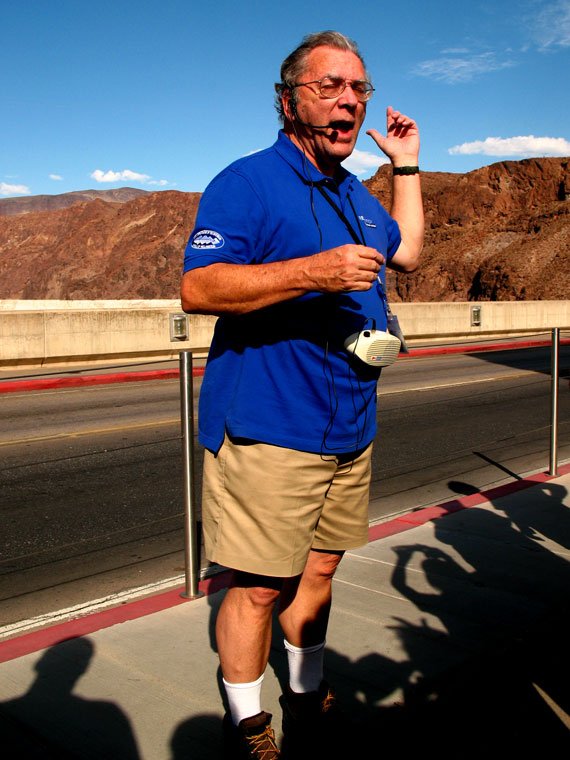
Some elevator doors closed and a group of people descended deep underground. “Shoot, I forgot to tell those people that there isn’t a restroom down there. Oh well they’ll figure it out. If you have to use the restroom you better go now.”

They flooded us with the typical “damn” jokes, I assumed because it was better than having to hear every damtourists make the same dam jokes as though they were the first to come up with them. “I’ve been a Dam tour guide for 30 years now…” “Ok, now let’s all squeeze into the Dam Elevator…” Thousands overhear it all day, every day.

We got in line. The group ahead of us was now dropping a couple hundred feet below. “Shoot, I forgot to tell those people that there isn’t a restroom down there. Oh well they’ll figure it out. If you have to use the restroom you better go now.” The people not here long enough, to have already heard the jokes, chuckled.

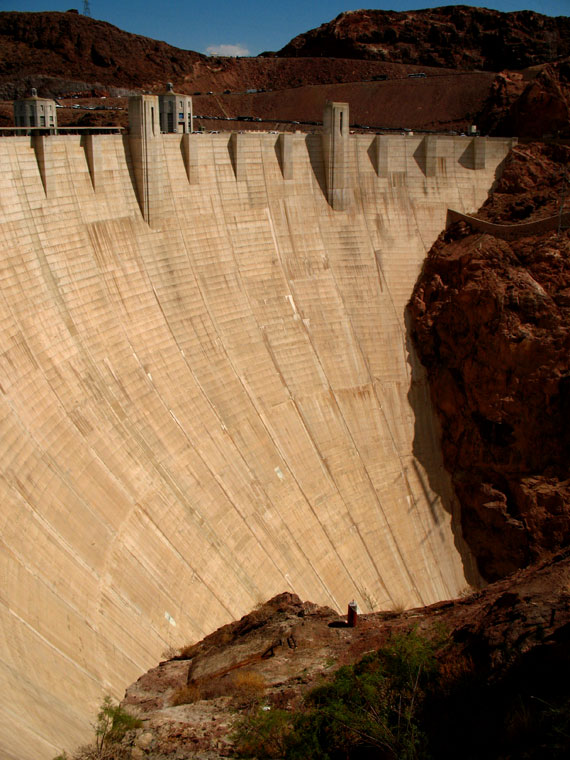
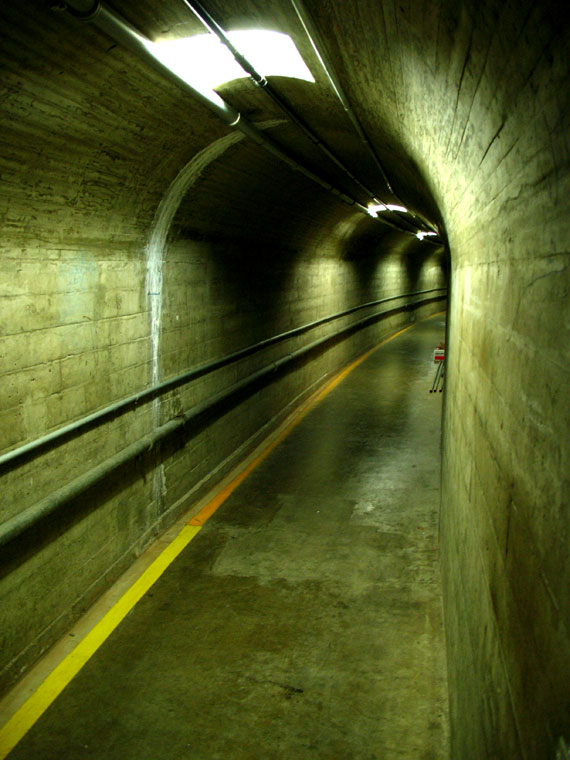
The Hoover Dam is truly one of the greatest engineering marvels of the 20th century. It was absolutely worth going to, even with the delay. We went into its depths, walked through tunnels hundreds of feet deep, and peered out a window half way up the smooth dam wall.

After getting back on the road, we stopped to eat at the overhyped In-and-Out burger, and then back through Vegas towards Zion National Park. We waited in more traffic from another accident, but by then I was unconscious in the passenger seat. By the time we got to the beautiful city of St. George, Utah, we were again ready to stop to eat.

We arrived at Zion after nightfall. It’s grandeur was hidden, but you could almost sense something massive just behind the darkness. An engraved wooden sign at the gate said, “No Vacancy.” We drove back out of the park until our cell phone had some bars and called a hotel. Only one had a room available, and it was their only one. It cost more than the stay in Vegas but it beat sleeping in the car. The room was a typical cheap hotel room, but huge. A small wooden table with four chairs sat in the middle surrounded by three beds, with their headboards up against the walls. We pulled everything out of the car, scattered it over scratchy cheap hotel comforters, and repacked it to get organized.

On the TV, Obama and McCain campaign press conferences warned us of a looming economy-sized recession. We couldn’t really care any less. Only the next few days mattered. I turned it to South Park, and we made our plans for tomorrow’s hike.

< Part Five | Part Seven >

The Grand Staircase, Part Five - Numbers 27, 47, 93, 111, 130, and 131 on my life list.

Monday Night
Click Here for Part One

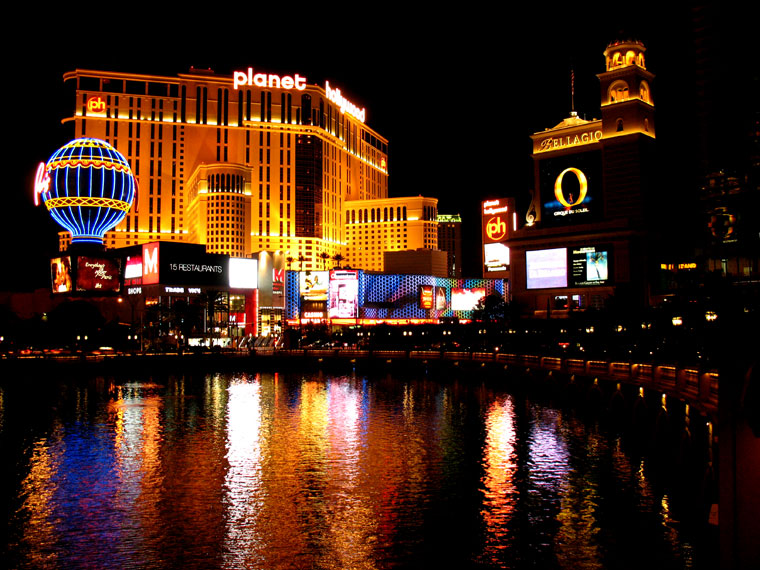
We got back to the car, pulled onto Route 66, and headed to Las Vegas. We aren’t Vegas-type people, as anyone that knows us would assume, but we were this close to it. I’ve wanted to see what it was like and it was on my list. Besides, it was a nice way to split up our week with showers and real beds.

We drove down the strip. I stared up at all the familiar buildings and lights like a 6-month old staring at a ceiling fan. We got to the Luxor and checked in.

“To get to your room make a left at that Starbucks right down there and go straight until you get to the next Starbucks and make a right and you’ll see the elevators,” said the girl at the front desk. I am not making that up.

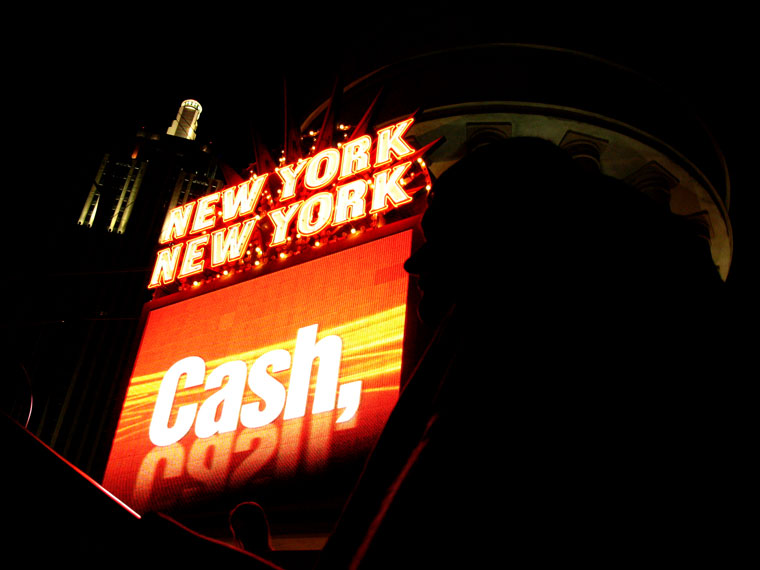
We dropped off our stuff and started down the 4-mile Las Vegas strip, the world capital of gambling, chapels and cheap buffets. We didn’t have a lot in mind to do. We just walked. I wanted to see all the famous casinos and maybe a few chemically imbalanced people.

I found slot machines extraordinarily boring, but I could say gambling in Vegas was officially off my list (number 111). I wanted to play a few just to get the feel of pulling down the handle and hearing the jingling change pouring out. To my disappointment, they got rid of the handle, in place of a monotonous little button. I quickly turned ten dollars into fifteen, but my winnings printed out on a little receipt. Where’s the excitement in that? Can I get some jiggling change over here please?

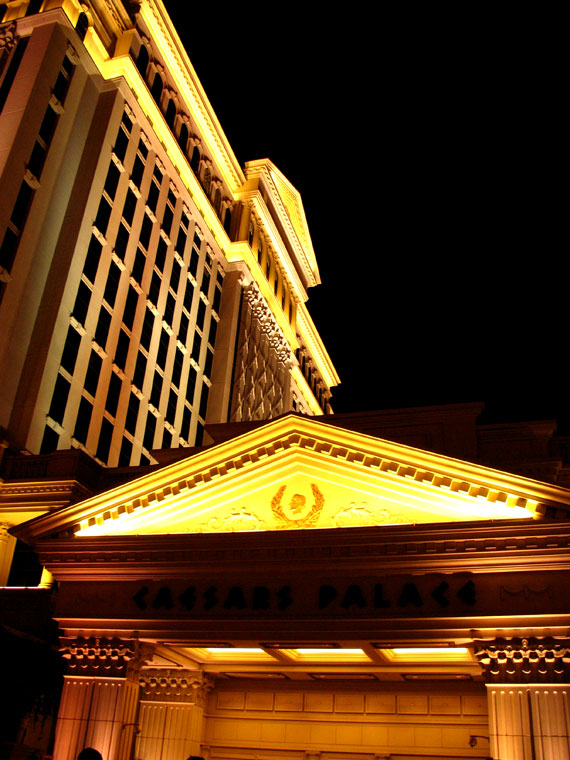
Neither of us felt our gambling skills were sufficient to sit at the $15 or higher per bet tables, and the cheaper tables were always full. When playing the Caesar’s Palace Nintendo game I cleaned up, but when faced with the real Caesar’s Palace, suddenly I couldn’t even remember how to play craps anymore. Nor did I have confidence in my Texas Hold ‘Em skills. It was probably for the best. I only lost enough money to buy dinner for two from a fast food value menu. I think I’ll recover.

I had more solicitations for prostitution than dollars lost to gambling actually. Randy warned me of this before getting to Vegas. I always knew about it, but there was more of it than I imagined. Everywhere we went someone is there flipping a card at us with some woman’s image. I didn’t take any, but I assumed they were something like prostitute trading cards. (Collect them all! Trade them with friends!) I wondered if they would have stats on the back, but I didn’t want to know enough to acknowledge their existence.

“Eh, just look forward and pretend they’re not there,” Randy reminded me. I wanted to bring a few souvenirs home with me but I didn’t want one to be an STD. If I’m looking for a souvenir that will last a lifetime, I’d just assume have one of those pressed pennies inscribed with “Viva Las Vegas” than herpes.

We stopped for drinks and a great meal, and continued down the strip, going into every casino whose name I recognized. All of them, on the inside, looked the same to me, like fancy Chuck E. Cheese’s for adults. If only they had adult-sized ball pits and skee ball. If I could gamble on skee ball, I’d be a rich man.

We took a few photos, hung out in a few more casinos, decided I would be ok if I never went to Vegas again, and made it back to the hotel around 4:00 am. We flipped on the TV, but I crashed and fell asleep in no time.

< Part Four | Part Six >

The Grand Staircase, Part Four - Numbers 27, 47, 93, 111, 130, and 131 on my life list.

Monday
Click Here for Part One

We woke well before dawn, at 3:30. We packed our tents and drove to Peach Springs, the Hualapai Tribe Capital, via Route 66. There was no traffic. Wild flowers and mountain ranges ran parallel to the infamous highway. The timing of the drive coincided with the sunrise. Rays foreshadowed its arrival from behind the rocky horizon.

We drove though lofty sprawling views of open undeveloped land. Fields of green cacti filled in the flat areas between immense red cliffs. At times, we could look up at the cliffs on one side of the road and down toward the canyon floor on the other side.

The Hualapai Native Americans own a 100-mile stretch of western Grand Canyon. The small town of 600 used to have a steady flow of visitors, until Interstate 40 overshadowed Route 66. The traffic now directed away from town. At a quick glance, it seemed the only thing here was the Hualapai Lodge, the meeting place for our Colorado River rafting trip.

We went into the Lodge diner to have breakfast. As I ate the best scrambled eggs that have ever existed, I glanced around at the other people and wondered who would also be on our trip. Would I have stories about any of them by this afternoon? Those who wore shorts and sandals on this chilly morning gave away who they might be.

We finished our breakfast and went to the front desk to register. “We’ll start getting on the bus in a half hour so you’ll need to be back here at 8 o’clock,” said a heavy-set Native American girl behind the counter that reminded me of Marilyn on Northern Exposure. We showed her our IDs and signed the obligatory its-not-our-fault-if-you-die insurance forms.

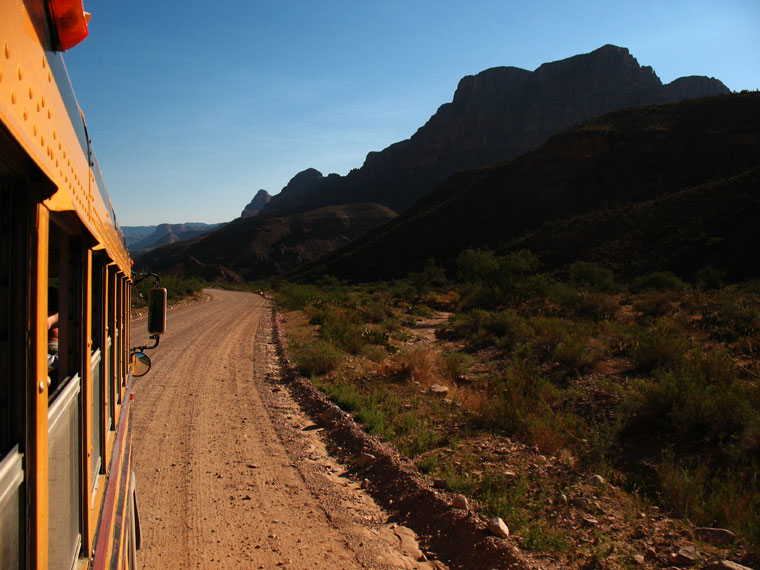
An old school bus pulled up and waited outside. I haven’t been on a school bus for 14 years. “Is there anything you ever wanted to do on a school bus but wasn’t allowed as a kid, like stick your arm out the window or anything,” I asked Randy as we walked out to the bus. “Ha ha, uh, no,” he said, less excited about it than me.

The driver back then told us about a kid whose arm got cut off by sticking it out the window. Enough to keep me in line at the time, but I’m an adult now. I know about scare tactics. I’m not letting such devices control me anymore. It’s just the principle of the matter. I don’t like all this manipulation and lying by our country’s school bus drivers. Let me live damnit!

In addition, I was sitting towards the back like one of the cool kids. I climbed up the bus’s steps and could smell the familiar plastic school bus seats. Most of the people already on the bus were in the front (i.e. losers). We moved to a few rows behind them and sat on opposite sides. I sat sideways with my legs up on the seat, feet hanging into the aisle. Obviously, throwing caution to the wind. How you like me now bus driver?

I imagined the retired Kingman Elementary school bus was in heaven as it bounced down the only road into the Grand Canyon. It screeched, rattled and ground its brakes around every bend. Heads of passengers in front of me sprang toward the ceiling with every hard bump. 

The views of Arizona cliff sides were incredible at every moment. As we snaked our way toward the Colorado River, the road became less discernable as it merged with Diamond Creek, until it was more creek than road. The bus splashed through the water then shrieked to a halt near the edge of the infamous river. Most human retirements aren’t this good.

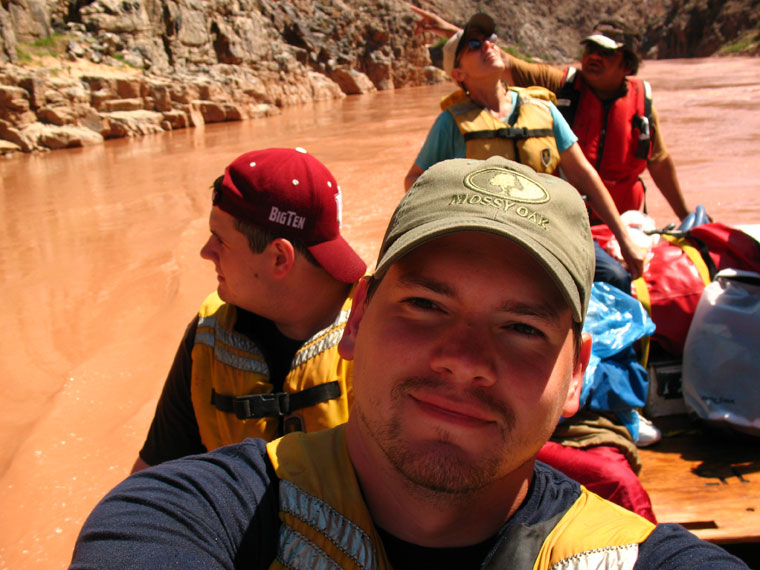
Several powder blue motorized rafts bobbed up and down at the edge of the “Willie Wonka chocolate river brown” Colorado. The boats had been loaded with gear, ready to continue our journey. We put on life jackets and climbed aboard. “Ok, now we are going to go upstream a little bit, jump in, and test the life jackets for defects,” said a stout Hualapai river guide with dark sunglasses and a chubby cheeked smile on his face. His name was Louis.

Louis secured all of the supplies then laid down a blue foam mat on the floor at the bow. “When we get to the rapids one of you kneel down and hold onto the front like this.” He knelt down and grabbed hold of the front edge of the raft. “This is the best view of the rapids. I guarantee it.” I wasn’t completely sure if he was serious, or just wanted to entertain himself by seeing if we’d do something stupid. “I’m serious, I’ll tell you when to get down there,” he said reading the thoughts in my face’s expression.

On an adjacent boat, another river guide was talking to his passengers, “Ok there has been a recall on these life jackets so we’re going to go up the river a bit and jump in to test them out before we go.” This was Louis’s son Randy. Clearly, he’s learned a lot from his father, even his wit.

The first rapids were just a few yards ahead. “Is that camera waterproof?” Louis asked me. I was even starting to annoy him with my camera. I took one last shot before stowing it in my waterproof case. I volunteered first to kneel down on the blue foam mat. Louis had, what seemed to me to be, an arbitrary system of telling us the speed of the rapids up ahead. He classified them from one to ten. The first rapids were about a three. We’d be going over some sevens later in the morning, he said. The boat started to pick up speed.

I’ve never been on even class I rapids so I was stunned when the frigid 45-degree water crashed over us. No part of me was dry. The cold made it hard to take in a breath so I gasped. The Colorado doesn’t taste too bad. I turned and saw everyone else thrilled and laughing. “Hey, this vapor-wicking shirt isn’t working!” Randy said completely soaked and dripping.

The current took us straight toward a canyon wall. I assumed Louis knew what he was doing and wouldn’t let us actually hit it. I turned back and saw him bent down not paying attention. “Hey!” I yelled out, but he didn’t hear me. Some others on the boat got his attention and he steered us towards the clear.

“I’ve been running this river for 30 years right next to these loud motors so I’m a little deaf. You’ll hafta yell louder.” Louis said. “Sorry ’bout that. The backup motor wasn’t tied down. That was my first priority. We don’t wanna lose that.”

By the time he secured the motor the other boats were ahead of us and out of sight. This was fine with me. This made the trip even better. He didn’t bother so much with catching up, but instead told us stories about both the geology of the canyon and his own life as a river guide.

“My son’s first river trip was when he was four or five.” Louis stood in the back of the raft and spoke loud over the motors, “I couldn’t find a babysitter so he stood right next to me here. He runs his own boat now. His name is Randy. He turned over a boat a couple years ago dumping all the passengers into the river.”

I once heard a river guide say the more rough a trip was, the more people would enjoy it and tell their friends. So, if the river was slow, he would intentionally dump someone in, guaranteeing good reviews. This wasn’t the case with Louis’s son; it was an accident that the other river guides still cracked jokes about. Louis pointed to him on the first boat we eventually approached. “That’s him there. Everyone say hi Randy,” he requested. “Hi Randy,” we said in unison.

Short calm moments on the river were broken up by moments of speed, adrenaline, and being tossed around as if weightless. Each one came right after drying just enough to start warming up, reminding us how cold the water was. Louis cautioned us that the rapids coming up were about a six or seven. Stephen, a Canadian passenger sitting with his girlfriend across from us, decided to be the next to kneel down up front. The approaching rapids were massive.

A raft out in front of us disappeared for a second behind walls of splashing water. Our boat was next. The bow shot up at steep angle and splashed back down. The water crashed on us hard. I gasped for air. More water up my nose and down my throat. We laughed and howled, again stunned from the cold. The river’s power was intimidating. I couldn’t remember a time I’ve had more fun.

Stephen moved back to his seat, battered by the Colorado. Blood smeared across his face and dripped from his nose. “You alright?” Louis asked. “Yeah I’m fine,” he replied. “You got clean blood? If you don’t got clean blood we’re running the next rapids backwards!”

The water calmed for a bit. We stopped for a short hike to a waterfall that flowed out of a cavern in the side of a canyon wall. We used knotted ropes and a wooden rope ladder to climb up to the cave entrance. The view could have been pulled straight from the cover of one of my backpacking magazines. We were the last to return to the raft due to my diligent picture taking.

When we got back on the river, we were hurtled over more rapids. Half way through a swift section, that Louis rated a five, he did a U-turn and slowly pushed upstream to park the boat next to a rocky shore. “I thought we’d stop here for lunch, unless you guys wanna catch up to the others and eat with them.” None of us did. This spot was perfect and he knew we’d love it. He passed out sandwiches and we scattered near the river, sitting on and around large warm boulders like iguanas soaking up the sun.

I couldn’t believe the trip so far. It just kept getting better. Here we were having lunch by the Colorado River, absorbed in the sound of white water with a view deep inside the Grand Canyon, cliffs towering hundreds of feet above our heads. Three days ago, I was in a beige fabric-lined cubicle, sitting at my desk, eating a banana, while my lean cuisine was warming up in the microwave.

The sound of the river blocked out all others. It was incredibly peaceful. We finished our meals and just sat for a while. Randy tapped me on the shoulder, “Look”. He pointed at Louis still in the boat. He was lying relaxed in the back eating a sandwich looking around at the view. Even after 30 years, he was enjoying this moment every bit as much as us, as if he too had spent the previous weekdays wasting life away in an uninteresting, soul-numbing, beige cube.

The final swift section approached. “How fast are these,” someone asked. “Uh about 6 or 7, but I’ll make it a 10,” Louis said with confidence. I took my final opportunity to get in position on the front of the raft. The river tossed me around like a rag doll. My left hand slipped off the edge and my body flew off the blue mat. Only the weakening grip of my right hand on the slippery boat kept me from floating down river. I’ve never held onto anything tighter.

The river had finally calmed down for good and the final one and a half hours of the trip was with the less violent side of the Colorado’s split personality. Many layers of rock formations surrounded us at imposing heights, as much as a half-mile above our heads. Each layer at different distances slowly slid past us like stone curtains; an enchanting effect that no still photo could ever capture.

Everyone relaxed. A cool mist blew over us from the front of the boat, cancelling the sun’s heat, now high in the cloudless sky. The rays reflected off immense canyon walls in many shades of brown and red. Our familiar world didn’t enter our minds down here. I can honestly say I didn’t think about my regular days or work much at all on this trip. That world existed somewhere over that rim and miles away.

“This is my office,” Louis said. Four simple words that could make anyone question the course of their own life. I suspect he doesn’t care that radiologists make more money.

Louis zigzagged across the river to show us a variety of interesting geological features. He pulled up close to a dark section of canyon wall smoothed to a shiny glaze by millennia of swirling water. “The river flows past the rock, spinning back on itself like small whirlpools, creating tall patterns of curled rock. Reach out, touch it, and feel how smooth it is. You’re touching one of the oldest rocks in the canyon, 1.3 billion years old. We call that sculpture rock.”

He pointed out areas where workers came to survey and mine in the canyon. We got out of the boat to hike up on a hill where evidence of their time here still existed. “Run up there and take a look. Watch where you step, there are snakes up there,” Louis said, always seeming to make things more exciting or dangerous than what they were. Maybe all river guides knew about increasing the sense of danger to ensure we’d have more fun and more stories to tell others.

I hiked up and saw an old gas stove and other pieces of rusted metal that I couldn’t identify. I hiked a little further up to check out the view. I made my way down when I noticed I was one of the few not back at the boats. My picture taking almost caused another delay.

“Around this corner is the surprise spot. That’s what we called it,” Louis pointed up ahead. “Surprise, surprise, surprise,” he said like Gomer Pyle. To our right we saw a narrow canyon a few yards wide. “When I was in high school we’d come down here to party.”

This river wasn’t just a job for him; this was his home, his backyard, where he grew up, and where he raised his son. It was his life. I hope he never wakes in the morning without realizing he’s the luckiest man alive. I should send him a photo of me in my cubicle just in case he doesn’t. He could look at it every morning and start his day instantly happy to be Louis the Hualapai River Guide.

When I say, “This is my office,” the effect isn’t quite the same. The response would be more like, “This is great, Ryan, but all this depressing beige is making me constipated where can I get some coffee?”

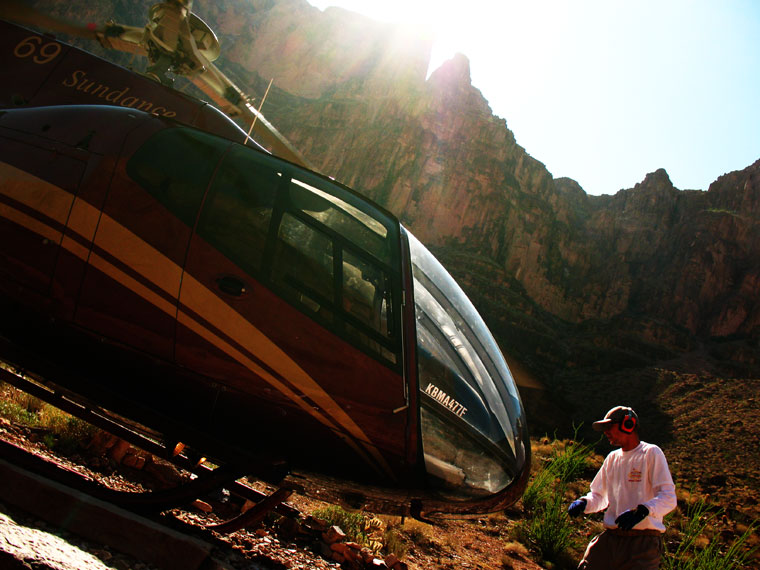
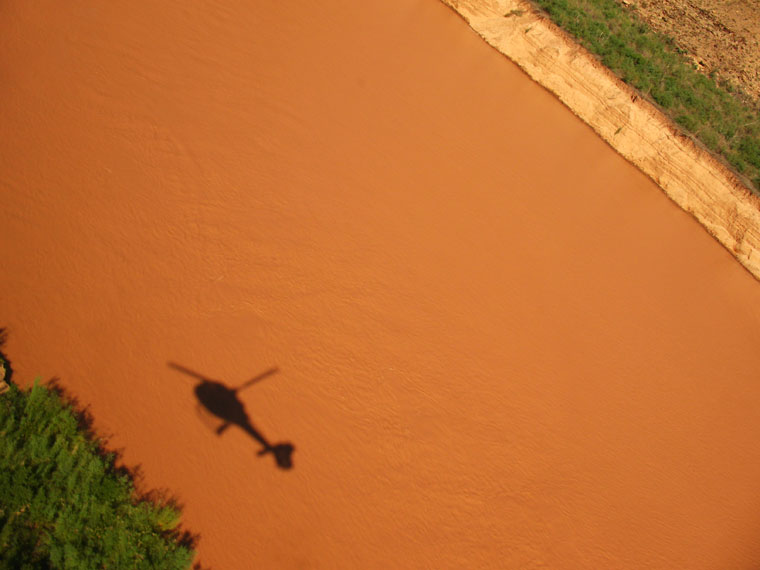
Our 8-hour journey was ending. The final attraction that he brought to our attention was the canyon where Robbie Knievel made his famous motorcycle jump. Soon we could see helicopters as we neared the Hualapai’s airport. Another half-mile or so down river some waited for us on landing pads to take us out of the canyon. We have seen the canyon from the rim, from deep inside the gorge on the Colorado River, and we’ll finish our visit seeing it from the sky. Few days in my life have been so remarkable.

Even though I didn’t envision doing this on a motorized raft, as day-long paddling trips are not offered anywhere on the Colorado at the Grand Canyon, I’m satisfied enough to cross number 47, “Raft on the Colorado River”, off the list.

A short flight later, we landed at the airport and boarded another school bus heading back to Peach Springs. We bounced around in the seats from another bumpy dirt road, through two hours of the Dr. Seuss-like panorama of hundreds of Joshua Trees. The bus occasionally filled with clouds of dirt. Randy tried to catch up on much needed sleep. I should have, but used the time mostly for writing in my journal and trying unsuccessfully to get good photos of Joshua Trees, while holding my camera out the window. My arm was never severed from my body (Stupid bus drivers and their lies!).

The Grand Staircase, Part Three - Numbers 27, 47, 93, 111, 130, and 131 on my life list.

Sunday
Click Here for Part One

My alarm went off just after sunrise; my goal of seeing the sun rise over the canyon ruined by not adjusting for the different time zone. We got up anyway, unpacked our food onto the picnic table, and made breakfast burritos over camp stoves.

“I think seeing the Grand Canyon is kind of like seeing a famous actress, who you’ve only seen on screen, and realizing they are much better looking in person,” I said. “I saw that old white haired dude from Jurassic Park in person,” Randy replied. “Was he hotter in perso…?” “No.” he said straight-faced and without hesitation.

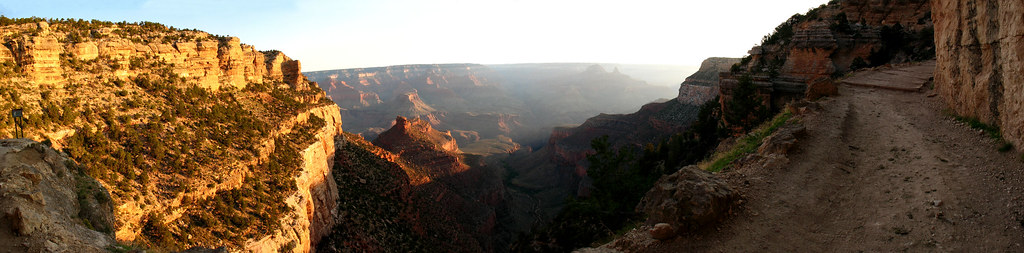
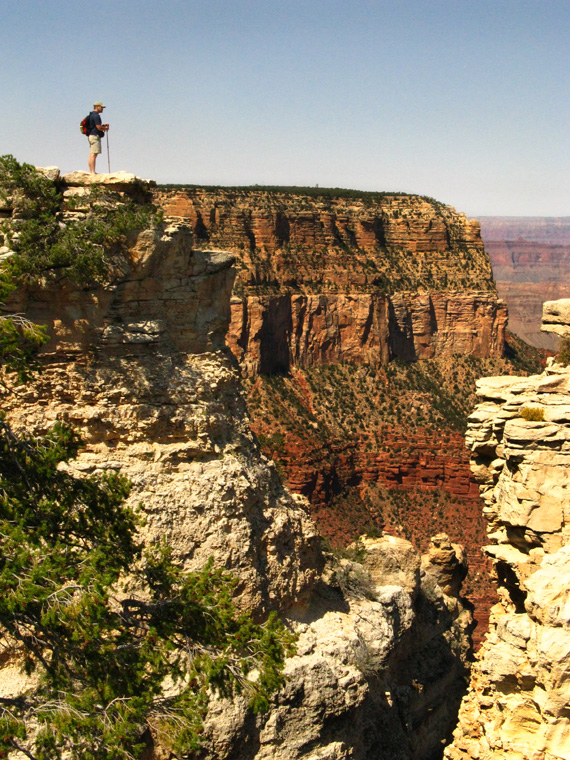
We finished our breakfast and hiked a half mile down the Bright Angel Trail. I badly wanted to continue hiking until reaching the inner gorge but didn’t prepare for that, it’s a two day trip. We only had the day, so we only planned to hike the South Rim Trail. The mostly paved trail was hardly demanding but the constant view made up for it. For the rest of the day, no matter where we were on the south rim, I could still see the bright angel trail below, far from noisy tourists, calling me. I later added ‘Hike the Bright Angel trail to Phantom Ranch’ to my life list, number 151.

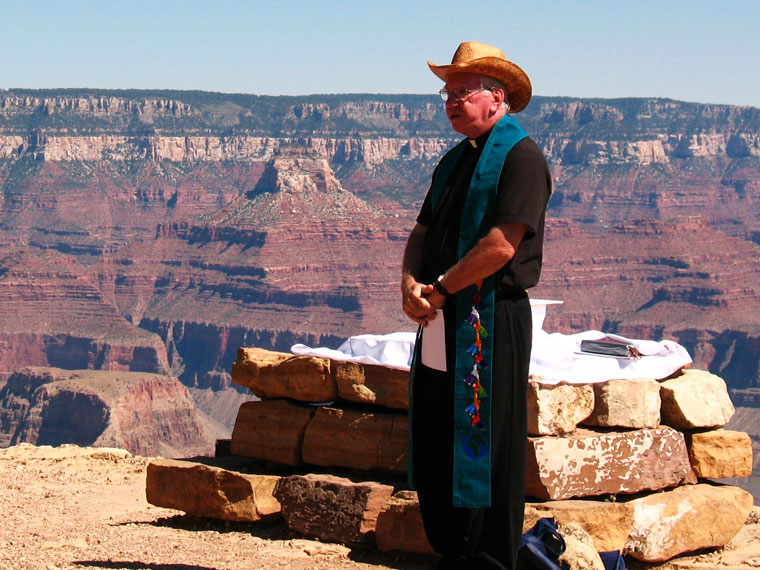
We passed a priest giving a sermon in front of the Grand Canyon backdrop. I couldn’t help but think that in the presence of such a view, a preacher shouldn’t need to tell a religious person about God. It seems you‘re looking too hard, or in the wrong place. In my opinion, the priest would have done them a greater service by silently handing them each a pair of hiking boots.

The priest wasn’t the only person to stand out among the tourists. When we weren’t constantly looking toward the canyon and exploring various pillars and ledges, there were plenty of people around to steal our attention. A middle-aged woman dressed in a tight leopard print leotard twisted her body into a Cique De Solei shape as a tall eccentric gray-haired man took her picture.

The reptilian part of my brain reacted quick and instinctually saying, “Oh my God Ryan, you gotta get a picture of… whatever the hell is going on here!” My hand went for my camera. Then, the more evolved reasoning part of my brain thought it would be weird and convinced me not to. I didn’t get my picture, but God knows the mental images will forever remain intact.

We hiked an easy 10 miles. The crowds were only in areas within a short distance to a parking lot, moving no more than from their car to the rim and back to their car. The further we hiked from parking spots, the fewer people we saw. One man stopped us, pointed to my hiking pole, and asked what it was. I don’t relate to or understand most people.

That night, to save time, we loaded anything we didn’t need into the car. We’d be leaving very early for a trip to the Colorado River.

< Part Two | Part Four >

The Grand Staircase, Part Two - Numbers 27, 47, 93, 111, 130, and 131 on my life list.

Saturday
Click Here for Part One

We rushed through the morning on almost no sleep, but got on the road feeling excited and fully conscious. Randy grabbed his MP3 player with tangled cables out of the console and began to hook it up to his car stereo.

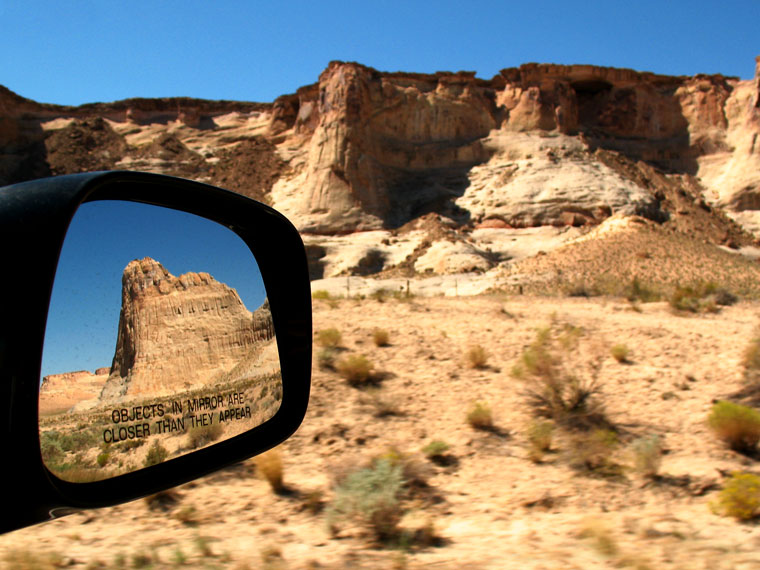
The scenery was never dull on the drive south through Utah. I’m from Northern Indiana. I rarely see mountains. Even a decent sized hill or abandoned rock quarry passes as a good view back home. One way I convince myself living in Indiana is ok, is that when I visit other states I can enjoy them that much more, like how winter makes me appreciate spring. I know this because bored-faced people were on their repetitive commute without cameras hanging out their windows, as mine always seemed to be.

It felt good to be on the highway, heading toward our long-anticipated adventure, at 70 miles per hour. I was glad Randy didn’t mind driving. Not having to watch the road ahead gave me plenty of time to admire the constantly changing view.

“Man, I have not looked at the road in a while,” Randy said, finally getting the MP3 player untangled and playing, after who knows how long.

“Let’s pull over so I can get a picture.” I said probably too often. We also stopped a few times for food and things we realized we should have packed. We had lunch somewhere near Glen Canyon and Lake Powell, both worthy of the trip themselves. As we neared our destination, small canyons with reddish hued cliff walls and dry desert fauna, emblematic of photos I’ve seen of the southwest, came into view.

As we got closer, signs began to display the mileage between us and the Grand Canyon. “Is that it?” There was a comical giddiness to Randy’s voice as he pointed towards a canyon beginning to open up the otherwise flat ground. It wasn’t it, but on any other day, it would be worthy of a photo op. We were too close to make another stop.

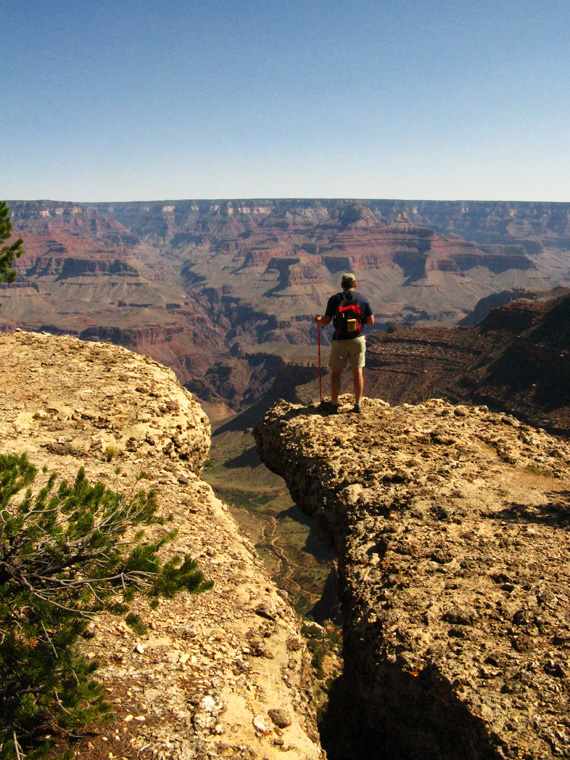
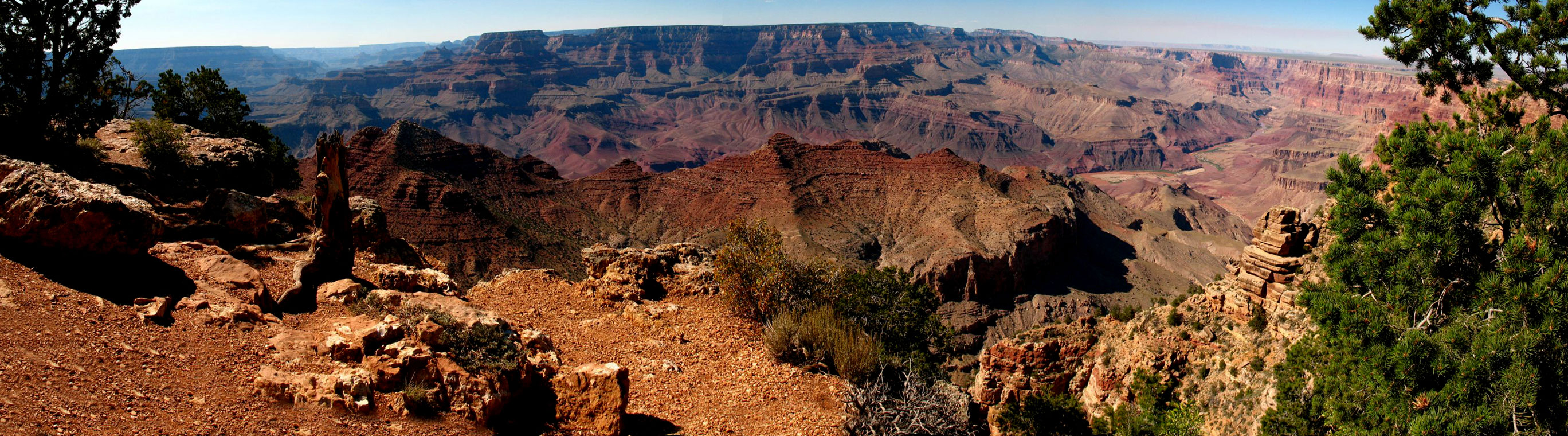
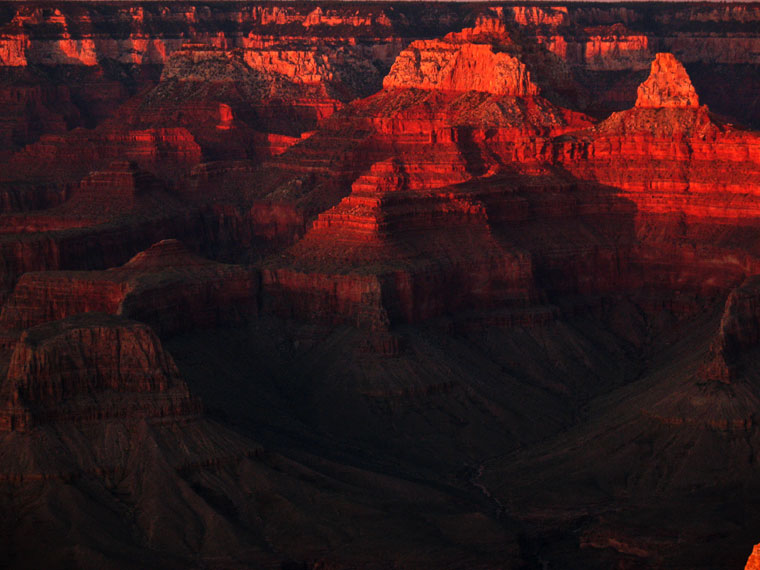
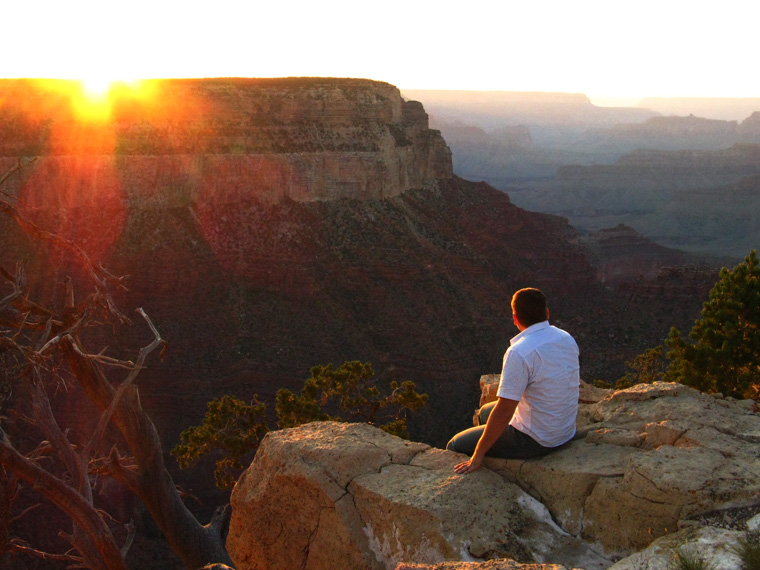
At last, our gate approached. We pulled into the first overlook, the Watch Tower, parked the car, and grabbed our cameras. Suspense built in the minute long hike to the canyon. When we neared the edge, we spoke at first in only Ws and vowels. “Aww, wow.” “Woah.” We stood there for a few minutes, then split up, took photos, sat on the ground, but rarely said a word.

“I love this silence,” Randy noted. There were several people nearby but the canyon seemed to absorb the sound. It was a silence of reverence. Any noise would have been an insult, like a loud boisterous laugh at a funeral.

I’ve seen dozens of photos, but everyone says pictures don’t do it justice, so I didn’t know what to expect. They are right. I've heard countless times that there are no adjectives in the English language to describe it, but we've been using the only appropriate one all along, Grand.

On the drive down, Randy and I talked about something we learned in a recent Phil Plait article. When you see the Earth from space, it looks like a sphere as smooth as a blue cue ball, but if you shrunk it down to the size of a cue ball, it would actually be smoother. I couldn’t help but think of this when standing at the edge. I felt insignificant (which I maintain is a good feeling). It’s a massive canyon, eons deep, but only a scratch in the cue ball’s surface, and us, only amoebas standing at the edge looking down.

A passing ranger gathered people together to tell stories about early expeditions to the canyon. We joined the group, hiked a bit to a secluded spot under a tree, and scattered on the shaded ground. The ranger stood between the canyon and us. They were interesting stories of survival, frustrating expeditions and the American expansion into the West, but I found it hard to sit there and pay attention. I wanted to be hiking.

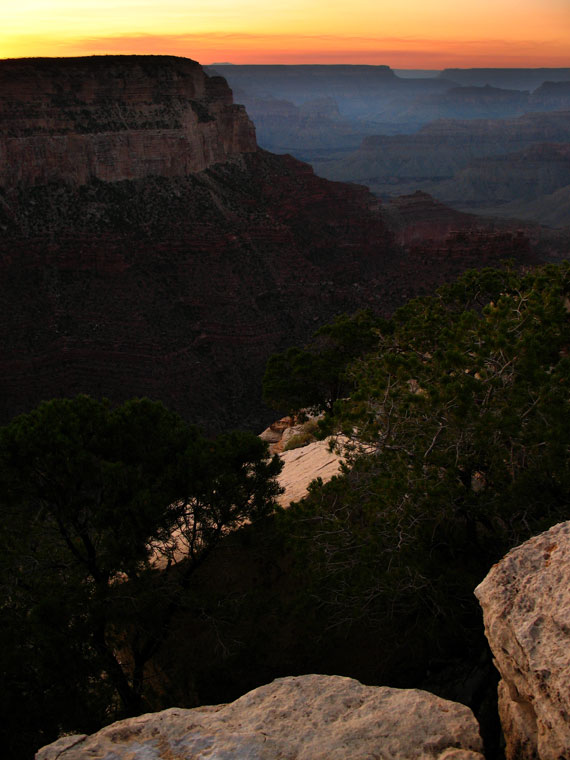
After lots of gazing and photographing at the canyon’s edge, we found a place to setup camp in the Grand Canyon’s primitive campground. We each picked clear flat spots and assembled our tents. We went back to the south rim to hike a couple miles and witness the sun setting over the canyon.

Two billion years for the Grand Canyon had passed. It began its formation around the time complex cells began to form. Every single event, in that incredibly long planetary history, had come together and settled on this exceedingly complicated, yet deceptively simple moment. Those complex cells had at last caught up to finally appreciate and admire a most spectacular event. If the only meaning to life’s four billion year history is that, then in my opinion, it’s all been worth it.

For me personally, it meant number 27, “See the Grand Canyon”, was off my list.

The air was taking on an evening chill. We hiked back to the campsite and started a fire. I couldn’t wait for the following days and wondered how they would measure up to the first. Once the fire was steady, Randy opened hot dogs and we searched the area for sticks to use as skewers. We found nothing, not a single stick. We resorted to using tent stakes instead. We learned something else of great significance that night that I’d like to pass on to you: Tent stakes short, fire hot.


The Grand Staircase, Part One - Numbers 27, 47, 93, 111, 130, and 131 on my life list.

Friday

I don’t love flying, not that I would call it a phobia. I’m not like B.A. Barrakas from the A-Team or anything, but if there was a scale from one to ten (one being as fearless of flying as a duck, and ten being, the only way you’re getting on a plane is if Murdoch distracts you while Hannibal injects a sedative into your bloodstream), I’m at about seven.

I sat at the Indianapolis airport stuffing airport cuisine into my mouth, hand cupped under my chin to keep a messy sandwich off the floor. I waited for my flight to Salt Lake City to meet up with Randy, a friend of about 18 years.

“Grand Canyon, September?” This instant message from Randy popped up on my computer screen July of 2008. A couple months passed since my last trip, but I was already itching for the next one. I knew I wanted to go west, just not sure where. This would definitely work.

“Sure,” I replied. That was that, the planning began.

Over the next few weeks, we brainstormed and settled on a tour of the Grand Staircase: the Grand Canyon, Zion National Park, and Bryce Canyon with a stop in Las Vegas. The name "Grand Staircase" comes from the topography of the region. The rim at the Grand Canyon is at the height of the canyon floor at Zion, the rim above Zion is at the height of the floor of Bryce Canyon, sort of creating stair steps. If all went as planned, I would cross off six items from my list.

I flipped through the latest Backpacker magazine with my backpack on the floor between my feet. “We are now boarding flight 1023 to Minneapolis…,” said a voice over the intercom. That was me. I slid the magazine into the backpack and grabbed my ticket.

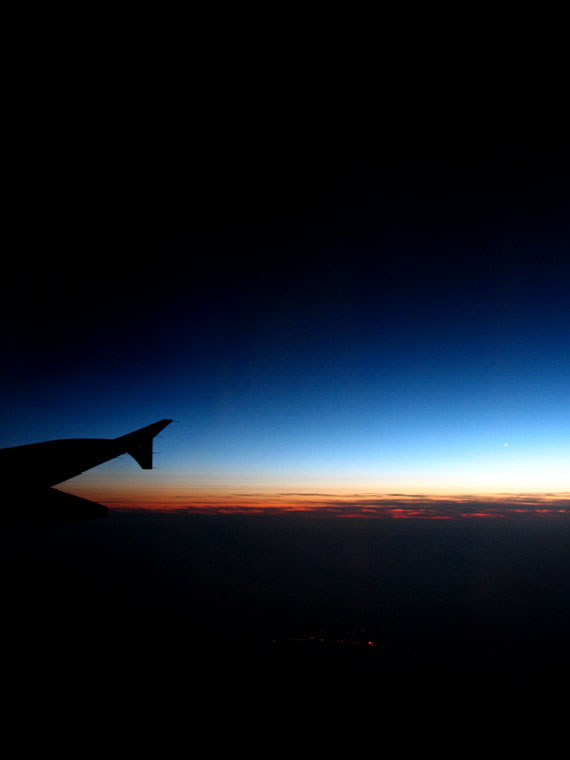
Soon speeding down the runway, I stared out the window as the land shrank below me and disappeared under a blanket of clouds. I turned off my overhead light as the sun began to set. Above the clouds, the sky was the deep blue you see in that narrow window between sunset and the black of night. A clearing opened in the middle of the white fluffy terrain revealing a fiery red sky below. When squinting I could imagine it to be a sweltering lake of fire and lava. A vision perhaps skewed by a tinge of irrational fear.

I pulled a book from my pack and tried reading. My mind wandered over the same page over and over. I tried sleeping, but couldn’t. I scribbled a few things in my journal and put it away. I leaned my temple next to the window and surveyed the sky, as I approached my layover at the St. Paul/Minneapolis airport.

The fasten seatbelts sign lit up and we began our decent. City lights came into view. Vehicle taillights flowed like red blood cells through veins of street light. Moonlight reflected off dozens of Minnesota lakes with a silvery glow. In general, the world hustles and bustles, but from up here, it seems to creep along like a slug. Tiny cars and ant-sized people inch forward deliberately, peaceful and affable. My view on humanity evidently improves, relative to my distance from it. Even a big-box store with glowing skylights fascinates me from this height. If I ever get to go into outer space (number 106 on my life list) my joyful brain will explode.

The plane landed with a soft jolt and screech. Feeling hungry again already, I moved toward the food court. All of my diet and nutrition rules go out the window when I’m on a backpacking trip. Calories are your friend when toting around thirty pounds of gear over hills and through valleys several miles every day. It is one of the many reasons I love doing it, but this trip wouldn’t involve calorie-demanding backpacking. “I’ll have a number two,” I said to the cashier at the airport McDonald’s. I gave in anyway.

I don’t mind layovers. It’s nearly impossible to not eavesdrop on the people coming and going: an elderly saleswoman endorsing a super antioxidant snake oil to a young college student, whose face snarled when the woman said the words “Big Pharma”, a confident looking young woman with long red hair and formal black and white dress traveling alone. An African-American man in desert-brown camo saying, “Yeah, I’m on the ground now baby, I’ll be home soon”, into a cell phone. There is a story everywhere you look.

“What do you want to be when you grow up?” a man asked a boy of about ten, pausing a moment from flirting with the boy’s mother. “Well, I’ve been thinking lately that I’d really like to become an astronomer,” he said more intelligently than his age. “Since when?” his mother asked. “You’re going to be a radiologist, remember? There’s a lot more money in that.” Carl Sagan sighed and turned in his grave, I know it.

I wanted to tell him how fortunate and rare it was to know what you want to do with your life at such a young age, or any age for that matter. I wanted to tell him to ignore those that cloud decisions with thoughts of money and that astronomers rarely starve from the lack of it. I knew deep down I should be saying that to myself as well.

They began boarding passengers for my flight to Salt Lake. Minutes later, we were back in the sky. I buried my face in a book and tried to appear as if I wasn’t hearing the conversation beside me. I couldn’t help it. I tried to determine if the guy worked at a mental hospital, or was temporarily out on leave. I really couldn’t tell. I only got about three pages into the book in about an hour of pretend reading when he said, “You know, I think Sarah Palin is the most qualified person to be president, I really do.” I had my answer.

Randy picked me up at the SLC airport. Number 93, “Visit Randy in Utah”, could officially be scratched from my list. We made a midnight grocery store run and filled the cart with easy camping meals, along with an impulse-buy deck of cards at the checkout counter. We unloaded everything back at his house. Brand new gear and food filled the room: backpacks, tents, sleeping bags, hiking shoes, hydration packs, enough food for three, and vapor-wicking clothing.

Sweaty clothing and cool temperatures don’t mix. Randy learned the importance of vapor-wicking non-cotton clothing the previous year when hiking in cold temperatures. He didn’t have much gear so had to purchase it all for this trip. It can be expensive, but the memories that will come from using it will be priceless. I absolutely guarantee it. Even if I had to repurchase it every year, it would still be worth it.

After taking the time to set aside all the things we didn’t really need to take, we packed it all into the car anyway. Randy handed me some blankets and showed me where I could sleep. In two hours, we would be heading to the Grand Canyon.

Part Two >

Isle Royale and My Pilgrimage to See a Moose, Part Six - Numbers 75 and 42 on my life list.

Part Six: Final Day in Paradise
Click Here for Part 1


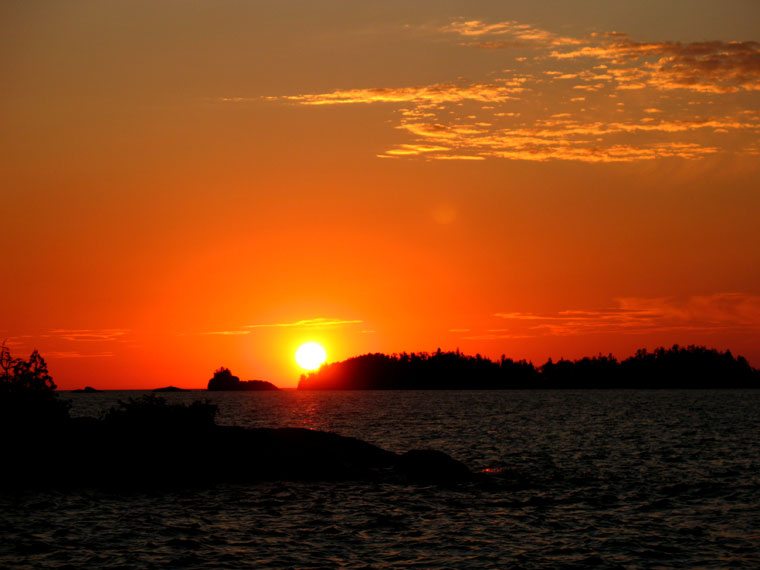
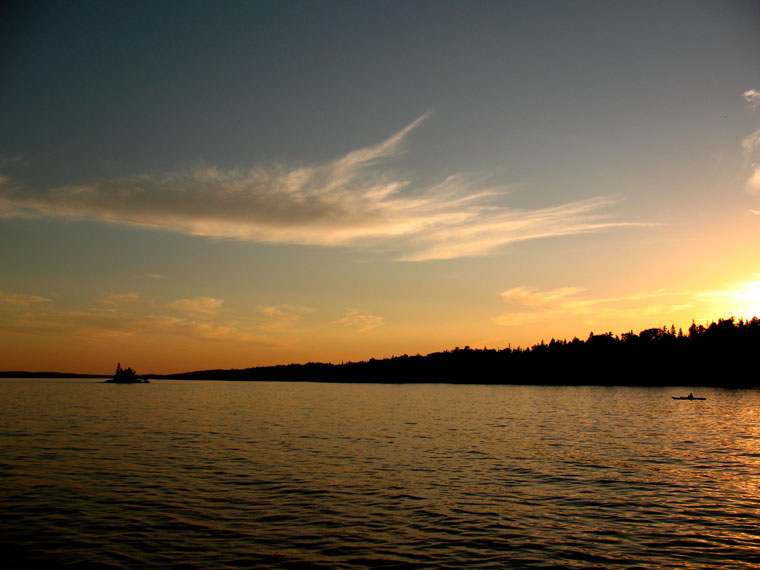
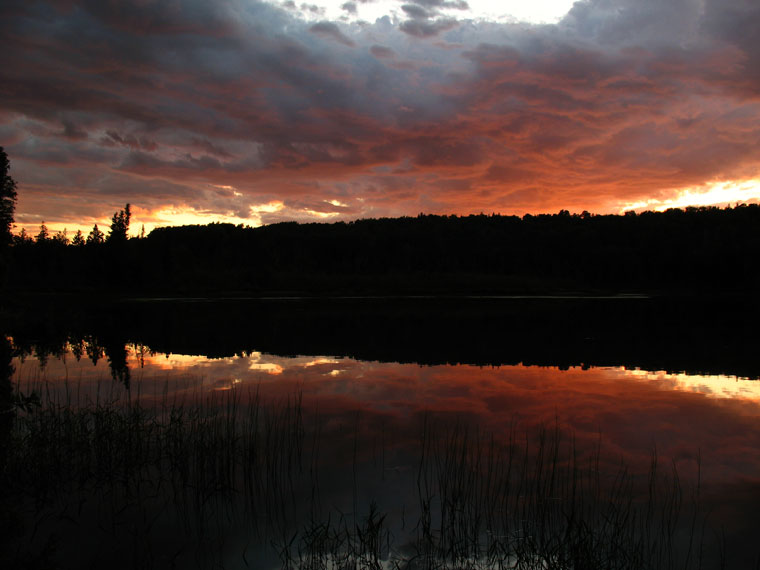
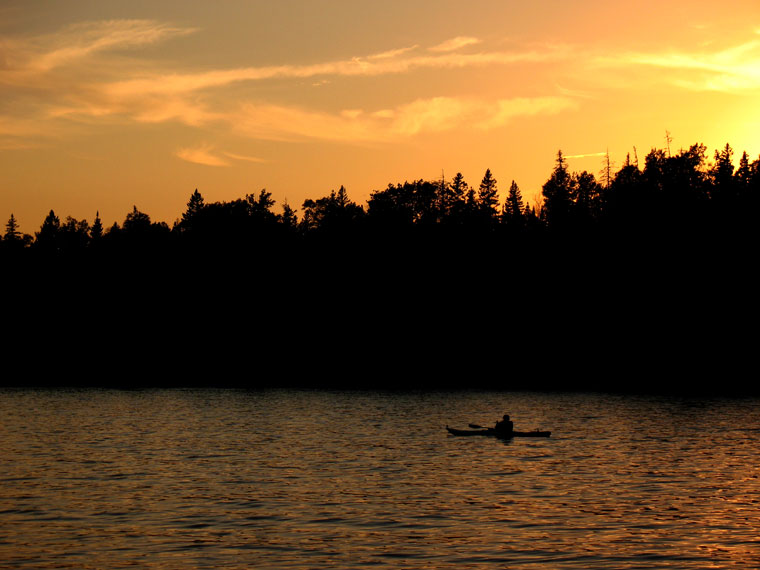
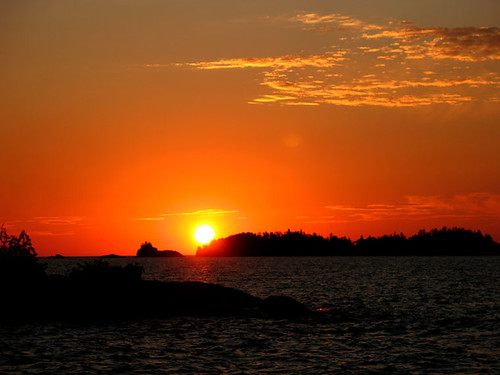
I woke up early the next morning to watch the sunrise for one last time over Lake Superior. I went back to the deck. I expected to see others enjoying the view, but I again had the deck to myself. Only this time, I sat on the east-facing bench. I didn’t leave until the sky passed its peak of red and orange.

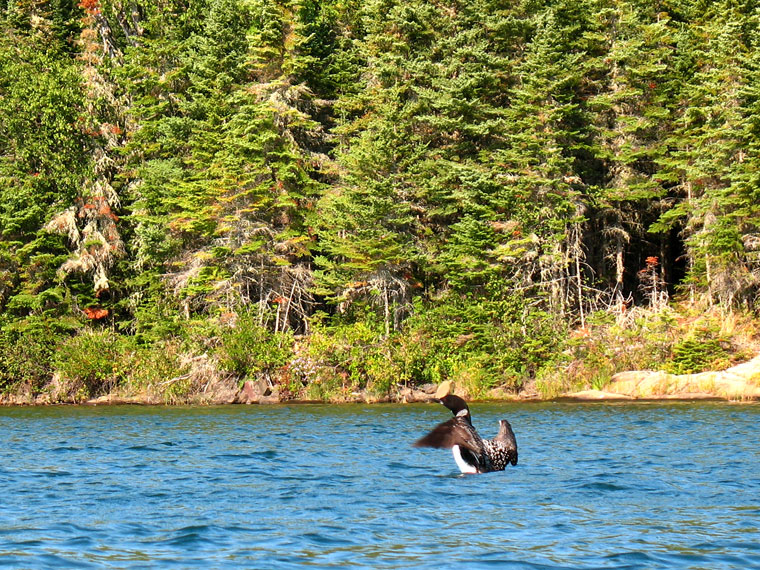
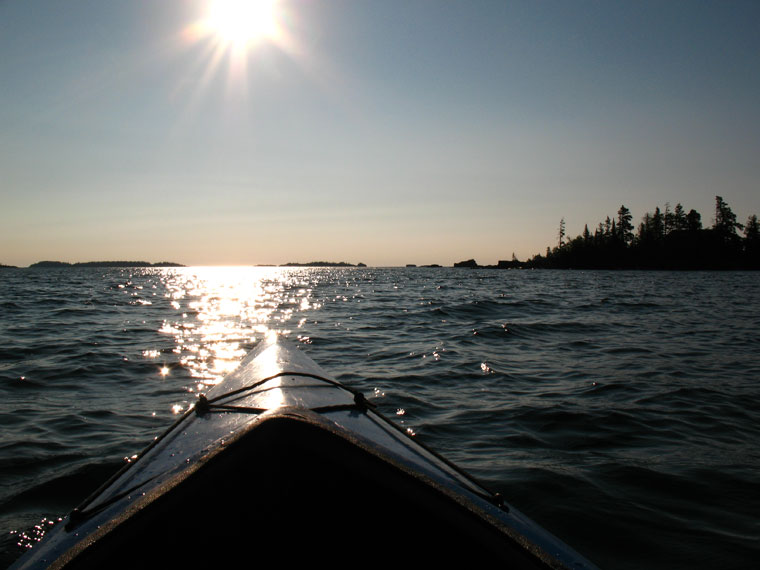
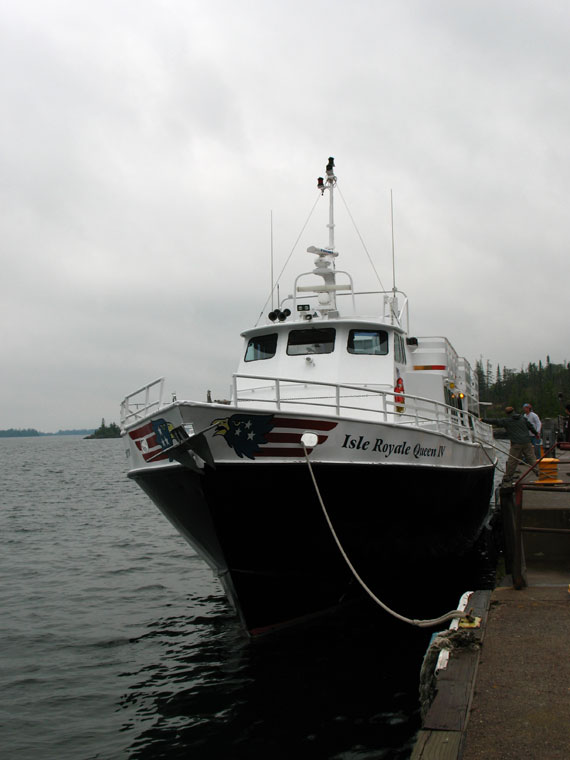
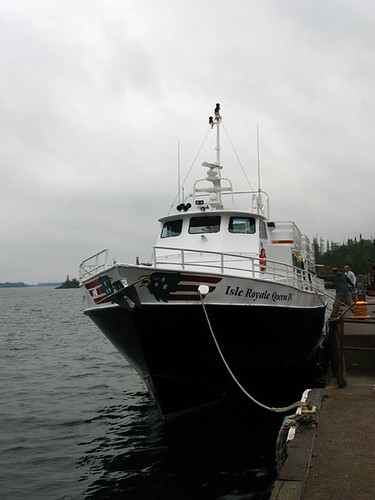
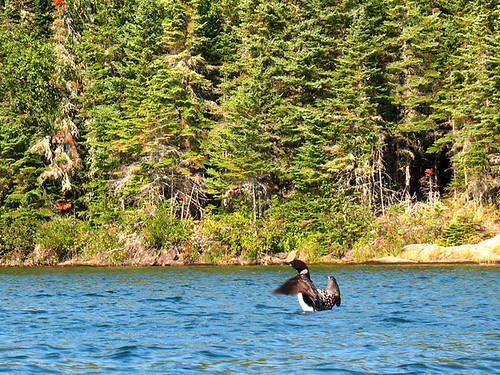
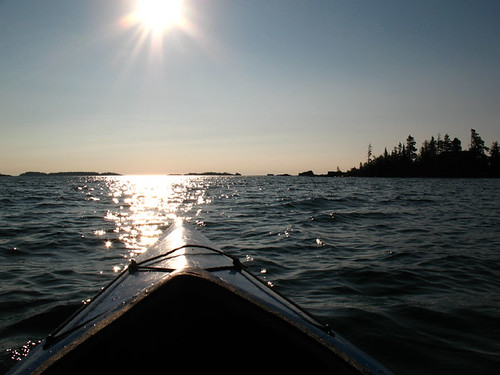
A couple of hours later, I was renting a kayak for one final adventure before boarding the Isle Royale Queen IV once again. I spent four hours circling Tobin Harbor hoping to catch another glimpse of moose. I didn’t see any but I did see two loons. I tried closing in on them to take a picture, but as I approached they would dive underwater for a minute or so and pop back up in another location, like real life whack-a-moles. They made me look like a fool as I paddled back and forth helplessly.

I passed several small islands, some inhabited by people staying in cabins. I tried to paddle closer to two ducks, standing on a log floating in the lake. I hoped to snap a quick picture, but before I could get close enough their fight or flight instinct kicked in and they flew away. Just once, I want a duck to choose fight. That should keep things interesting. If nothing else I’d find out what I’m truly made of.

I took the kayak back to the beach and returned my paddle and life jacket. I still had over two hours left on the island and decided to go on the harbor walk with a small group lead by Ranger Marcia. I learned about useful and edible plants that I wish I had known about before the hike. Most notably a small feathery plant that is said to relieve the itch of mosquito bites if rubbed on the skin.

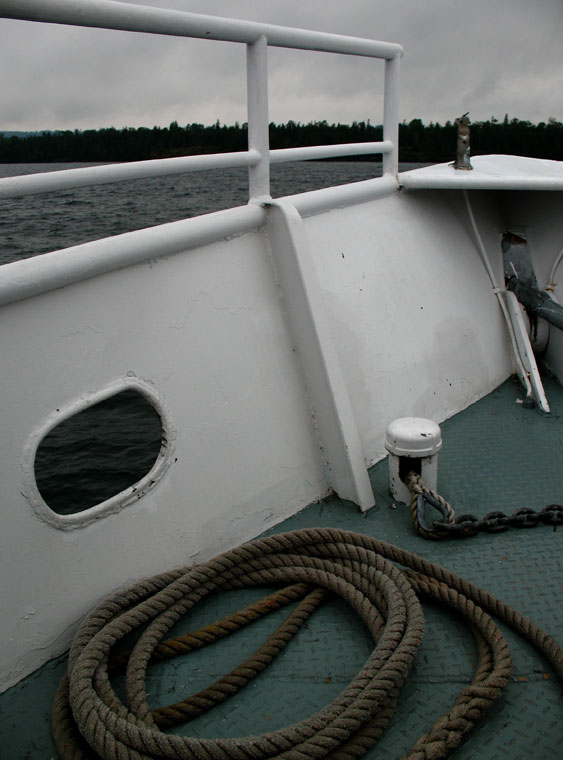
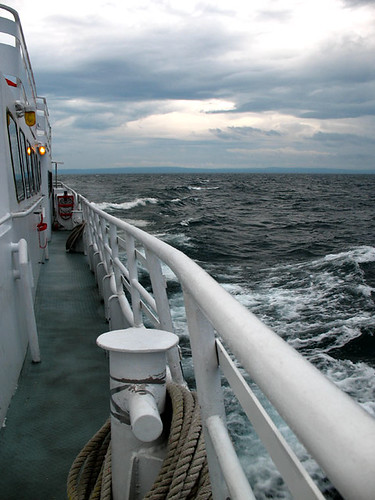
When we returned from the informative walk, they were loading gear and kayaks onto the boat. A long row of passengers lined up along its side. I wasn’t anywhere close to being ready to leave but I didn’t really have a choice. I sat again in the stern of the ship and watched as Isle Royale faded away, a depressing sight.

When we docked at Copper Harbor, I got back into my car and drove straight through for thirteen hours. I was surprisingly wide-awake for almost the entire time. Although when driving past Fort Wayne, less than 40 miles from my house, sleep deprivation finally started to set in. I started to hallucinate, more than normal, or maybe I was asleep for seconds and dreaming. I occasionally imagined that something was running out in front of me. One looked like an 18” tall Sasquatch, although I’m fairly certain it wasn’t. With only 15 miles to go, the road appeared to drop off on the left side until my lane looked like a plateau on a ridge overlooking a shear drop off.

I couldn’t take it anymore. This was not good. I stopped at a gas station and slept for an hour. I woke up suddenly, feeling like I had just fallen asleep for a moment, and finished the last 15 minutes of driving.

It didn’t take long to find myself back into my routine, but Isle Royale will forever be a special place to me, a significant part of my timeline. I already want to plan a second trip but I have too many other things on my list to do. It’s not a Yahtzee; you don’t get bonus points for doing it more than once. Nevertheless, there is something unique about this place. It’s the most revisited national park in the country and now I know why. I think I’m going to add, ‘Circumnavigate Isle Royale in a kayak’ to my life list. It would still be a new experience and an excuse to return.

All life is, is the present moment and a collection of memories from past moments. If I fill too much of my past with those repetitive, ignored memories and am not living in the here-and-now, then it’s no mystery why time is flying by. I used to spend my vacations at home, or close to it, thinking I couldn’t afford to do the things I wanted to do. I was wrong. (This trip was just over $300, including gas.) I have no good excuse for staying home. Life is too short and too important. These six days will never be forgotten, blocked out or ignored as insignificant. Every detail will be with me forever.

< Part Five

Isle Royale and My Pilgrimage to See a Moose, Part Five - Numbers 75 and 42 on my life list.

Part Five: Naturalist's High
Click Here for Part 1


The morning was chilly but no jacket needed. I ate breakfast, read, and again listened to the loons and other birds. I packed up camp slowly, paying attention to the quality of my actions. I cleaned every piece of gear unhurriedly before carefully packing it away. I accomplished another one of my intended goals. Life was moving at a snail’s pace.

I decided to go back to Rock Harbor, where my trip started, for my final night. This would put me just a couple hundred yards from where I could rent a kayak for Monday morning. Heading out of Lane Cove, back over balance beams and through clouds of bees, I hiked along with my head down staring at the trail in front of me. 

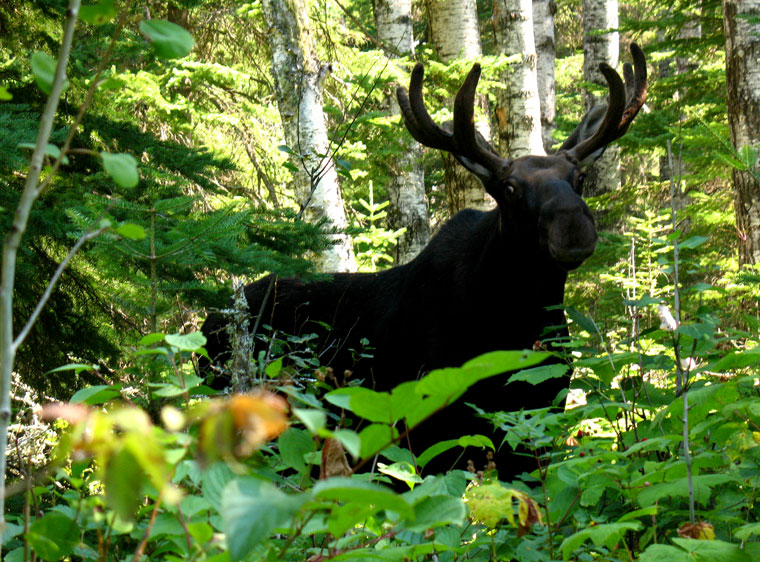
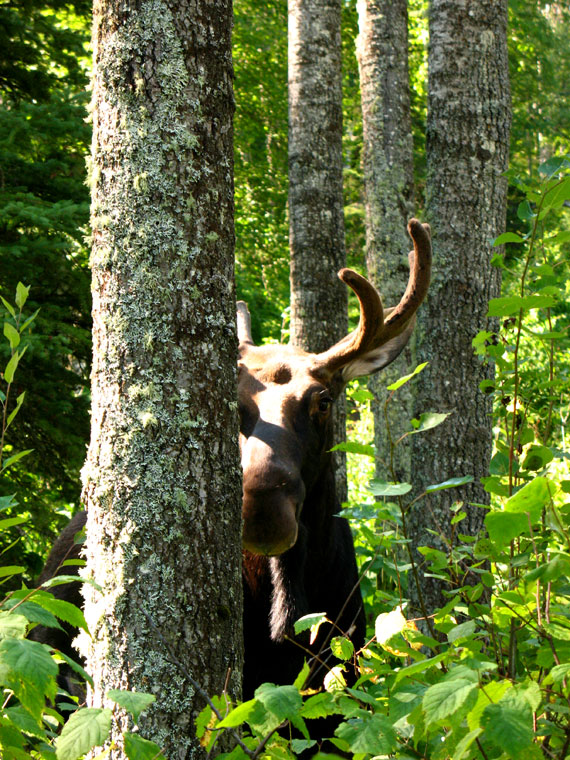
I stopped suddenly when I saw two enormous moose in front of me grazing. I don’t know what a safe distance is to be away from a moose, but I was certain this wasn’t it. I, of course, grabbed my camera and snapped about a dozen pictures of the closer and slightly smaller moose to my left. It crossed the trail a few yards in front of me. I could see sores on its hind legs that looked like bite wounds, fresh bite wounds. Did he escape from certain death nearby? Where wolves still close? I really didn’t think about that much. I was too excited about the photos I was getting and mesmerized by its size and closeness.

I moved towards the larger moose further up the trail. He wasn’t facing me and didn’t know I was there. I creeped forward but still spooked him when he heard something behind him. He darted about 10 feet then must have realized I wasn’t a threat and went back to eating. The commotion however startled the first moose, which had now turned to face me and seemed to move slightly forward. This may have just been my imagination. His faced seemed to have a concerned fearful look. Fear can lead to anger, anger can lead to violence. The kind of violence that makes you just want to headbutt an idiot with a camera. I backed away slowly but continued taking photos like those tourists in Godzilla movies moments before their death.

I learned later that moose can be more problematic than bears, and very aggressive during mating season, but that doesn’t start until late September. This was early September so clearly nothing to worry about. Again, my naivety will one day be the death of me.

With such a wonderful night and being right in the middle of the moose’s world I was on a naturalist’s high. I don’t even know what that means. I just know it doesn’t get any better than this, at least not so far.

Since I was in a hurry the day before, I walked back up to Mt. Franklin to sit and enjoy the view from 1,080 feet, without feeling rushed. Several people came to check out the view, take a photo, and left quickly. I remained. I knew once I headed back down it might be the last I’d get to see it. As a result, it was hard to leave.

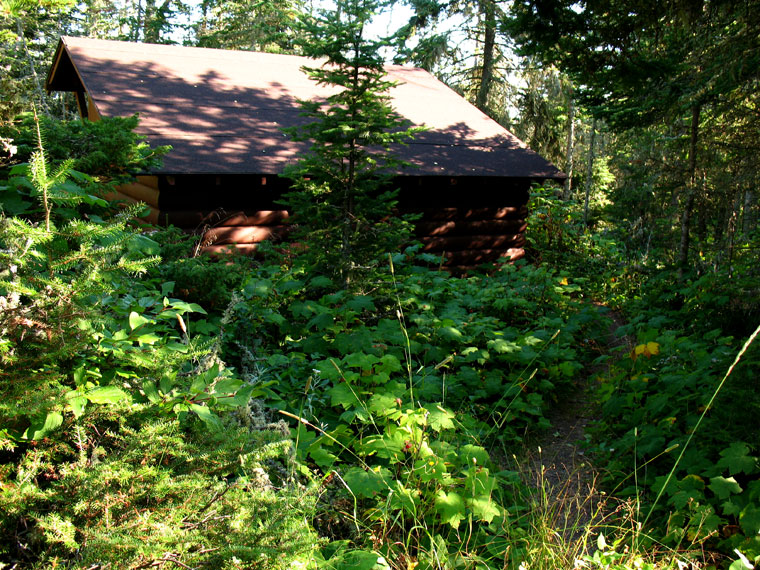
At Rock Harbor campground, I expected to see it crowded and full of activity, especially since it was Labor Day weekend. Other than the side with the restaurant and lodge, it was the opposite. I pretty much had the pick of whichever site I wanted. I choose to stay in one of the shelters. An empty 10 x 15 foot space, with one wall made entirely of screen, facing the forest and a picnic table out front.

Writings and drawings covered the walls and ceiling inside. There were signatures, poems, short reports about experiences, testimonies, and commentary. One thing was clear, even those who wrote about bad experiences from weather or failed gear, they all enjoyed their stay and wanted to come back.

I left my gear behind and went to check out the slightly more civilized part of the island. I felt out of place. I was a guy from the woods who has been drinking water from the lake and lying on the ground. They were drinking wine on a patio. It’s a very small section but where most people congregate. I thought about getting a meal at the restaurant but turned down the $35 cost. Instead, I walked down a trail and discovered a deck with benches angled towards both the sunrise and sunset. I hung out for at least a couple of hours. A few other people where there too, but all had left before the sun completely set. I stayed, happy to be alone.

Daylight faded like a retractable roof revealing the cosmos. The smell of campfires started to waft over in the breeze. The first point of light to emerge was Jupiter, then Vega, the Big Dipper constellation, the Northern Cross, Cassiopeia, and a small handful of other stars light years away. Soon thousands of others followed. The sky was full of them and yet I can still only see a fraction of all that exist with the naked eye. 

There are hundreds of billions in our galaxy alone, which is one of hundreds of billions of galaxies. There are more stars in our universe than grains of sand on all the beaches on earth. Nobody ever believes me when I say this but it is true; ask any astronomer or statistician (if you can find one). I cannot help but wonder how many of those stars hold planets in their gravitational grasp. How many of those planets support life? What color are the plants where their entomological dramas unfold?

Light emitted from these stars takes years to reach my eyes. In fact, the stream of light from each star left at different times, so every twinkle that I see represents a different moment in history. The light from Vega, which I can see now, left its source in about 1983. That’s before the Cosby Show and the creation of Alf. Think about it.

The ancient light from Mu Cephei started its voyage towards earth while humans were entering the Bronze Age, fighting wars with copper and bronze weapons, constructing Stonehenge, and for the first time using ploughs, pottery wheels, and interestingly astronomy itself. It is a journey so long that when it finally passes by, I am not using copper for weapons anymore, but in the circuitry making it possible for me to later Google this information about the 4th century B.C.E.

The Andromeda galaxy is just a pale white point of light to the naked eye. That beam’s voyage is so old that pre-human hominids were tramping over the same planet, which I now lay, with the first primitive stone tools ever created. Now here it is colliding with my retinas and registering in my brain not as just another pale light from far away, but conjuring up feelings about my life of both insignificance and precious rarity. Whenever I am taking my life too seriously and need brought back down to earth, I once again, simply have to look up.

I wish I could hold onto these moments always. Permanently slow things down. A rushed life finally unhurried. Regrettably, I know it will not last forever; but thanks to a love of the natural world, I will forever know that at any time I can get it back. Even in the realm of the known, without making up fantastical and magical stories, the world can be seen as fascinating, miraculous, and enchanting; and should above all, never be seen as repetitive and boring.

I had to put on my headlamp to see the trail for my hike back. When I was near the resort’s lights, I temporarily turned the lamp off and strolled with my head still pointed towards the sky, which caused me to veer off the trail and nearly trip. I just couldn’t keep my eyes off it. This was my last night; I had to take it all in.

< Part Four | Part Six >

Isle Royale and My Pilgrimage to See a Moose, Part Four - Numbers 75 and 42 on my life list.

Part Four: Greenstone Ridge Trail
Click Here for Part One


At first light, my stealthy moose search began. (I’m excited to be able to say that.) I crossed over moose-created paths and over puddles from moose-created footprints. It was chilly, about 47 degrees. A thick fog was drifting across the lake reflecting a peach sky. A river otter was enjoying an early morning cold swim.  I stood patiently by the lake with my camera, but there were no moose to be seen.

I went back to camp and lounged in my hammock listening to the early birds. Their songs are a little different this far north. “Burlap, burlap.” “Tweep, tweep,” some birds said, with crazy northerner accents. I moved back to my cozy tent and sleeping bag to warm up. Apparently too cozy, I slept for an additional four hours. The day started late. I didn’t get on the trail until 1:30 and I had over thirteen miles to travel. I intended to start at a decent time, so much for that.

My next target was Lane Cove via the Greenstone Ridge Trail. It was rougher and didn’t look as manicured as the previous trails, but the views were amazing. As I got to the top of the first overlook, I was stunned. My tense body slumped as I exhaled a “wow”. I had no idea there would be such views or that the ridge would be over 1,000 feet high. There is something to be said for under planning and letting yourself be surprised. (Pictures can’t do it justice.)

I could see many small islands out in the lake and a hazy Canadian shore. I joined a fellow hiker and sat on the edge of exposed bedrock with my feet hanging over the side. He was on day 2 of 16. We talked for a few minutes. He wasn’t carrying a lot of food but would instead go fishing each night to catch dinner. He gave me some information about the trip to Lane Cove and continued on his way. I stayed there for a little while longer to take it all in. I knew I didn’t have a lot of daylight left, but to hell with deadlines, I have a headlamp.

This was not the only excellent lookout from Greenstone Ridge. Much of the 10 miles I spent on it today were in view of the Lake nearly a thousand feet below. I climbed the fire tower on Mount Ojibwa, trying to get as high as possible, and took a few photos. I could see the Rock Harbor lighthouse over a mile away. I was beginning to fall in love with this place. A couple of generations ago many people fought long and hard to turn this into a national park, to protect it from overfishing, logging, the building of resorts, and other financial exploitations. I now sensed a connection with those people. I understood. I would have been fighting alongside them.

More trails of that seemingly landscaped splendor was back on my decent to Lane Cove. I was exhausted, however, and the mosquitoes were bad so I was beginning to get a bit frustrated and ready to be finished for the day.

Everything was moist and covered in a thick green moss. Sage green lichens draped Birch trees. Long foot-wide planks occasionally raised you up off the wet ground to both keep you out of mud and to protect the land below.

A particularly long thirty yard stretch of these boards was about two feet off the ground. A heavy pack can pull you down if you lean to one side too much. That combined with a nervousness of falling and the constant swatting of mosquitoes, I felt like I was on one of those Japanese game show obstacle courses. I could hear the announcer in my head as I walked across. “Alright and he’s off, over the balance beam, crossing the stagnant water pit of snakes, uh oh he’s crouching down to take a picture of a pretty S-shaped snake laying in the water, a potentially devastating choice as this could compromise his stability, there’s a massive hit on his right by the mosquito swarm, that frantic swatting is going to cost him his sense of balance, but wait a minute, he’s back up and he finishes in record time! Stay tuned for more Super Happy Joy Fun Show!”

The mosquitoes were so annoying, that I began referring to them as skeeters, which is the derogatory slur to use when wanting to intentionally show them disrespect. I was constantly smacking and swatting at them. I really don’t like killing anything. I don’t even kill insects in my house. Some I give sanctuary, others I carefully pick up and set them outside in the safety of a bush.  Nonetheless, with mosquitoes, I got a definite sense of satisfaction when killing one. Sorry skeeters, but nobody likes you. 

By the time I arrived at Lane Cove, the mosquitoes were mostly gone. The frustration instantly eroded and I was thrilled that I chose to hike the extra two and a half extra miles to get here. The site bordered the cove and the view pointed towards the opening into Lake Superior. The water was shallow for several feet so provided plenty of room for wading and rinsing off. I set my gear down, put on my water shoes, and headed into the lake.

The water was very cold. Superior is always cold. The average yearly temperature is in the 40s or 50s. It was a bit warmer now however, but probably only in the low-60s. I walked out until I was thigh deep and started to shiver, but it felt great. I hesitated due to the cold but I wanted to be submerged. Before I could think about it too much, I held my breath and went under. It was exhilarating at first. I became acclimated just enough to tolerate it but never fully. I swam further out. My head popped above the surface while treading. I breathed air into my tightened lungs with short, almost hyperventilating breaths. Obviously, I’m not use to this.

I went back under and moved to shallower water so I could stand. I took a few more breaths, went under again, and swam towards the shore until my hands and knees were grazing large fist sized rocks on the bottom. It felt incredible. A cold swim after a few days of backpacking under a layer of sweat and grim is one of life’s most invigorating moments. I rolled onto my back then to a sitting position for a couple minutes before I would go dry in the sun.

There wasn’t much daylight left, so I started to prepare camp. Periodically I’d stop to admire the sunset. After finally making myself at home, I laid on my back on a bench made of a large log planed down so it was flat. My head rested on my hands with fingers intertwined. I realize that the rush of the day is not for me. I wish I had gotten here earlier. My previous treks have been too hurried, this day included. That is not why I hike, not why nature draws me in. This was it, this simplicity, this kind of moment. (Am I paying attention to it?)

When I look up at the sky, I'm reminded that in over four billion years it has never looked exactly the same way. The clouds arranged in this particular combination of shapes and colors, moving in this particular way, will only exist at this moment and never again. I wish I could always remember that when I need to slow things down, live in the present and see something new, I simply have to look up.

I roll over onto my side, hand now propping up my head, occasionally scribbling in my journal. I concentrate on the feeling of tall grasses touching my skin, the smell of dirt, and start to see just how much is going on all around me. Paying attention to the little things I normally block out is another way to slow things down and to live in the moment.

Over green chlorophyll and soil, an insect is living out his days with a struggle, drama, and determination that I cannot even imagine. It’s common to see the plants, not as living things, but as lifeless as gravel or mud, even though we share DNA. If they moved at a faster time-lapse pace that I could easily see, turning their leaves quickly towards the sun and roots slithering under our feet, how different would they seem? Would I give them personality? Would I talk to them and give them names? Would I think twice before picking a flower?

The diversity and cooperation between plants on the island is also admirable. There are species that wouldn’t ordinarily be able to survive on Isle Royale due to its poor soil quality with low levels of nitrogen. Some species of plants however, convert the nitrogen in the air, and put some back into the soil in forms other plants can use to survive. Below me, even though I can’t see it, I know this overlooked world exists buried under several tons of dirt, roots, stones, bedrock, and water, churning away unknowing and selflessly keeping everything alive and growing here on the surface.

Just as important is the microscopic life, which is so abundant that if everything we can observe with the naked eye were to disappear, we would still see ghostly outlines of it constructed out of trillions of bacteria and nematodes.

The lichens covering the trees and rocks look like a single organism, but are actually comprised of fungus with algae or cyanobacteria, or both. The fungus provides structure and nitrogen allowing the algae or cyanobacteria to photosynthesize and provide food for the fungi. One would not survive in this beautiful form without the other. Lichens are fungi that discovered agriculture, as one lichenologist put it. This delicate cooperation illustrates both the strength and endurance of the island but also the fragility and teamwork required to maintain it.

So much of this activity is going on continuously, and yet, I typically fail to pay attention to it. It’s a magnificent world and largely ignored in the course of the average day. An essentially useless dollar bill unclaimed blows across a parking lot, and most of us will go out of our way to chase it down. At the same time fail to see the priceless things always around us, each one blocked out as repetitive and insignificant.

The sun was now set, the clear sky still a bright but now darkening blue. The absence of moon and city light made every possible star visible. Periodic breezes hissed through the pines and water gurgled against the rocks on the shore. This is the time of my life.

SMACK, the sound of another dying mosquito. “Thought you were going to bite me, huh? Skeeta please.”

I moved to my tent to be away from them, so they wouldn’t take away from this moment. I sat up late reading and writing. Occasionally I’d lie on my back to gaze up at the unusual amount of stars that I normally can’t see at home. Complete darkness is something I forgot how to appreciate.

< Part Three | Part Five >

Isle Royale and My Pilgrimage to See a Moose, Part Three - Numbers 75 and 42 on my life list.

Part Three: Life List Item Forty-Two
Click Here for Part 1


The night was in the upper forties and remained chilly the next morning as I repacked my gear. McCargoe Cove, 10 miles away, was today’s planned destination. I walked along a twelve-inch plank raised above the ground, with beautiful wild flowers on both sides. I didn’t hear the buzzing until I was right in the middle of it. Bees surrounded me. It was like being in an apiary without the benefits of a beekeeper outfit. I didn’t think they would sting me. I just kept walking through it. My naivety will one day be the death of me.

So far, my pilgrimage to see a moose was unsuccessful. I worried that not seeing any was a possibility. Then somewhere between Lake Richie and Chickenbone Lake, just a few yards on my right, I hear a loud exhaling grunt that could have only come from one of the half-ton lumbering beasts.

I was temporarily startled but drew the camera from my side pocket like Wyatt Earp. I walked along fallen trees to get closer, balancing myself by reaching for nearby trunks and branches. He was grazing, preparing for winter, so says Ranger Marcia. His massive size and huge rack made me feel very trivial and fragile. His movements were unhurried, living in the moment. He grabbed branches between his teeth then slid up stripping it of leaves. It was fascinating to watch. With great satisfaction, I mentally cross off #42.

I picked a site at Chickenbone Lake to stay for the night. I didn’t get to McCargoe Cove, three more miles away. I was ready to rest and after seeing the moose, I wanted to stay in the area to increase my chances of seeing more. Moose don’t like hot weather. They don’t get cold until about minus-25 degrees Fahrenheit, so I figured they would frequent the lake to cool themselves. After surveying the site, I found a few moose tracks and many paths leading toward the water. I was certain I’d be successful. I set my alarm for 6:00 am. I’d hunt early, camera in hand.

Logs and rocks surrounded a large boulder near the center of the campsite, which I used as a table and chairs to prepare dinner. While I ate, and for the rest of the evening, the periodic cry of the loon and the equally long echo, lifted my spirits. Shortly after, it started to rain. I quickly grabbed everything and put it in the tent and under the rain fly. It cleared up as quickly as it started but would return a little while later.

I moved to another large boulder that was a couple of feet out into the lake. I sat watching droplets from the slight drizzle collided with the still water. The light reflecting off the ripples looked like thousands of fireflies swarming on the surface.

Another reason I stopped three miles before reaching McCargoe was that I didn’t want this trip to be about completing as many miles as possible. I wanted time to relax by the lake, sway in my hammock, and read my book. Aside from the few intermittent showers, it was a perfect night to do so. The storm clouds moving in reflected many warm hues from the setting sun, creating a dramatic and menacing sky.

I am a hammock-based sloth with nothing to do, nowhere to go, and no one to answer to. Finally, I’m beginning to have the frame of mind to answer some, often ignored, but important questions. That is, questions that keep me in the here and now: what is going on around me, what sounds have just entered my ears that I am ignoring, what is my skin feeling, am I paying attention.

< Part Two | Part Four >


Isle Royale and My Pilgrimage to See a Moose, Part Two - Numbers 75 and 42 on my life list.

Part Two: Ride on the Isle Royale Queen IV
Click Here for Part One


The next morning my two alarm clocks annoyed me as instructed at precisely 6:30. After hitting snooze on both, followed by nine more minutes of blissful sleep, I rolled out of bed squinting and stumbled into the hot pink shower. I was soon clean and ready to go.

When I arrived, there were a dozen people already waiting under an awning, shielding them from the morning rain. The weather report called for showers on this morning only, so I wasn’t too worried. I got my ticket and loaded my pack onto the boat. As I waited under the awning myself, I checked out the other backpacker's gear, eavesdropped on stories about their previous trips to the island, and watched the workers load several kayaks onto the ship.

Once allowed to board I sat by the window at a table with four comfy blue seats. I knew the boat would be close to full and wouldn’t be able to keep my own table. I was ok with that, since most people were backpackers, I figured I’d get to meet someone that had common interests. Instead, however, a couple of about 18-20 years old asked if they could have the seats across from me. The girl painted in make-up was obviously more interested in how she looked than the other rough looking backpackers on the boat. Her boyfriend constantly yawned and rubbed his eyes. We didn’t exchange a word after “mind if we join you” and they soon fell asleep.

The boat was a couple minutes from leaving. What is this diamond shaped thing in my pocket I wondered, a keychain? My goldfish memory eventually kicked in and I realized I had forgotten to drop the key off at the motel front desk. I told a girl who worked on the boat the situation, pointed to the motel, and asked how much time I had.

“Hah, none.” she said. “But if you hurry, you can make it.” The engines started to rev up. The 30 seconds to drop it off and get back on the boat turned out to be a blessing in disguise. I could now scurry past my sleepy shipmates unobserved, onto the stern’s deck outside, where I would spend most of the 3 ½-hour trip.

I leaned against the railing looking out over the side. Michigan disappeared. The horizon and Lake Superior was all I could see in any direction. It was cold. Every so often a chilly mist sprayed from windblown white-capped waves. I staggered to the snack bar, trying to walk on a surface that rolled and swayed, and bought a cup of hot cranberry apple cider to warm up. I moved onto the bow of the ship I stared at the horizon waiting for an island to emerge.

The voice of the captain occasionally bellowed out of a speaker to tell us some information about Isle Royale that we may find useful or interesting. He tells us this year is the 50th anniversary of a moose/wolf study on the island. The populations of moose and wolves fluctuate like a teeter totter. As the predator wolf population goes up, the moose prey population goes down. With the food source low, the wolf population goes down until the moose population is back up, then repeat indefinitely. That is a simplification but you get the idea.

He says there are 23 wolves in 4 packs and 650 moose on the island; a low number for Isle Royale but still almost ensures I’d see one. I’m not sure why I like this animal but I think it just conjures up images of the Alaskan wilderness and boreal forests that I love so much.

He tells us the story of a moose that ventured into a campsite drawing the attention of excited backpackers. Wolves came into the camp and attacked it. The moose tried to flee by jumping in the lake but drowned. The wolves pulled the body back into the camp and begun devouring it, in front of some, I assume now, horrified, shocked, and disgusted backpackers. Since it was disturbing people, and the wolves would be there for a while feasting, they evacuated the area. A week later, the pack finally finished their meal and, umm, lived happily ever after?

I looked around at the other passengers and confirmed that they had the same, “what the hell?” look on their faces that I did. I’m not sure of his point to the story, but he seemed to enjoy telling it. I’ve read several times that wolves are not a threat to humans. After his story, I started to question my sources.

Finally, Isle Royale appeared in the distance. Waves crashed on its rocky shore painted with bright orange lichens. The forest looks like those you expect to see north of the Canadian border, with conifers like white spruce and balsam fir and younger deciduous trees like birch and aspen. There is a good reason for this. Isle Royale is just barely at the southern tip of the Boreal forest, rarely seen in the lower 48, that covers millions of acres in Alaska and Canada.

There was a quick orientation and registration with Ranger Marcia before heading into the wilderness. I could tell she had a love affair with this place. I imagined that she would occasionally head off into the woods alone, during off-hours, and eat edible plants and berries along the trails. I pictured her finding a rock to sit on, with a good view, while writing poetry about how she feels connected to nature, complete with metaphors that give the island human-like traits. She was my kind of person.

I decide to head to Daisy Farm campground just over seven miles away. My first impression of the trail running along the shore was that it seemed meticulously landscaped. The placement of large and small-leafed plants, moss covered boulders and bedrock, wide assortments of wildflowers, edible thimbleberries right at arm’s reach, were all under a canopy of trees that flowed with the trail just as it should with nothing out of place. This was especially noticeable in places I decided to stop for short breaks, like at Suzy’s Cave, and along Lake Superior’s rocky shoreline.

I picked several thimbleberries along the trail. I got somewhat addicted to them. They look like raspberries and the taste reminds me of pomegranate. They get their name from the shape, but to me, they looked more like little red berets on the ends of my fingers than thimbles. I put them on my fingertips like when we’d put those pointy Bugles snacks on our fingertips as kids. We’d pretend they were witches nails, and walk around with our hands up near our face, fingers curling, cackling, and saying things like “I’ll get you, my pretty, and your little dog too”. 

Once my index finger had on a red beret, suddenly I imagined it had a French accent (I really didn’t have a choice, it just happened.) Beret Wearing Index Finger doesn’t care much for vile, despicable, American scum. Beret Wearing Thumb tried to do a ‘Rerun from What’s Happening’ impersonation but all he knew to say was “Hey, Hey, Hey!” although I had my doubts that that was Rerun’s catchphrase on the show, but I kept my comments to myself. Beret Wearing Pinky just incoherently yelled things like” Viva La Revolucion!”, in a high-pitched futile attempt to sound threatening, but nobody paid attention to the pinky. They never do. This just fuels his desire for revolution. I ate so many thimbleberries that my fingertips were dyed red, the sign of true addict. This dialogue only took place in my head. Does that make it less odd?

Nearing Daisy Farm, hiking up a slight incline, I encountered a nonchalant red fox standing in the middle of the trail. He stood staring at me. I quickly got out my camera to take pictures. Not concerned in any way, he just sat down on the ground looking around in different directions, almost as if he was posing. After eight or more photos, he remained unmoved. After finally putting my camera away it seemed as if he might said, “Ok, now that I have your attention please answer me these riddles three and you may pass.” As another noisy group started to approach behind me, he strolled away from the trail slowly and out of sight.

I arrived at Daisy Farm and found only one site unoccupied. I was lucky since the next site was four miles away. I unpacked, ate a quick meal (including some thimbleberries that were growing nearby), and relax in my hammock under spruce needles and birch leaves. Even with the crowded campground, the sounds of screen doors from shelters and pit toilets tapping shut, and the sound of mumbling and laughter, it was a peaceful night. The young couple from the boat walked by three times, searching for an open spot. I thought I would once again hear him say, “Mind if we join you?” Luckily, I did not.

< Part One | Part Three >

Isle Royale and My Pilgrimage to See a Moose, Part One - Numbers 75 and 42 on my life list.

Part One: A Long Drive North

Sometimes I reach up to feel the edge of my glasses to see if they are still on my face. On my drive home from work, I’m occasionally surprised to see that final turn without realizing I’ve already passed all the familiar landmarks. I know I am wearing underwear but I can’t feel it. My brain signals my consciousness only when there is a change; the repetitive consistently blocked out.

There is an evolutionary advantage to disregarding the ordinary. It allows us to focus and react quickly to a dangerous or advantageous situation; but the shortcoming is that much of life is repetitive and thus ignored as insignificant. The result is realizing one day I’m 30 and can’t remember where all the time has gone.

I can’t smell myself either, but I’ve been on a trail for a couple days as I write this, so I’m sure I stink.

One night, while my brain was trying to block out the repetitive chore of folding laundry, I stared at a mound of socks on my bed rolled into balls. Each ball of socks represented a day in my life. Looking at them piled together, I felt like someone with amnesia seeing unfamiliar photographs of themselves with smiling strangers. What did I do with all of these days? Where was I? It seemed like I just did laundry. I was troubled by the number of days now piled up on my bed.

The speed at which this particular year is traveling by is quite alarming. This is the reason I started a life list. The only way I know how to apply the brakes is to do something different, always be thinking of the next adventure, and strive to live in the moment.

Quieting the mind and living in the present is not always an easy task; I pretty much fail at daily actually. I find that it is effortless, however, when I’m alone in nature… and there is no better place for solitude in a pristine natural world than the island of Isle Royale, number 75 on my life list.

Isle Royale National Park is a series of islands tucked away in Lake Superior about 15 miles off the shores of Minnesota and Ontario, although technically part of Michigan. This archipelago encompasses over 400 islands. All of which dwarf the main 45 by 9 mile island, Isle Royale, with 165 miles of trails.

Our more frequented national parks like the Grand Canyon and Yellowstone will see more visitors in a single day than Isle Royale will see in an entire year (approximately 20,000), making it the least visited national park in the United States. It is however, the most revisited park. Over 40% of first time guests will return; a statistic that instantly intrigued me.

Opting for a more spontaneous trip, I didn’t do much planning. I wanted to be surprised. I didn’t want to do a lot of research and expect anything in particular. I did learn about the moose that live on the island however, and saw an opportunity to simultaneously cross 42 off my list, see a wild moose.

My goals were simple: go to an isolated island, hike, camp, lounge in my hammock, see a moose, live in the moment, and slow down the passage of time. How hard could that be?

I purchased my ticket for the Isle Royale Queen IV ferry, departing from Copper Harbor, Michigan, a month before this late-August trip. I left work a little early and drove north through Chicago just missing rush hour, then through Milwaukee while of course singing the theme song from Lavern and Shirley as I passed various breweries. Then I passed Green Bay, which somehow I don’t even remember, but I know I did. My brain ignores a tedious drive as much as anything, and I do a lot of it.

After twelve hours of driving, stopping only for gas, I arrived in Copper Harbor around midnight. I searched for the dock where I would need to be at 8 AM the next morning, then for an unassuming place to sleep in my car.

I pulled into a motel parking lot about 200 feet from the boat. It looked closed. I would be waking early, so I figured nobody would notice a strange man sleeping in his car. Just then, a woman walk to the front desk with a Golden Retriever by her side, holding his beloved tennis ball. I’ve never met a Golden Retriever that didn’t share this peculiar love for tennis balls.
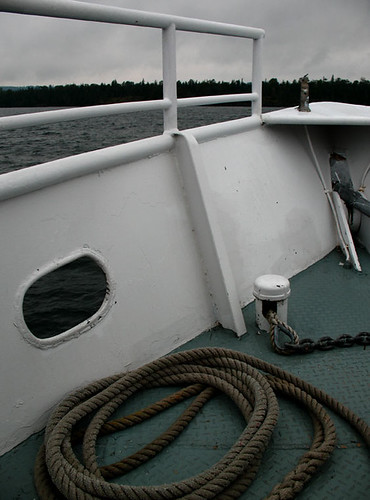
She was heading out the door, so I decided to go talk to her and check for vacancies. The dog’s friendliness was also typical of the breed. He dropped his ball and reared up to put his paws on me, a greeting that never fails to make me happy.

“Get down!” she yelled, but I really didn’t mind. “Can I help you?” she added.

“Are you getting ready to leave for the night?” I asked while crouching down to pet the dog.

“No, just making rounds to check ice machines and whatnot.”

I asked if she had a room available. She did and it would be $60. I quickly went through my options: sleep in the front seat of a small Honda or a bed with blankets and a pillow, shower or no shower, private restroom or find one in a gas station, extra alarm clock or rely on my unreliable cell phone alarm, a private place to change clothes or that gas station bathroom. It was an easy decision.

I put the key in the door numbered 17 and it popped open, unlocked and unlatched. It was a butterscotch colored room with two beds and a hot pink bathroom. The door would barely shut behind me and the curtains didn’t really close all the way, but it was clean (at least on the macroscopic level).

Another benefit to staying here, that I didn’t consider was cable television; I could watch Letterman, which I hardly ever get to do since I don’t have TV at home. His guests were the women’s beach volleyball gold medalists. It was clear I made the right choice in staying. There would be no regrets.

Click Here for Part Two >

Isle Royale and My Pilgrimage to See a Moose - Numbers 75 and 42 on my life list.

Download to Your Kindle (prc format)

Sometimes I reach up to feel the edge of my glasses to see if they are still on my face. On my drive home from work, I’m occasionally surprised to see that final turn without realizing I’ve already passed all the familiar landmarks. I know I am wearing underwear but I can’t feel it. My brain signals my consciousness only when there is a change; the repetitive consistently blocked out. There is an evolutionary advantage to disregarding the ordinary. It allows us to focus and react quickly to a dangerous or advantageous situation; but the shortcoming is that much of life is repetitive and thus ignored as insignificant. The result is realizing one day I’m 30 and can’t remember where all the time has gone. I can’t smell myself either, but I’ve been on a trail for a couple days as I write this, so I’m sure I stink.
One night, while my brain was trying to ignore an overdue chore called folding laundry, I stared at a mound of socks on my bed rolled into balls. Each ball of socks represented a day in my life. Looking at them piled together, I felt like someone with amnesia seeing unfamiliar photographs of themselves with smiling strangers. What did I do with all of these days? Where was I? It seemed like I just did laundry. I was troubled by the number of days now piled up on my bed.
The speed at which this particular year is traveling by is quite alarming. This is the reason I started a life list. The only way I know how to apply the brakes is to do something different, always be thinking of the next adventure, and strive to live in the moment.
Quieting the mind and living in the present is not always an easy task; I pretty much fail at daily actually. I find that it is effortless, however, when I’m alone in nature… and there is no better place for solitude in a pristine natural world than the island of Isle Royale, number 75 on my list.
Isle Royale National Park is a series of islands tucked away in Lake Superior about 15 miles off the shores of Minnesota and Ontario, although technically part of Michigan. This archipelago encompasses over 400 islands. All of which dwarf the main 45 by 9 mile island, Isle Royale, with 165 miles of trails.
Our more frequented national parks like the Grand Canyon and Yellowstone will see more visitors in a single day than Isle Royale will see in an entire year (approximately 20,000), making it the least visited national park in the United States. It is however, the most revisited park. Over 40% of first time guests will return; a statistic that instantly intrigued me.
Opting for a more spontaneous trip than usual, I didn’t do much planning. I wanted to be surprised. I didn’t want to do a lot of research and expect anything in particular. I did learn about the moose that live on the island however, and saw an opportunity to simultaneously cross 42 off my list, see a wild moose.
My goals were simple: go to an isolated island, hike, camp, lounge in my hammock, see a moose, live in the moment, and slow down the passage of time. How hard could that be?
I purchased my ticket for the Isle Royale Queen IV ferry, departing from Copper Harbor, Michigan, a month before this late-August trip. I left work a little early and drove north through Chicago just missing rush hour, then through Milwaukee while of course singing the theme song from Lavern and Shirley as I passed various breweries. Then I passed Green Bay, which somehow I don’t even remember but I know I did. My brain ignores a tedious drive as much as anything… and I do a lot of it.
After 12 hours of driving, stopping only once for gas, I arrived in Copper Harbor about midnight. I searched for the dock where I would need to be at 8 AM the next morning, then for a nice unassuming place to sleep in the car. I pulled into a motel parking lot located about 200 feet from the boat. It seemed closed, and I would be waking early, so I figured nobody would notice a strange man sleeping in his car. Then I saw a woman walk to the front desk with a Golden Retriever by her side, holding his beloved tennis ball. I’ve never met a Golden Retriever that didn’t share this peculiar love for tennis balls.
She was heading out the door so I decided to go talk to her and check for vacancies. The dog’s friendliness was also typical of the breed. He dropped his ball and reared up to put his paws on me, a greeting that never fails to make me happy. “Get down!” she said but I really didn’t mind. “Can I help you?” she added. “Are you getting ready to leave for the night?” I asked. “No, just making rounds to check ice machines and what not.” I asked if she had a room available. She did and it would be $60. I quickly went through my options: sleep in the front seat of a small Honda or a bed with blankets and a pillow, shower or no shower, private restroom or find one in a gas station, extra alarm clock or rely only on my cell phone’s alarm, a private place to change clothes or that gas station bathroom. It was an easy decision.
I put the key in the door numbered 17 and it popped open, unlocked and unlatched. It was a butterscotch colored room with two beds and a hot pink bathroom. The door would barely shut behind me and the curtains didn’t really close all the way, but it was clean (at least on the macroscopic level). Another benefit to staying here, that I didn’t consider was cable television; I could watch Letterman, which I hardly ever get to do since I don’t have the option at home. His guests were the women’s beach volleyball gold medalists, Misty May and Kerri Walsh. It was clear I made the right choice in staying. There would be no regrets.
The next morning my two alarm clocks annoyed me as instructed at precisely 6:30. After hitting snooze on both, followed by nine more minutes of blissful sleep, I rolled out of bed squinting and stumbled into the hot pink shower. I was soon clean and ready to go.
When I arrived, there were a dozen people already waiting under an awning, shielding them from the morning rain. The weather report called for showers on this morning only, so I wasn’t too worried. I got my ticket and loaded my pack onto the boat. As I waited under the awning myself, I checked out the gear of the other backpackers, eavesdropped on stories about their previous trips to the island, and watched the workers load several kayaks onto the ship.
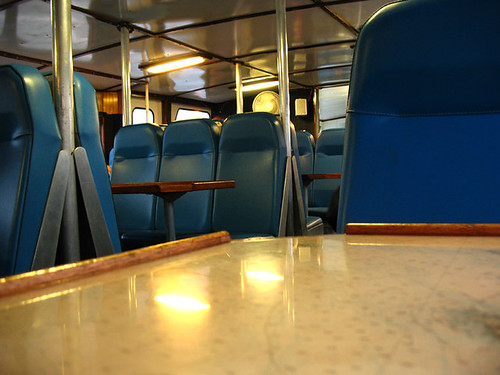
Once allowed to board I sat by the window at a table with four comfy blue seats. I knew the boat would be close to full and wouldn’t be able to keep my own table. I was ok with that, since most people were backpackers, I figured I’d get to meet someone that had common interests. Instead, however, a couple of about 18-20 years old asked if they could have the seats across from me. The girl painted in make-up was obviously interested in how she looked more than the other rough looking backpackers in the majority on the boat. Her boyfriend constantly yawned and rubbed his eyes. We didn’t exchange a word after “mind if we join you” and they soon fell asleep.
The boat was a couple minutes from leaving. What is this diamond shaped thing in my pocket I wondered, a keychain? My goldfish memory eventually kicked in and I realized I had forgotten to drop the key off at the motel front desk. I told a girl who worked on the boat the situation, pointed to the motel, and asked how much time I had. “Hah, none.” she said. “But if you hurry, you could make it.” The engines started to rev up. The 30 seconds to drop it off and get back on the boat turned out to be a blessing in disguise. I could now scurry past my shipmates unobserved, onto the stern’s deck outside, where I would spend most of the 3 ½-hour trip.
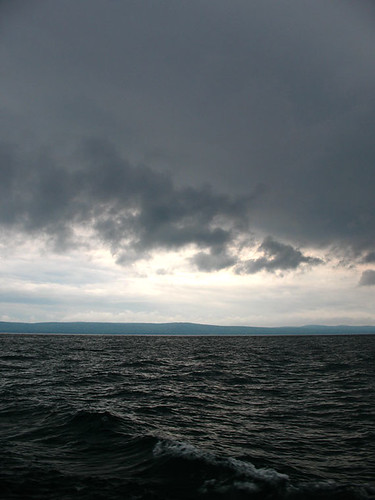
I leaned against the railing looking out over the side. Michigan disappeared. The horizon and Lake Superior was all I could see in any direction. It was cold. Every so often a chilly mist sprayed from windblown white-capped waves. I staggered to the snack bar, trying to walk on a surface that rolled and swayed, and bought a cup of hot cranberry apple cider to warm up. I moved onto the bow of the ship I stared at the horizon waiting for the island to emerge.


The voice of the captain occasionally bellowed out of a speaker to tell us some information about Isle Royale that we may find useful or interesting. He tells us that this year is the 50th anniversary of a moose/wolf study on the island. The populations of moose and wolves fluctuate like a set of scales. As the predator wolf population goes up, the moose prey population goes down. With the food source low, the wolf population goes down until the moose population is back up. That is a simplification but you get the idea.
He says there are 23 wolves in 4 packs and 650 moose on the island; a low number for Isle Royale but still almost ensures I’d see one. I’m not sure why I like this animal but I think it just conjures up images of the Alaskan wilderness and boreal forests that I love so much. He tells us the story of a moose that ventured into a campsite drawing the attention of excited backpackers. Wolves came into the camp and attacked it. The moose tried to flee by jumping in the lake but drowned. The wolves pulled the body back into the camp and begun devouring it, in front of some, I assume now, horrified, perplexed, shocked, disgusted backpackers. Since it was disturbing people, and the wolves would be there for a while feasting, they evacuated the area. A week later, the pack finally finished their meal and, umm, lived happily ever after? I looked around at the other passengers and confirmed that they had the same, “what the hell?” look on their faces that I did. I’m not sure of his point to the story, but he seemed to enjoy telling it. I’ve read several times that wolves are no threat to humans. After his story, I started to question my sources.
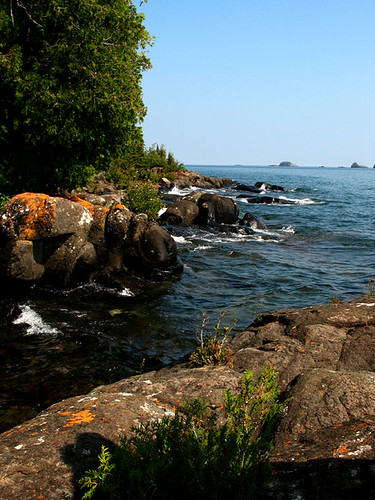
Finally, Isle Royale appeared in the distance. Waves crashed on its rocky shore painted with bright orange lichens. The forest looks like those you expect to see in the north with conifers like white spruce and balsam fir and younger deciduous trees like birch and aspen. There is a good reason for this. Isle Royale is just barely at the southern tip of the Boreal forest, rarely seen in the lower 48, that covers millions of acres in Alaska and Canada.
There was a quick orientation and backpacker registration with Ranger Marcia before heading into the wilderness. I could tell she had a love affair with this place. She seemed like the type that would head off into the woods alone during off-hours and eat edible plants and berries along the trails. I could picture her finding a rock with a good view to sit and write poetry about how she feels connected to nature, complete with metaphors that give the island human-like traits. She seemed like my kind of person.
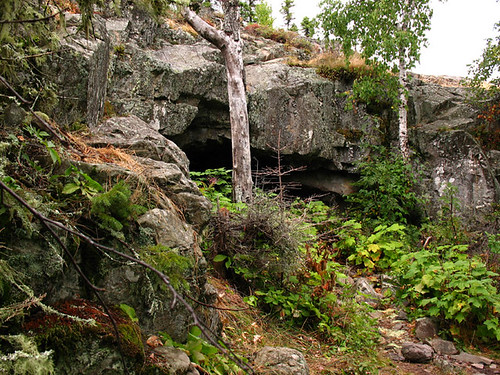
I decide to head to Daisy Farm campground just over seven miles away. My first impression of the trail running along the shore was that it seemed meticulously landscaped by dozens of hired hands. The placement of large and small-leafed plants, moss covered boulders and bedrock, wide assortments of wildflowers, edible thimbleberries right at arm’s reach, were all under a canopy of trees that seemed to flow with the trail just as it should with nothing out of place. This was especially noticeable in places I decided to stop for short breaks, like at Suzy’s Cave, and along Lake Superior’s rocky shoreline.
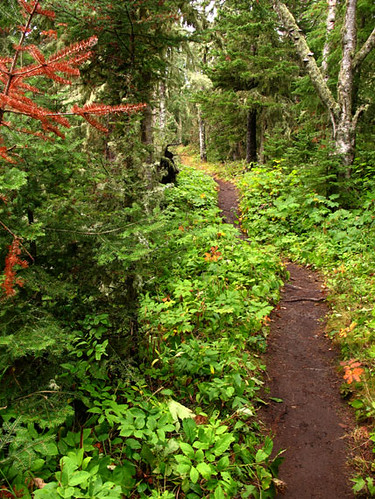
I picked several thimbleberries along the trail. I got somewhat addicted to them. They look like raspberries and the taste reminds me of pomegranate. They get their name from the shape. They kind of look like thimbles on the ends of your fingers, but they look more like little red berets to me. I put them on my fingertips just like when we’d put those pointy Bugles snacks on our fingertips as kids. We’d pretend they were witches nails, and walk around with our hands up near our face, fingers curling, cackling, and saying things like “I’ll get you, my pretty, and your little dog too”. I hope readers can relate to that story, otherwise, I’m afraid you may all think I’m just weird.
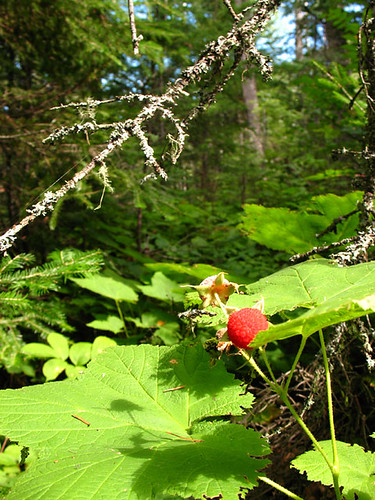
Anyway, if you still don’t think I’m weird, once my index finger had on a red beret, suddenly I imagined it had a French accent as well (I really didn’t have a choice, it just happened.) Beret Wearing Index Finger doesn’t care much for vile, despicable, American scum. Beret Wearing Thumb tried to do a ‘Rerun from What’s Happening’ impersonation but all he knew to say was “Hey, Hey, Hey!” although I’m not sure that was Rerun’s catchphrase on the show, but I kept my comments to myself. Beret Wearing Pinky just incoherently yelled things like” Viva La Revolucion!” but nobody paid attention to the pinky. They never do. This just fuels his desire for revolution. I was eating them so much that my fingertips were dyed red, the sign of true addict. This dialogue only took place in my head. Does that make it less odd?
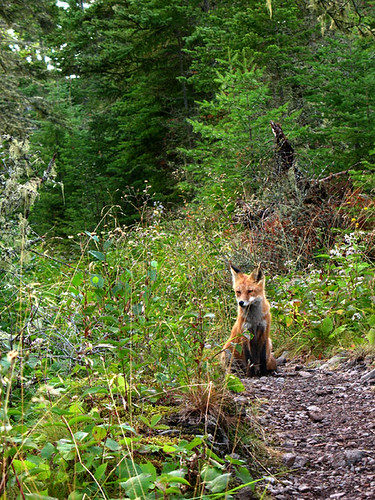
Nearing Daisy Farm up a slight incline, I encountered a nonchalant red fox standing in the middle of the trail. He stood there staring at me. I quickly got out my camera to take some pictures. Not concerned in any way he just sat down on the ground, looking around in different directions, almost as if he was posing. After eight or more photos, he remained unmoved. I wouldn’t have been very surprised if after finally putting my camera away he said, “Ok, now that I have your attention please answer me these riddles three and you may pass.” As another noisy group started to approach behind me, he strolled away from the trail and slowly out of sight.
I arrived at Daisy Farm and found only one site unoccupied. I was lucky since the next site was four miles away. I unpacked, ate a quick meal (including some thimbleberries that were growing nearby), and relax in my hammock under spruce needles and birch leaves. Even with the crowded campground, the sounds of screen doors from shelters and pit toilets tapping shut, and the sound of mumbling and laughter, it was a peaceful night. The young couple from the boat walked by three times, searching for an open spot. I thought I would once again hear him say, “Mind if we join you?” Luckily, I did not.
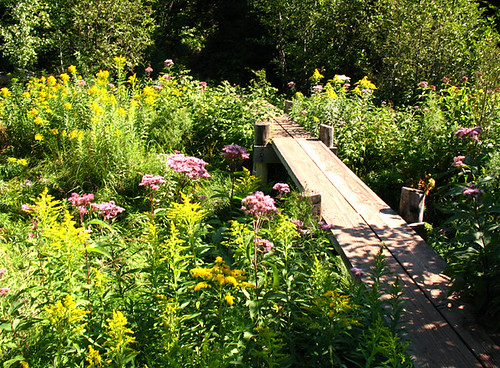
The night was in the upper 40s and remained chilly the next morning as I repacked my gear. McCargoe Cove, 10 miles away, was today’s planned destination. I walked along a 12” plank raised above the ground, with beautiful wild flowers on both sides. I didn’t hear the buzzing until I was right in the middle of it. Bees surrounded me. It was like being in an apiary without the benefits of a beekeeper outfit. I didn’t think they would sting me. I just kept walking through it. My naivety will one day be the death of me.
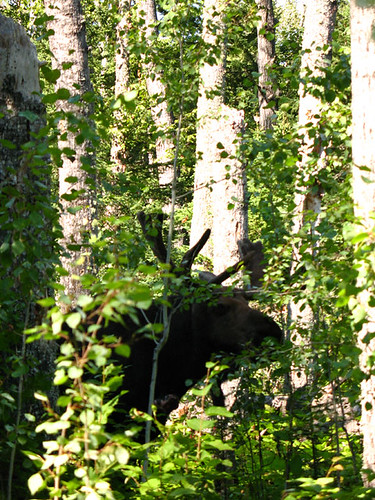
So far, my pilgrimage to see a moose was unsuccessful. I worried that I wouldn’t see any. Then somewhere between Lake Richie and Chickenbone Lake, just a few yards on my right, I hear a loud exhaling grunt that could have only come from one of the half-ton beasts. I was temporarily startled but drew the camera from my side pocket like Wyatt Earp. I walked along fallen trees to get closer, balancing myself by reaching for nearby trunks and branches. He was grazing, preparing for winter, so says Ranger Marcia. His massive size and huge rack made me feel very trivial and fragile. His movements were unhurried, living in the moment. He grabbed branches between his teeth then slid up stripping it of leaves. It was fascinating to watch. With great satisfaction, I mentally cross off #42.
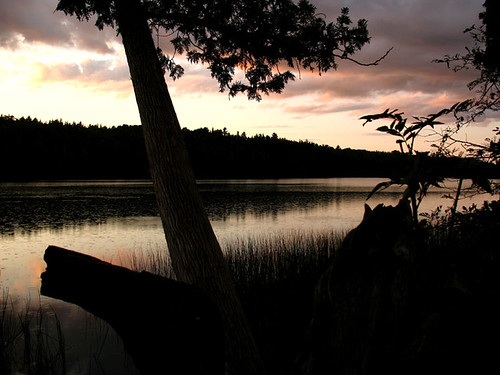
I picked a site at Chickenbone Lake to stay for the night. I didn’t get to McCargoe Cove, three more miles away. I was ready to rest and after seeing the moose, I wanted to stay in the area to increase my chances of seeing more. Moose don’t like hot weather. They don’t get cold until about minus-25 degrees Fahrenheit, so I figured they would frequent the lake to cool themselves. After surveying the site, I found a few moose tracks and many paths leading toward the water. I was certain I’d be successful. I set my alarm for 6:00 am. I’d hunt early, camera in hand.
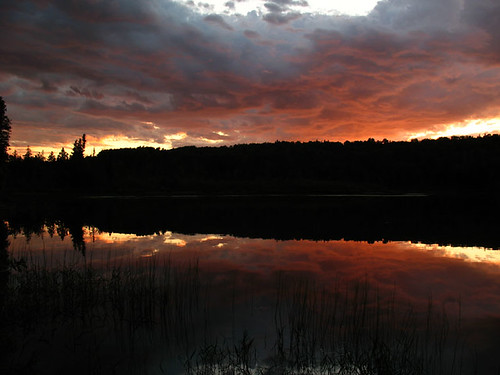
Logs and rocks surrounded a large boulder, which I used as a table and chairs to prepare dinner. While I ate, and for the rest of the evening, the periodic cry of the loon, followed by an equally long echo, lifted my spirits. Shortly after, it started to rain. I quickly grabbed everything and put it in the tent and under the rain fly. It cleared up as quickly as it started but would return a little while later. I moved to another large boulder that was a couple of feet out into the lake. I sat watching droplets from the slight drizzle collided with the still water. The light reflecting off the ripples looked like thousands of fireflies swarming on the surface.
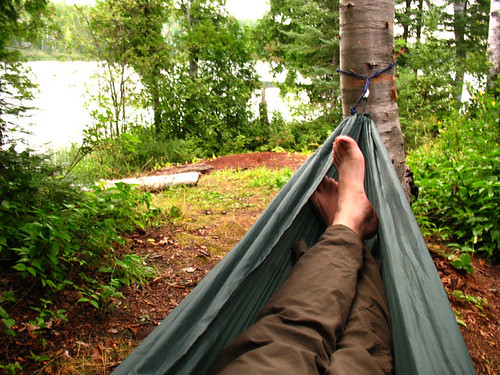
Another reason I stopped three miles before reaching McCargoe was that I didn’t want this trip to be about completing as many miles as possible. I wanted time to relax by the lake, sway in my hammock, and read. Aside from the few intermittent showers, it was a perfect night to do so. The storm clouds moving in reflected many warm hues from the setting sun, creating a dramatic and menacing sky.
I am a hammock-based sloth with nothing to do, nowhere to go, and no one to answer to. Finally, I’m beginning to have the frame of mind to answer some, often ignored, but important questions. That is, questions that keep me in the here and now: what is going on around me, what sounds have just entered my ears that I am ignoring, what is my skin feeling, am I paying attention.
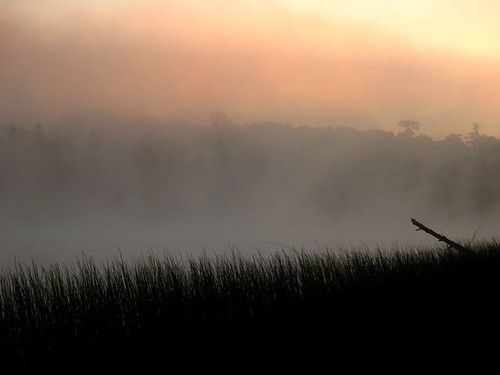
At first light, my stealthy moose search began. (I’m excited to be able to say that.) I crossed over moose-created paths and over puddles from moose-created footprints. It was chilly, about 47 degrees. A thick fog was drifting across the lake reflecting a peach sky. A river otter was enjoying an early morning cold swim, but no moose. I went back to camp and lounged in my hammock listening to the early birds. Their songs are a little different this far north. “Burlap, burlap.” “Tweep, tweep,” some birds said with crazy northerner accents. I moved back to my cozy tent and sleeping bag to warm up. Apparently too cozy, I slept for an additional four hours. The day started late. I didn’t get on the trail until 1:30 and I had over 13 miles to travel. I intended to start at a decent time, so much for that.
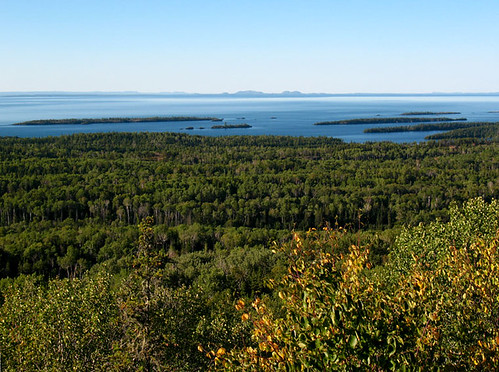
My next target was Lane Cove via the Greenstone Ridge Trail. It was rougher and didn’t look as manicured as the previous trails, but the views were amazing. As I got to the top of the first overlook, I was stunned. My tense body slumped as I exhaled a “wow”. I had no idea there would even be such views or that the ridge would be over 1,000 feet high. There is something to be said for under planning and letting yourself be surprised. (Pictures can’t do it justice.)
I could see many small islands out in the lake and a hazy Canadian shore. I joined a fellow hiker and sat on the edge of exposed bedrock with my feet hanging over the side. He was on day 2 of 16. We talked for a few minutes. He wasn’t carrying a lot of food but would go fishing each night to catch dinner. He gave me some information about the trip to Lane Cove and continued on his way. I stayed there for a little while longer to take it all in. I knew I didn’t have a lot of daylight left, but to hell with deadlines, I have a headlamp.
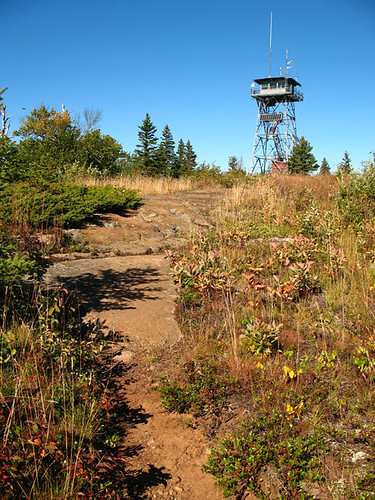
This was not the only excellent lookout from Greenstone Ridge. Much of the 10 miles I spent on it today were in view of the Lake nearly a thousand feet below. I climbed the fire tower on Mount Ojibwa, trying to get as high as possible, and took a few photos. I could see the Rock Harbor lighthouse, over a mile away. I was beginning to fall in love with this place. A couple of generations ago many people fought long and hard to turn this into a national park, to protect it from overfishing, logging, the building of resorts, and other financial exploitations. I now sensed a connection with those people. I understood. I would have been fighting alongside them.
More trails of that seemingly landscaped splendor was back on my decent to Lane Cove. I was exhausted, however, and the mosquitoes were bad so I was beginning to get a bit frustrated and ready to be finished for the day. Everything was moist and covered in a thick green moss. Sage green lichens draped Birch trees. Long foot-wide planks occasionally raised you up off the wet ground to both keep you out of mud and to protect the land below.
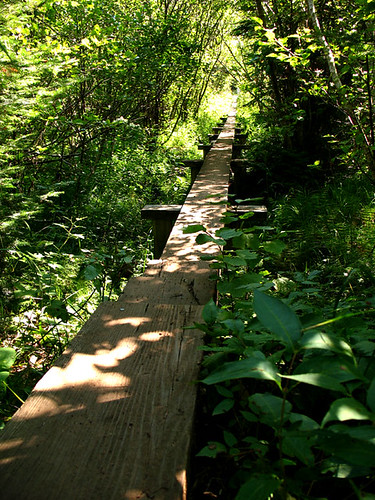
A particularly long 50-yard stretch of these boards was about 2 feet off the ground. A heavy pack feels like it will pull you down if you lean to one side too much. That combined with a nervousness of falling and the constant swatting of mosquitoes, I felt like I was on a Japanese game show. I could hear the announcer in my head as I walked across. “Alright and he’s off, over the balance beam, crossing the stagnant water pit of snakes, uh oh he’s crouching down to take a picture of a pretty S-shaped snake laying in the water, a potentially devastating choice as this could compromise his stability, there’s a massive hit on his right by the mosquito swarm, that frantic swatting is going to cost him his sense of balance, but wait a minute, he’s back up and he finishes in record time! Stay tuned for more Super Happy Joy Fun Show!”
The mosquitoes were so annoying. I began referring to them as skeeters, which is now the derogatory slur I’d use when wanting to intentionally show them disrespect. I was constantly smacking and swatting at them. I really don’t like killing anything. I don’t even kill insects in my house. Some I give sanctuary, others I carefully pick up and set them outside in the safety of a bush. Nevertheless, with mosquitoes I got a definite sense of satisfaction when killing one. Sorry skeeters, but nobody likes you. Even myself, and I love all living things.
After arriving at Lane Cove the mosquitoes were mostly gone, the frustration instantly eroded, and I was thrilled that I chose to hike the extra two and a half miles to get here. The site was right up on the cove and the view angled towards the opening into Lake Superior. The water was shallow for several feet so provided plenty of room for wading and rinsing off. I set my gear down, put on my water shoes, and headed into the lake.
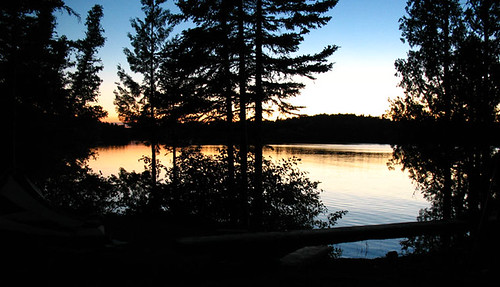
The water was very cold. Superior is always cold. The average yearly temperature is in the 40s or 50s. It was a bit warmer now however, but probably only in the low-60s. I walked out until I was thigh deep and started to shiver, but it felt great. I hesitated due to the cold but I wanted to be submerged. Before I could think about it too much, I held my breath and went under. It was at first exhilarating. I became acclimated just enough to tolerate it but never fully. I swam further out. My head popped above the surface while treading and I breathed air into my tightened lungs with short, almost hyperventilating breaths. Obviously, I’m not use to this.
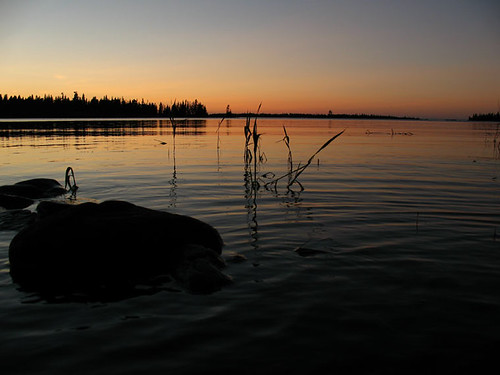
I went back under and moved to shallower water so I could stand. I took a few more breaths, went under again, and swam towards the shore until my hands and knees were grazing large fist sized rocks on the bottom. It felt incredible. A cold swim after a few days of backpacking under a layer of sweat and grim is one of life’s most invigorating moments. I rolled onto my back then to a sitting position for a couple minutes before I would go dry in the sun.
There wasn’t much daylight left so I started to prepare camp. Periodically I’d stop to admire the sunset. After finally making myself at home, I laid on my back on a bench made of a large log planed down so it was flat. My head rested on my hands with fingers intertwined. I realize that the rush of the day is not for me. I wish I had gotten here earlier. My previous treks have been too hurried, this day included. That is not why I hike, not why nature draws me in. This was it, this simplicity, this kind of moment. Am I paying attention to it?
I look up at the sky and it reminds that in over four billion years it has never looked exactly the same way. The clouds arranged in this particular combination of shapes and colors, moving in this particular way, will only exist at this moment and never again. I wish I could always remember that when I need to slow things down, live in the present, and see something new I simply have to look up.
I roll over onto my side, hand now propping up my head, occasionally scribbling in my journal. I concentrate on the feeling of tall grasses touching my skin, the smell of dirt, and start to see just how much is going on all around me. Paying attention to the little things I normally block out is another way to slow things down and to live in the moment.
Over green chlorophyll and soil, an insect is living out his days with a struggle, drama, and determination that I cannot even imagine. It’s common to see the plants, not as living things, but as lifeless as gravel or mud, even though we share DNA. If they moved at a faster time-lapse pace that I could easily see, turning their leaves quickly towards the sun and roots slithering under our feet, how different would they seem? Would I give them personality? Would I talk to them and give them names? Would I think twice before picking a flower?
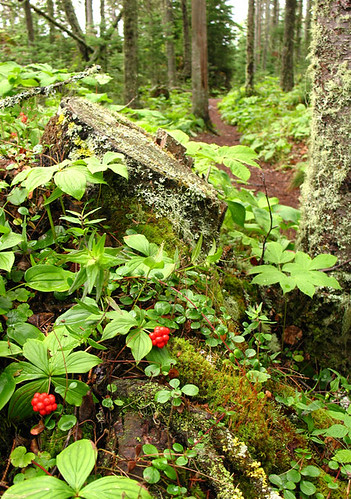
The diversity and cooperation between plants on the island is also admirable. There are species that wouldn’t ordinarily be able to survive on Isle Royale due to its poor soil quality with low levels of nitrogen. Some species of plants however, convert the nitrogen in the air, putting it into the soil in forms they can use to survive. Below me, even though I can’t see it, I know this overlooked world exists buried under several tons of dirt, roots, stones, bedrock, and water, churning away unknowing and selflessly keeping everything alive and growing here on the surface.
Just as important is the microscopic life, which is so abundant that if everything we can observe with the naked eye were to disappear, we would still see ghostly outlines of it constructed out of trillions of bacteria and nematodes. The lichens covering the trees and rocks look like a single organism, but are actually comprised of fungus with algae or cyanobacteria, or both. The fungus provides structure and nitrogen allowing the algae or cyanobacteria to photosynthesize and provide food for the fungi. One would not survive in this beautiful form without the other. Lichens are fungi that discovered agriculture, as one lichenologist put it. This delicate cooperation illustrates both the strength and endurance of the island but also the fragility and teamwork required to maintain it.
So much of this activity is going on continuously, and yet, I typically fail to pay attention to it. It’s a magnificent world and largely ignored in the course of the average day. An essentially useless dollar bill unclaimed blows across a parking lot, and most of us will go out of our way to chase it down. At the same time fail to see the priceless things always around us, each one blocked out as repetitive and insignificant.
The sun was now set, the clear sky still a bright but now darkening blue. The absence of moon and city light made every possible star visible. Periodic breezes hissed through the pines and water gurgled against the rocks on the shore. This is the time of my life.
SMACK, the sound of another dying mosquito. “Thought you were going to bite me huh? Skeeta please!”
I moved to my tent to be away from them, so they wouldn’t take away from this moment. I sat up late reading and writing. Occasionally I’d lie on my back to gaze up at the unusual amount of stars that I normally can’t see at home. Complete darkness is something I forgot how to appreciate.
The morning was chilly but no jacket needed. I ate breakfast, read, and again listened to the loons and other birds. I packed up camp slowly, paying attention to the quality of my actions. I cleaned every piece of gear unhurriedly before carefully packing it away. I accomplished another one of my intended goals. Life was moving at a snail’s pace.
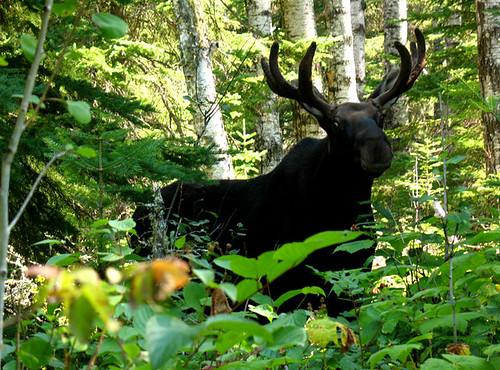
I decided to go back to Rock Harbor, where my trip started, for my final night. This would put me just a couple hundred yards from where I could rent a kayak for Monday morning. Heading out of Lane Cove, back over balance beams and through clouds of bees, I was hiking along with my head down. I stopped suddenly when I saw two enormous moose in front of me grazing. I don’t know what a safe distance is to be away from a moose but I was certain this wasn’t it. I, of course, grabbed my camera and snapped about a dozen pictures of the closer and slightly smaller moose to my left. It crossed the trail a few short yards in front of me. I could see sores on its hind legs that looked like bite wounds, fresh bite wounds. Did he escape from certain death nearby? Where wolves still close? I really didn’t think about that much. I was too excited about the photos I was getting and mesmerized by its size and closeness.
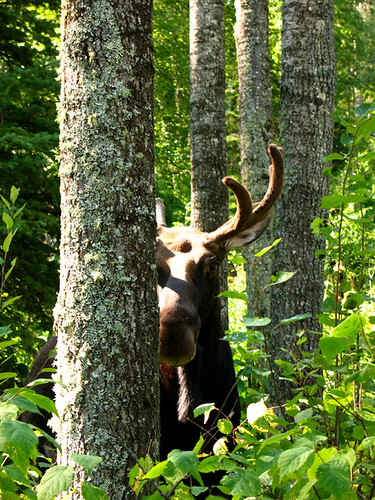
I moved towards the larger moose further up the trail. He wasn’t facing me and didn’t know I was there. I creeped forward but still spooked him when he heard something behind him. He darted about 10 feet then must have realized I wasn’t a threat and went back to eating. The commotion however startled the first moose, which had now turned to face me and seemed to move slightly forward. This may have just been my imagination. His faced seemed to have a concerned fearful look. Fear leads to anger, anger leads to violence. The kind of violence that makes you just want to headbutt an idiot with a camera. I backed away slowly but continued taking photos like those tourists in Godzilla movies moments before their death.
I learned later that moose can be very aggressive during mating season, but that doesn’t start until late September. This was early September so clearly nothing to worry about. Again, my naivety will one day be the death of me.
With such a wonderful night and being right in the middle of the moose’s world I was on a naturalist’s high. I don’t even know what that means. I just know it doesn’t get any better than this, at least not so far.
Since I was in a hurry the day before, I walked back up to Mt. Franklin to sit and enjoy the view from 1,080 feet without feeling rushed. Several people came to check out the view, take a photo, and left quickly. I remained. I knew once I headed back down it might be the last I’d get to see it. As a result, it was hard to leave.
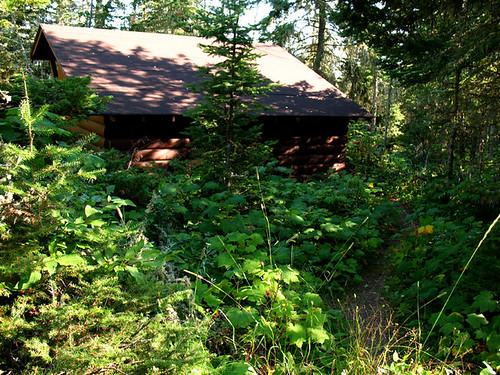
At Rock Harbor campground, I expected to see it crowded and full of activity, especially since it was Labor Day weekend. Other than the side with the restaurant and lodge, it was the opposite. I pretty much had the pick of whichever site I wanted. I choose to stay in one of the shelters. An empty 10 x 15 foot space, with one wall, made entirely of screen, facing the forest and a picnic table out front. Writings and drawings covered the walls and ceiling inside. There were signatures, poems, short reports about experiences, testimonies, and commentary. One thing was clear, even those who wrote about bad experiences from weather or failed gear, they all enjoyed their stay and wanted to come back.
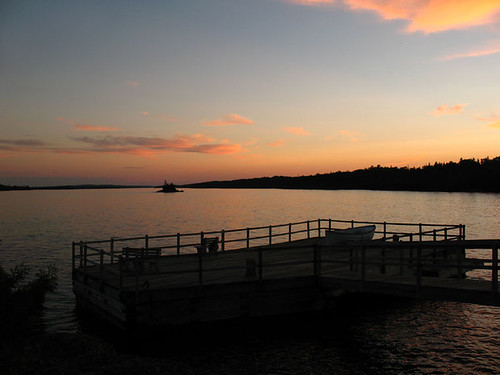
I left my gear behind and went to check out the slightly more civilized part of the island. I felt out of place. I was a guy from the woods who has been drinking water from the lake and lying on the ground. They were drinking wine on a patio. It’s a very small section but where most people congregate. I thought about getting a meal at the restaurant but turned down the $35 cost. Instead, I walked down a trail and discovered a deck with benches angled towards both the sunrise and sunset. I hung out for at least a couple of hours. A few other people where there too, but all had left before the sun completely set. I stayed, happy to be alone.
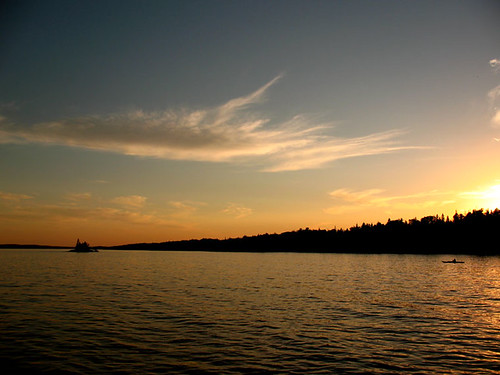
Daylight faded like a retractable roof revealing the cosmos. The smell of campfires started to waft over in the breeze. The first point of light to emerge was Jupiter, then Vega, the Big Dipper constellation, the Northern Cross, Cassiopeia, and a small handful of other stars light years away. Soon thousands of others followed. The sky was full of them and yet I can still only see a fraction of all that exist with the naked eye. There are hundreds of billions in our galaxy alone, which is one of hundreds of billions of galaxies. There are more stars in our universe than grains of sand on all the beaches on earth. Nobody ever believes me when I say this but it is true; ask any astronomer or statistician (if you can find one). I cannot help but wonder how many of those stars hold planets in their gravitational grasp. How many of those planets support life? What color are the plants where their entomological dramas unfold?
Light emitted from these stars takes years to reach my eyes. In fact, the stream of light from each star left at different times, so every twinkle that I see represents a different moment in history. The light from Vega, which I can see now, left its source in about 1983. That’s before the Cosby Show and the creation of Alf. Think about it.
The ancient light from Mu Cephei started its voyage towards earth while humans were entering the Bronze Age, fighting wars with copper and bronze weapons, constructing Stonehenge, and for the first time using ploughs, pottery wheels, and interestingly astronomy itself. It is a journey so long that when it finally passes by, I am not using copper for weapons anymore, but in the circuitry making it possible for me to later Google this information about the 4th century B.C.
The Andromeda galaxy is just a pale white point of light to the naked eye. That beam’s voyage is so old that pre-human hominids were tramping over the same planet, which I now lay, with the first primitive stone tools ever created. Now here it is colliding with my retinas and registering in my brain not as just another pale light from far away, but conjuring up feelings about my life of both insignificance and precious rarity. Reminding me that whenever I am taking my life too seriously and need brought back down to earth; I once again, simply have to look up.
I wish I could hold onto these moments always. Permanently slow things down. A rushed life finally unhurried. Regrettably, I know it will not last forever; but thanks to a love of the natural world, I will forever know that at any time I can get it back. Even in the realm of the known, without making up fantastical and magical stories, the world can be seen as fascinating, miraculous, and enchanting; and should above all, never be seen as repetitive and boring.
I had to put on my headlamp to see the trail for my hike back. When I was near the resort’s lights, I temporarily turned the lamp off and strolled with my head still pointed towards the sky, which caused me to veer off the trail and nearly trip. I just couldn’t keep my eyes off it. This was my last night; I had to take it all in.
I woke up early the next morning to watch the sunrise for one last time over Lake Superior. I went back to the deck. I expected to see others enjoying the view but I again had the deck to myself. Only this time, I sat on the east-facing bench. I didn’t leave the bench until the sky reached its peak of red and orange.
A couple of hours later, I was renting a kayak for one final adventure before boarding the Isle Royale Queen IV once again. I spent four hours circling Tobin Harbor hoping to catch another glimpse of moose. I didn’t see any but I did see two loons. I tried closing in on them to take a picture but as I approached, they would dive underwater for a minute or so and pop back up in another location, like real life whack-a-moles. They made me look like a fool as I paddled back and forth helplessly.
I passed by several small islands some inhabited by people staying in cabins. I tried to paddle closer to two ducks, sitting on a log floating in the lake. I hoped to snap a quick picture, but before I could get close enough their fight or flight instinct kicked in and they flew away. Just once, I want a duck to choose fight. That should keep things interesting. If nothing else I’d find out what I’m truly made of.
I took the kayak back to the beach and returned my paddle and life jacket. I still had over two hours left on the island and decided to go on the harbor walk with a small group lead by Ranger Marcia. I learned about useful and edible plants that I wish I had known about before the hike. Most notably a small feathery plant that is said to relieve the itch of mosquito bites if rubbed on the skin.
When we returned from the informative walk, they were loading gear and kayaks onto the boat, a long row of passengers lined up along its side. I wasn’t anywhere close to being ready to leave but I didn’t really have a choice. I sat again in the stern of the ship and watched as Isle Royale faded away, a depressing sight.
When we docked at Copper Harbor, I got back into my car and drove straight through for 13 hours. I was surprisingly wide-awake for almost the entire time. Then driving past Fort Wayne, less than 40 miles from my house, sleep deprivation started to set in. I was starting to hallucinate, and more than normal. I occasionally imagined that something was running out in front of me. One looked like an 18” tall Sasquatch, although I’m fairly certain it wasn’t. With only 15 miles to go, the road appeared to drop off on the left side until my lane looked like a plateau on a ridge overlooking a shear drop off. I couldn’t take it anymore. This was not good. I stopped at a gas station and slept for an hour. I woke up suddenly, feeling like I had just fallen asleep for a moment, and finished the last 15 minutes of driving.
It didn’t take long to find myself back into my routine, but Isle Royale will forever be a special place to me, a significant part of my timeline. I already want to plan a second trip but I have too many other things on my list to do. It’s not a Yahtzee; you don’t get bonus points for doing it more than once. Nevertheless, there is something unique about this place. It’s the most revisited national park in the country and now I know why. I think I’m going to add, ‘Circumnavigate Isle Royale in a kayak’ to my life list. It would still be a new experience and an excuse to return.
All life is, is the present moment and a collection of memories from past moments. If I fill too much of my past with those repetitive, ignored memories and am not living in the here-and-now, then it’s no mystery why time is flying by. I used to spend my vacations at home, or close to it, thinking I couldn’t afford to do the things I wanted to do. I was wrong. (This trip was just over $300, including gas.) I have no good excuse for staying home. Life is too short and too important. These 6 days will never be forgotten, blocked out or ignored as insignificant. Every detail will be with me forever.

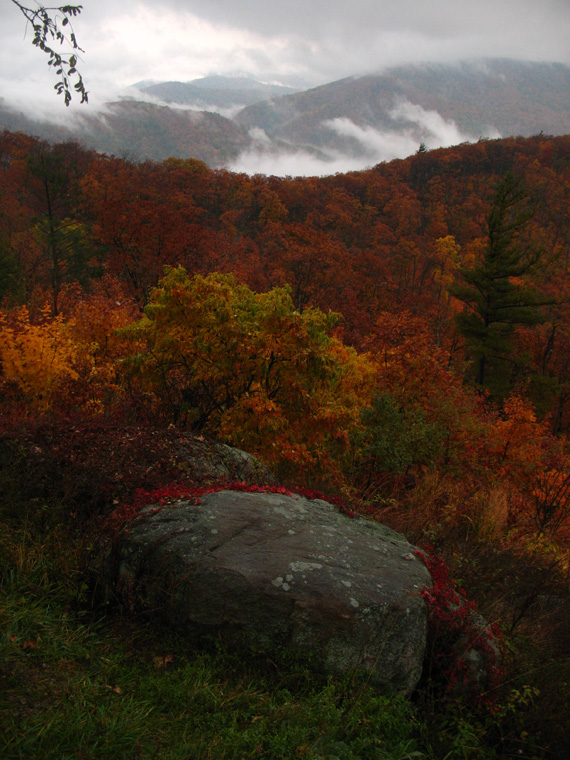
The Knobstone Trail, Part Four - Number 69 on my life list.

Part Four 
Go to Part 1, 2, 3, 4

I woke up in the middle of the night and, for just a moment, I felt like I couldn't move my legs. I thought for about two seconds that it was another episode of sleep paralysis; where you are conscious but an ill-timed disconnection between your brain and body prevents you from moving.

I realized quickly that I was just extremely stiff. I had never been so stiff in my life. The next morning I spent several minutes stretching and felt amazingly better. I felt so good that I couldn’t believe how I felt the night before. 

After another couple of miles going down into shaded valleys then back up again on switchbacks, I came to Elk Creek Lake. The sky over the lake made for an appealing photo opportunity so I stopped briefly at an established campsite, that was right next to the water. I passed many ideal campsites like this, but they were never there when I was ready to stop for the night. If I do the trail again I’ll adjust my mileage to change that. 

It had been over two days and I hadn’t spoken a word since the couple of sentences to the father and son I met just after mile six. Never was this more evident than when a toad crossed my path and I greeted it. I tipped my hat and nodded but the word "ma'am" only came out as a hoarse whisper. Perhaps not talking for a couple days also causes me to do peculiar things; like properly greeting a toad, that I presumed was female, in much the same way a 19th century cowboy might have greeted a woman passing him while exiting a saloon. 

At about mile 33 I passed another backpacker and shortly after a gray-haired older man who I assumed was his father or grandfather. As the old man met up with us he fell but got back up quickly. I asked if he was alright and they both ignored the whole situation like it happens a lot. I figured he was about 70 years old. He looked like he has had his share of adventures and hard work. Kind of rugged looking and showing his age but at the same time seemed youthful and spry.

One day he said he heard about the KT and decided, "I’d like to try that." The younger man who was with him asked if he wanted company, so, they went to buy gear and headed out for their first backpacking trip.
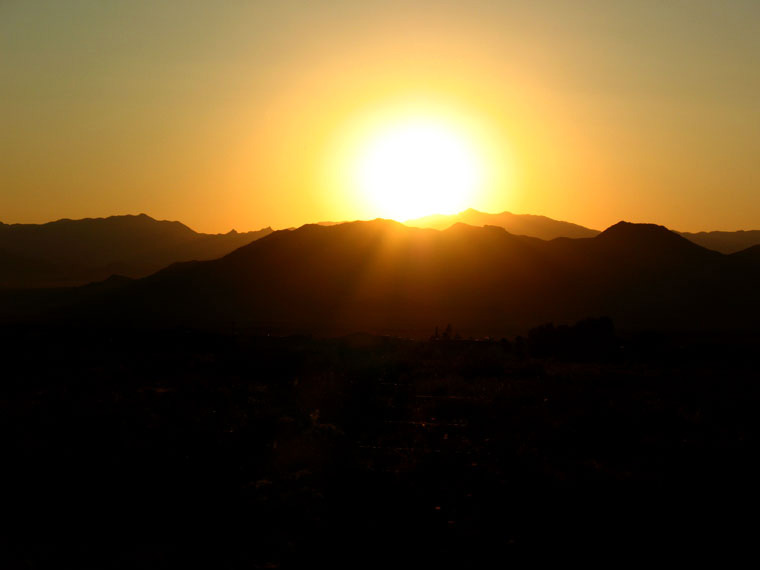
"You picked a tough trail to be your first", I said unnecessarily since they had already figured that out. 

“So you do this a lot?” the old man asked. He didn’t say it but the look on his face and his tone suggested that his next comment might have been, “are you nuts?” I asked them if they planned on thru-hiking. He said that was the original plan but wasn’t sure if they could finish. 

They had hiked thirteen miles since Saturday afternoon and as I was about to find out it was a tough thirteen miles. In my opinion, whether he finished or not didn’t matter. What did matter was that he was still searching for an adventure. I hope that I find that spark of courage to accomplish something new in my later years. 

We exchanged some information about what was coming up for each other on the trail. I told them of the easy section around Elk Creek but also warned them of the exhausting terrain that would follow. We went our separate ways and the old man turned to thank me for the information. 

When I'm hiking I like that my mind wanders and I occasionally have an interesting thought or remember some repressed memory that I hadn't thought about in years. One childhood recollection in particular made me want to be at home sitting in front of a fan on high, eating cereal, and watching my copy of the Karate Kid on VHS. 

As the day went on, my thoughts weren't as nostalgic and certainly not interesting. That afternoon I was thinking of the lyrics to the song ‘Ironic' by Alanis Morrisette and how nothing she says in it is actually ironic by definition, coincidental maybe. Technicalities aside, I couldn't get the song out of my head. It really isn’t necessary to say, but, I was running out of things to write about in the little black journal I keep in my back pocket. 

I was six miles from the finish and decided I wouldn’t be stopping for a third night; but instead would push through the final stretch. Partly this was due to the tick problem. I wasn’t able to lie on the ground or sit up against a tree and enjoy the simplicity of it all like I normally would. I could only focused on the tiny legs of ticks and mosquitoes and very small insect mouths digging in to pilfer my hard-earned blood. 

Also, I had eaten all of the appetizing food left in my pack and had no desire for the other foods that I would need to retain my energy level. I had only eaten about one-fourth of the calories I should have and I started craving a fast food cheeseburger which I hadn’t eaten in years. After a while the taste of the water from the streams became less exceptional and was starting to be hard to swallow. I’m not exactly sure why. Maybe it’s time for a new filter. It was hard to keep down so I was only drinking enough to not get dehydrated.

Every stream I passed was extraordinarily refreshing to see and hear, but not to drink, which made me even thirstier. Whenever I heard the sound of rushing water I wanted to dive in. I stopped at one stream that was deep enough to stick my whole head into, which wasn’t all that common on this trail. Some salamanders, that had already claimed the spot, were somewhere between their hatching day and emerging from the water to test out there fancy new lungs. Their feathery gills still remained, along with four legs with toes all sticking straight out from their sides. They wiggled towards the protection of the roots of a tree while I got down on the ground to put my head in the water. 

I relished the feeling of being on the ground with my hands on the rocks, getting dirty and not caring, while the cool water surrounded my head. After hiking for three straight days without a shower it was the most refreshing thing in the world. You might be contemplating something right now that you think is more refreshing, but you'd be wrong. This is the most refreshing thing, trust me. 

One of the final sections of trail was through a forest of towering pine trees on a path of brownish-orange dried pine needles that contrasted the bright green foliage on each side. White moths fluttered around me creating a especially peaceful atmosphere that felt much different than the rest of the trail.

After some trouble getting around two large fallen pine trees and emerging on the other side with a couple of scrapes, I had a choice to make. Towards the end of the trail it does a loop for those who want to do a short section that begins and ends at their vehicle. I could take the long way and do an extra mile or take the shorter but more difficult route. I decided on the shorter but harder section and after one more final climb I got back to the car. I could see its green paint between the green-leaved branches of the trees. It was such a sight for sore eyes.

I was thirsty, hell-bent on eating a cheeseburger and ready to rest my now very sore left foot. I stopped to take a photo to mark the end of my journey and immediately drove to a soda machine that I knew was next to the showers at the campground. Luckily it had something other than soda. I don’t drink soda, but probably would have in this case. I grabbed a dollar from my wallet but the machine wouldn't take it. Isn't it coincidental? Don't you think? It's like rain on your wedding day. Uh, that song was still in my head.

I turned on my “Songs From Quentin Tarantino Films” playlist and headed out of Delaney to the theme from Pulp Fiction. It seemed a good fit to the end of my short but exhausting expedition. 

I drove into Salem about sever or eight miles from the campground and, after a few minutes, found a Wendy’s. I stared at the menu for a few seconds at the selection of cheeseburgers. From left to right each burger got larger and less healthy than the one before it. I settled on the largest greasiest most unhealthy in the bunch. A double cheeseburger with a half pound of beef and several strips of bacon. I knew I wouldn’t have another one for a few more years if at all so I ate it slowly and enjoyed each bite to the fullest then washed it all down with 32 ounces of lemonade… it was glorious.

When I arrived at home I didn't bother taking my gear inside. I opened my fridge and guzzled every ounce of liquid I could find. I headed upstairs and crashed on my bed with my aching feet propped up on pillows; not waking up once for the next 12 hours.

On my backpacking trips, I come back with a new appreciation for things that would normally seem mundane. This one was no exception; namely cheeseburgers, lemonade, showers, a tick-less place to sit, and music blaring on a car radio speeding down a highway. That is one of the great aspects of backpacking. Even though there will occasionally be things that makes a trip less enjoyable than you’d like, you will always enjoy something enormously by the end of it that you weren’t enjoying before you left. Whether it’s the trail itself or those same mundane things you had at home all along. In this particular case it was a little of both. 

Go to Part 1, 2, 3, 4

The Knobstone Trail, Part Three - Number 69 on my life list.


Part Three
Go to Part 1, 2, 3, 4

The next morning I kept hearing very faint voices. I assumed that other backpackers were getting ready to pass by, but I didn’t see anyone. This went on for a while, but I never could pinpoint where it was coming from. It seemed close. It was like one of those dreams where you are moving forward but can never quite get to your destination. Is this similar to what the schizophrenics are hearing? How could I really know if I was crazy?

As I made my way down the trail, the voices seemed to move with me; always just ahead but never closer. Once I came near enough to the source I realized it was coming from a speaker hundreds of yards away.

It was a peculiar auditory effect that I still don’t understand. I tried to make out the muffled words, but, it wasn’t until they were put to music that I understood. A young girl’s voice started singing the national anthem. I imagine the sounds were emanating from a nearby baseball diamond. I would have put my hand over my heart or saluted but I was too busy defending the legs of Helm's Deep again. 

I hiked about eight miles today before stopping for lunch. A log was reaching over a shallow stream that was dry in spots and offered a perfect place to sit and rest. 

I propped my backpack against the log, sat next to it and unpacked my cooking gear. Today’s feast was going to be dehydrated chili mac, more turkey jerky, and an energy bar. The chili mac didn’t taste good at all, so I pulled the trowel from my pack, walked a little further into the woods, and buried the uneaten portion in the ground (leave no trace). I enjoyed this spot so I sat on the log a while longer and listened to the gurgling creak and took some photos. 

After another day of many strenuous ups and downs, I decided I couldn’t go up another hill. So, for some reason, I climbed one more. I got to about mile thirty before finding a decent spot to setup camp. 

Seventeen miles was my new one day record. My feet had taken a lot of abuse but were still holding up pretty well considering. I had a sore developing on the back of my left foot from the steady friction of an exposed piece of plastic in the back of my worn out hiking shoes. Before leaving I knew this spot would be a problem, so, rather than spend more money on gear, I tried to repair it with some aquarium filter media and duct tape. It was comfortable for a while but overall an incredibly dumb idea. I learned my lesson. Good shoes will, from now on, be my most important piece of equipment. 

The rest of my body felt great, with only mild but expected soreness in my shoulders from the weight of the pack. I only had sixteen miles to go and was debating whether or not I should take it easy and do the rest in 2 days or get done early and spend Tuesday recovering at home, before going back to work early the next morning. I figured I'd wait and see how I felt. 

The campsite was similar to the one the night before. I laid out my tarp and tent on top of a flat bed of dried pine needles and leaves. I also spent this night much like the previous one; had the same meal and listened to the same sounds. The one difference was I could sort of see the sun setting as I got into my tent. The trees were thick but I could see the orange sky between the few openings between leaves.

Part 4 >
Go to Part 1, 2, 3, 4