
 Used to be, when deciding which pen to take on a trip, the most important quality it could have was its proximity to me while I packed. I just grabbed anything, but like every unattached man who spends a considerable percentage of his life walking, I've had plenty of time for superfluous contemplation. Used to be, when deciding which pen to take on a trip, the most important quality it could have was its proximity to me while I packed. I just grabbed anything, but like every unattached man who spends a considerable percentage of his life walking, I've had plenty of time for superfluous contemplation.Sometimes it might be about the nature of existence or how everything in the universe is connected in a very real way, or I might wonder how salmon would feel if they knew we had a color called "salmon", but it wasn't the color of their healthy scales... My thoughts on the trail aren't always meaningful or useful, but I think about practical things too. Like what would be the best writing utensil for a backpacker. Also, cheeseburgers come up a lot. I write most nights, while lying in a tent or hammock, at weird angles. Sometimes while hiking, I stop to write something down in cold temperatures or at high altitudes and get frustrated with pens that fail.
After some research (i.e. watching the "Pen" episode of Seinfeld), I decided to try using the astronaut pen, aka Fisher Space Pen. Actually, I just use the refill ink for it, which offers some advantages for backpackers:
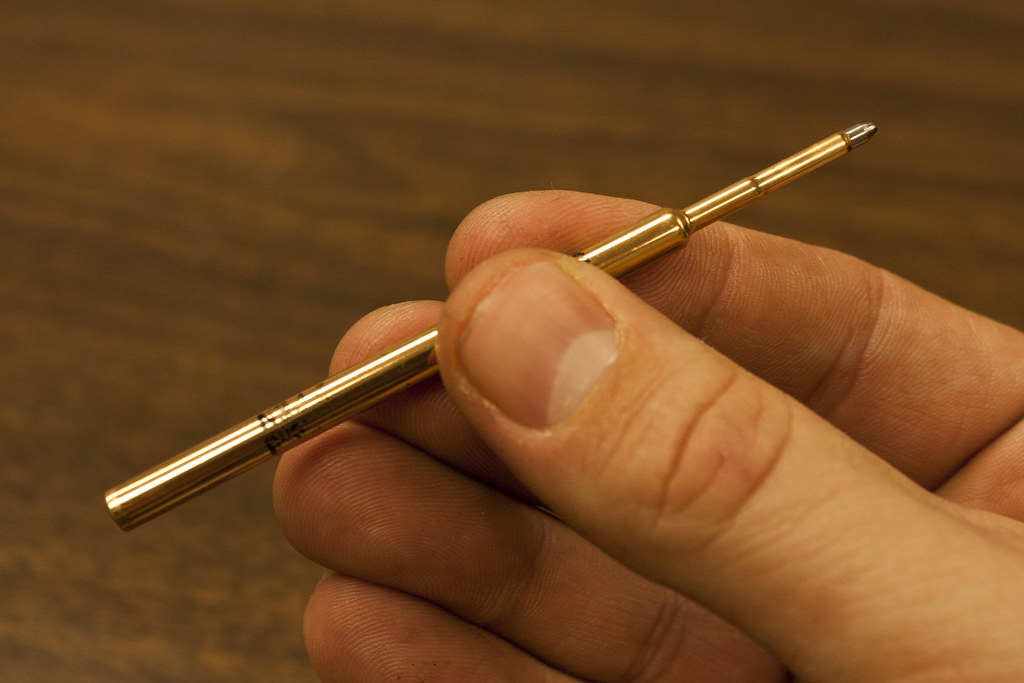
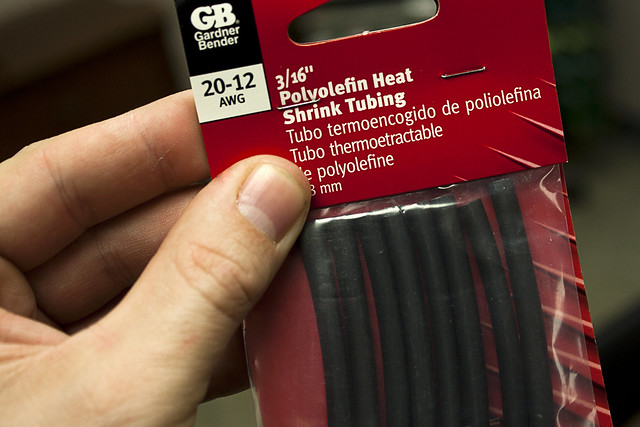 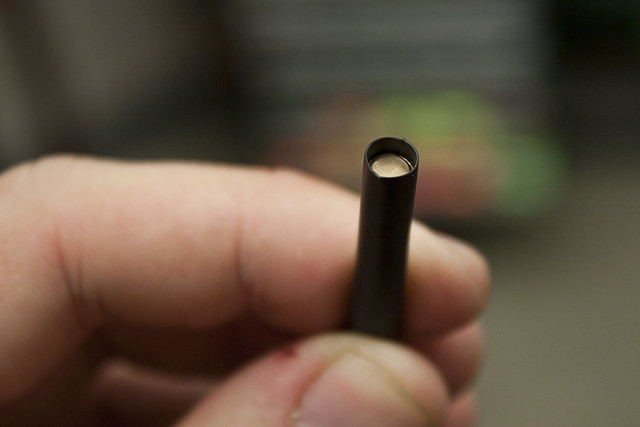 The tubing runs about $3-4 in most hardware stores, for 8 tubes. The tubing runs about $3-4 in most hardware stores, for 8 tubes.First, slide the tube over the pen with about a 1/16th of an inch hanging over the end. 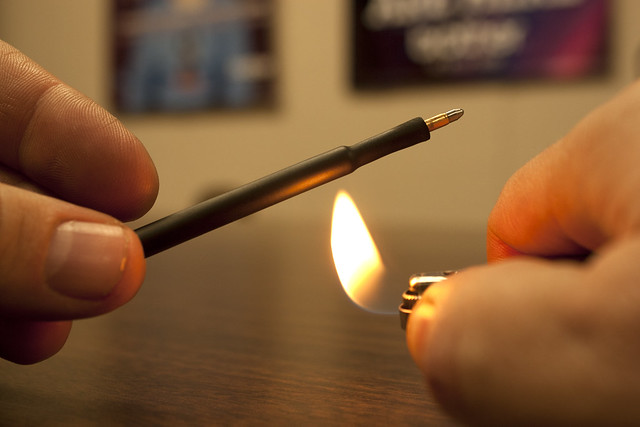 Constantly move the flame back and forth so you don't burn the tube. It will start shrinking in a couple of seconds. 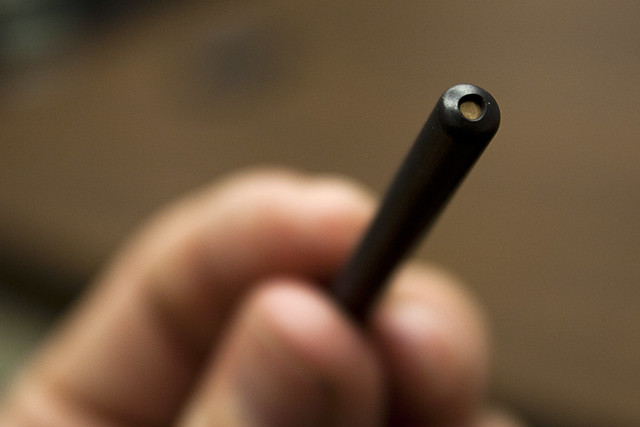 Now it's comfortable to write with and it stays put when I stick it on my ear, which I do a lot. Final weight, just 3 grams. 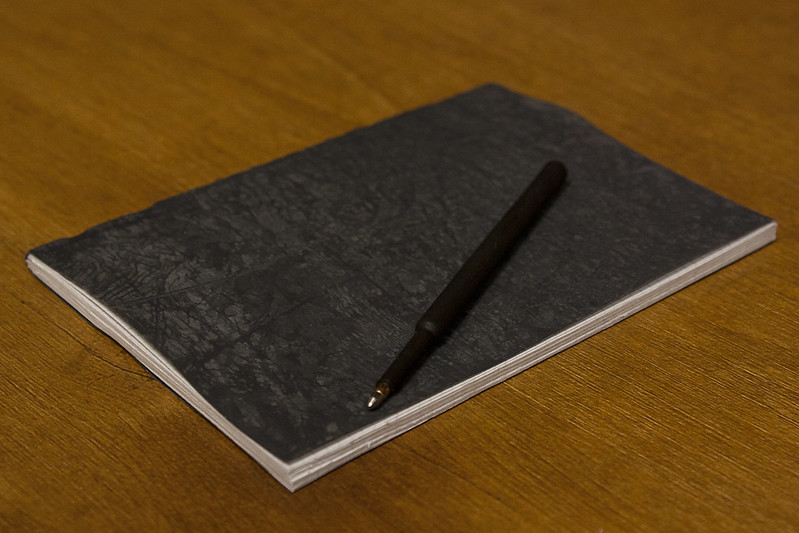 Since I use a space pen, occasionally I hear the joke about how NASA spent millions of dollars to develop a pen that would work in zero-gravity, when crafty Russians solved the problem by using a pencil. This would be a funny anecdote about wasteful government spending if it were true, but it's a myth. What can I say, I'm a huge NASA fan, so I'm compelled to defend them... Actually, NASA didn't develop it, Paul Fisher did, independently and without government money. He presented it to NASA, they tested it thoroughly, and started using it on space missions. Cost to NASA, $2.95 each. It's not clear how much he spent to develop the pen, but it is clear that he did it to market his pen company. The space program was incredibly popular in those days, and he wanted to capitalize on it by making the pen the astronauts used. Hmm, now I'm wondering if his marketing genius had anything to do with that Seinfeld episode. It's true that Russian cosmonauts used pencils, because before these pens were invented, pens didn't work well in extreme temperatures or in a vacuum. Pencils are problematic too, though. Wood and lead burn rapidly in a pure oxygen environment and plastic mechanical pencils with graphite "lead" broke easily, which caused problems when floating around in zero gravity by shorting out electronics and floating into eyes and noses. Then the inventor, Paul Fisher, walk in with an inexpensive solution to a potentially expensive problem, a little cartridge of thixotropic ink hermetically sealed and pressurized with nitrogen gas. It has been used in all manned space missions since. Not long after the Americans adopted the space pen, the Russian started using it as well. So, a story that has been touted as proof of wasteful American spending, is actually a story of American innovation and our entrepreneurial spirit. And most importantly, now I don't have to roll over on my elbow in the middle of the night to write down a thought that I'm convinced is interesting or clever, even if I'm on top of Mount Whitney in the middle of winter. I may have walked 3,000 miles with gear on my back, but rolling over on my elbow to write? Come on, I'm not Superman. |
Cleaning Clothes in the Backcountry
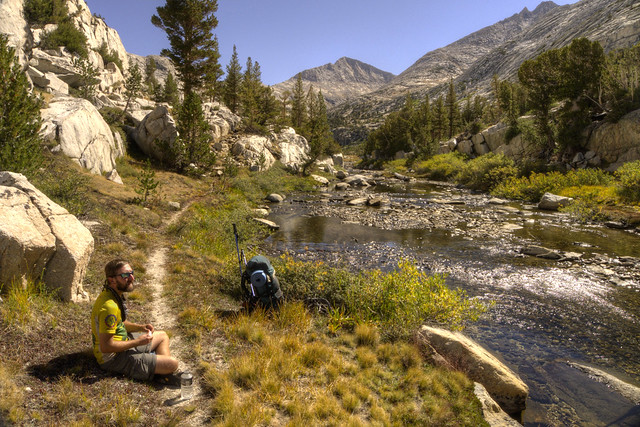 "Alright," I said to Lightfoot on our John Muir Trail hike in 2012. "Smell this sock again and tell me if the baking soda made any difference." The sour look on his face gave me the answer as he slowly handed the sock back to me.
After a while on a long distance hike, you start to lose your ability to smell yourself, at least to a certain point. This is a blessing when you're alone, otherwise it's a curse. It would be great if I was a cartoon and could just look up to see if there were stink lines drawn above my head, but sadly I'm not, so Lightfoot offered to smell my socks after a thorough rinse and again after they had soaked in a baking soda and water solution for thirty minutes. Only a true friend would take a bullet like that.
 "Hmm, alright, next time I'll let it soak longer or add more baking soda."
I began experimenting with environmentally-safe ways to clean my clothes in the backcountry after hiking the Appalachian Trail. Since I started backpacking, I've pretty much started to define "clean" as "dry," so don't get me wrong, clean out there isn't the same thing as clean at home. I decided, however, that long-distance backpacking would be more enjoyable if I could feel cleaner. Being tranquil and at peace in the natural world is a lot easier if you don’t smell like a corn chip’s foot. That's why cleanliness is next to godliness, and why you haven't seen a drawing of Buddha with stink lines above his head.
First, I pack a recycled plastic bread bag or a one-gallon Ziploc and at least 2 tablespoons of baking soda. Since I'm usually only washing one or two pairs of socks, a pair of underwear, and a lightweight shirt at one time, the bread bag or Ziploc is big enough.
 "Hmm, alright, next time I'll let it soak longer or add more baking soda."
I began experimenting with environmentally-safe ways to clean my clothes in the backcountry after hiking the Appalachian Trail. Since I started backpacking, I've pretty much started to define "clean" as "dry," so don't get me wrong, clean out there isn't the same thing as clean at home. I decided, however, that long-distance backpacking would be more enjoyable if I could feel cleaner. Being tranquil and at peace in the natural world is a lot easier if you don’t smell like a corn chip’s foot. That's why cleanliness is next to godliness, and why you haven't seen a drawing of Buddha with stink lines above his head.
First, I pack a recycled plastic bread bag or a one-gallon Ziploc and at least 2 tablespoons of baking soda. Since I'm usually only washing one or two pairs of socks, a pair of underwear, and a lightweight shirt at one time, the bread bag or Ziploc is big enough.
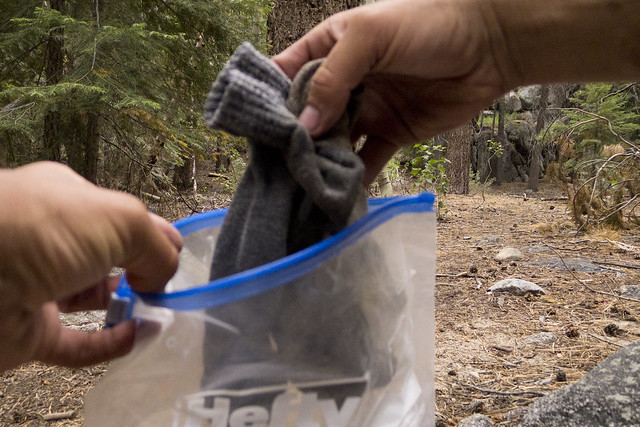 |
1. After setting up camp at the end of the day, I put the offending clothes into a one-gallon Ziploc bag. |
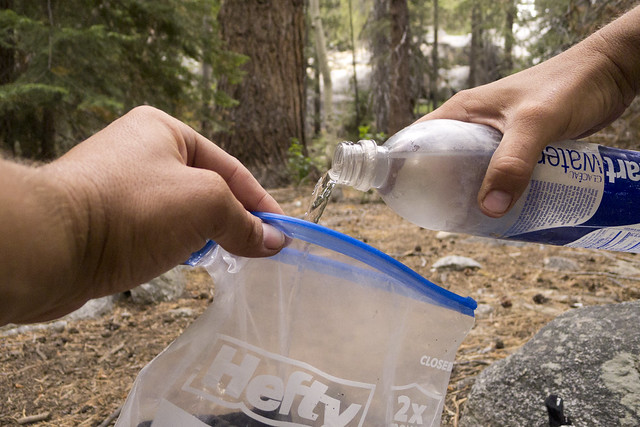 |
2. Then I add water. Don't put the clothes directly in the water source. Clothes hold residual detergents from previous washes, which you may see proof of in the form of suds during the next step. Clothes may also contain other chemicals from deodorants, bug sprays, etc. Consider putting your backpacking clothes through another rinse cycle after you've washed them at home. |
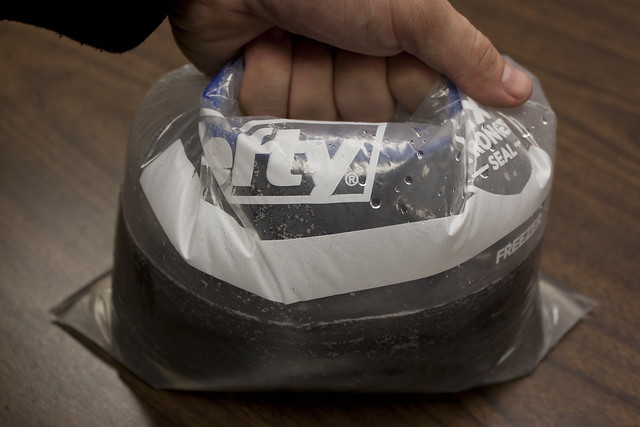 |
3. Seal the bag with a little bit of air inside. Now, shake it vigorously. This is where most of the cleaning happens, and the longer you agitate the clothes the cleaner they'll get. |
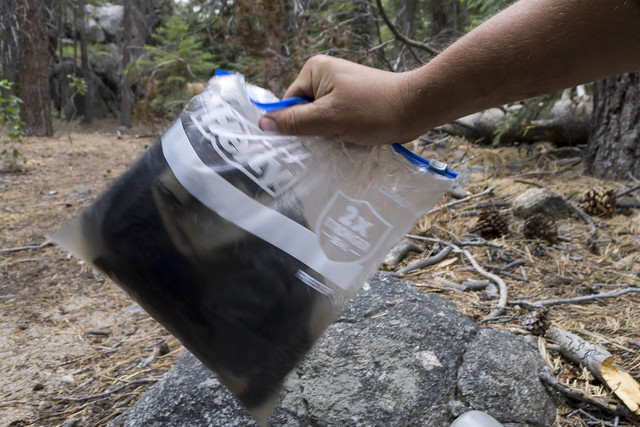 |
4. Make sure you're at least 200 feet from all water sources then empty the bag and squeeze as much water out of the clothes as you can. Avoid twisting wool and synthetic fabrics when wringing out the water. It's less damaging to roll them up and squeeze the water out. Repeat steps 2 through 4 as often as necessary. I usually do it 3 to 5 times, and agitate for at least a couple minutes each time. This alone will make a tremendous difference, and more so the longer you agitate and the more times you replace the water as you do it. Your clothes will be a lot less smelly, and a lot more comfortable to wear. Actually, if your clothes weren't that dirty to begin with, water and agitation would probably be enough to get them clean. After wearing the same clothes on the trail for a couple days, however, they'll probably still smell at this point, but hey, at least people won’t be able to smell you from ten feet away. If you want to stick with slightly smelly clothes to save weight in your pack and have as little impact on the environment as possible, feel free to skip the next two steps. If you want to get them cleaner, however, it's time to get out the baking soda. |
| 5. If you want to remove a stain, mix a little water with baking soda to make a paste, apply it to the stain, gently rub the stained fabric into itself, and then continue. | |
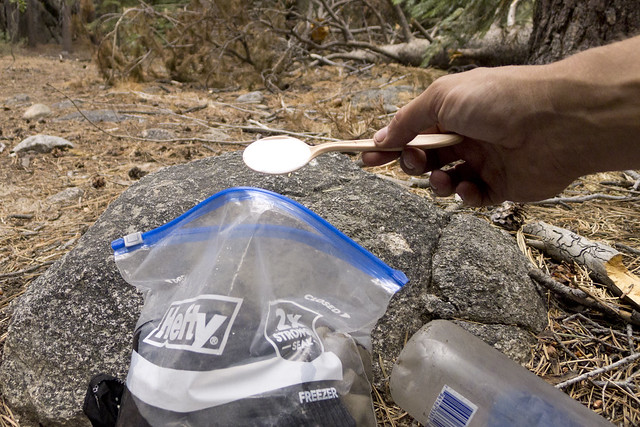 |
6. Fill the bag with about a quart of water and about 2 tablespoons of baking soda (more on why I don't use detergents below). Shake vigorously to mix. If you need more water to cover your clothes, just increase the baking soda as well by roughly that same ratio. It doesn't have to be exact. Now, let that soak overnight. |
| 7. In the morning, go about 200 feet from all water sources, squeeze the baking soda water out the clothes, and then rinse them in the same way as steps 1 through 4. | |
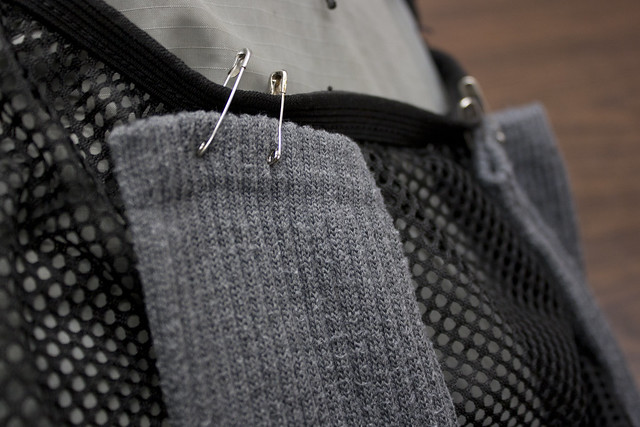 |
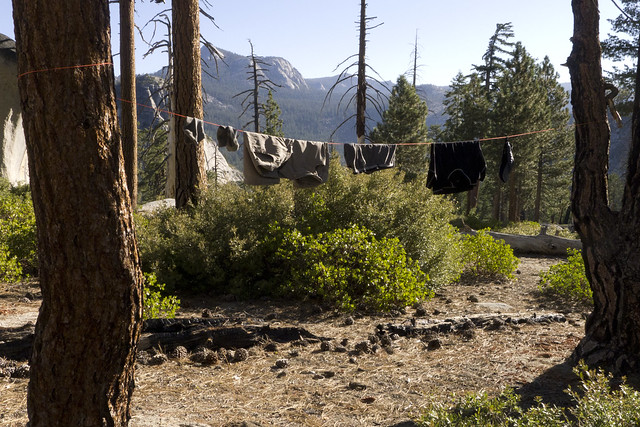
8. I attach the wet clothes to my backpack using safety pins, so they can dry while I hike. If it's warm enough, I'll just wear the shirt wet. The synthetic or merino wool fabric my shirts are made of dry quickly from body heat. Safety pins also work great to hang clothes on a line, so wind doesn't blow them off and so you don't have to fold them over the line, which makes them take longer to dry. The odors will continue to decrease as your laundry dries in the sunlight. |
| 9. And finally, go find Lightfoot and have him sniff your sock to see if it worked. |
More Uses for Baking Soda
Before I go into why I don’t use detergents in the backcountry, one reason I take baking soda instead of the other alternatives is it's useful for other things on the trail. For example:
1. You can mix some baking soda and a little water in the palm of your hand to form a paste and use it as a gritty hand and foot scrub to remove dirt and odors.
2. Relieve the itch of bug bites, bee stings, or Poison Ivy by applying the baking soda paste like a salve onto the affected skin.
3. You can scrub cook pots with that baking soda paste solution, as well. Or just sprinkle some on a damp bandanna and scrub away.
4. The paste can also be used to brush your teeth. It doesn't contain fluoride, but it makes a decent toothpaste if you run out.
5. You can also dissolve a teaspoon in 4 ounces of water to make a mouthwash. Slosh it around in your mouth to get rid of bad breath or relieve canker sore or tooth pain.
6. Dust some under your arms and on your feet to use it as a deodorant. Not a good alternative if you're going on a date, but it helps a little bit on the trail.
7. You can cool a sunburn, windburn, or other minor burns or rashes by saturating a bandanna in a warm water and baking soda solution and gently dabbing it onto the affected area.
8. Supposedly, you can rub dry baking soda on your roots to degrease your hair, and then just towel out the excess after 1 to 3 minutes. I haven’t tried this yet, but I have heard of people doing it.
9. Sprinkle some dry baking soda on your dirty clothes so they don’t stink up your whole backpack.
10. Relieve a sore throat by gargling a mixture of ½ teaspoon of baking soda and ½ teaspoon of salt with a ½ cup of warm water a few times a day until it’s gone.
That's a lot, but I'm sure there are many other uses for baking soda on the trail.
Why I Don’t Use Detergents
I'm not totally opposed to people using certain environmentally-friendly biodegradable detergents, but I'm just not convinced any are 100% safe. I prefer to keep as many chemicals out of the backcountry as possible and baking soda is useful in so many other ways.
If you prefer to use a detergent, there are some that are considerably safer for the environment, and safer ways to use them.
First, there are no detergents safe enough to dump directly into a water source, even if the detergent's label has a bright blue sky and green leaves on it, and you can only buy it in a locally-owned co-op from a barefoot hippie drenched patchouli oil. Always dump the wastewater into a 6 to 8” deep hole dug at least 200 feet from a water source, and use it sparingly.
It’s hard to tell which detergents are the safest to use because they don’t have to disclose all ingredients on the label. So, choose a detergent based on what they claim they don’t add. They don't have to legally tell you if it does contain certain things, but false advertising is still illegal (sort of). For example, look for detergents that are phosphate-free, chlorine-free, fragrance-free, dye-free, and ones that are plant-based and contain no petroleum solvents.
Fragrance-free is also important because it can attract animals, but also because companies may be able to hide certain chemicals in their fragrances and still legally claim the product is free of it. (As of this post, that is the case, but there is a proposed law in the US that may change that soon.)
Biodegradable Soap
Also, in addition to the advice above, only use biodegradable detergents. Just remember that no soap is biodegradable in water. Biodegradable soaps are only biodegradable when buried in the soil.
Spend enough time on the trails and you'll eventually hear something like, “I have biodegradable soap, so I just jump in the lake to bathe.” If that is how you’re using it, it’s not biodegradable soap. If biodegradable soap accumulates in water sources, it can lead to excessive plant and algae growth and decrease dissolved oxygen in the water.
To print biodegradable on a label, the product just has to be “capable of being decomposed by biological agents, like bacteria, fungi, or algae, and break down into carbon dioxide, water, and biomass in a reasonable amount of time in the natural environment.” Further, it could take up to six months to biodegrade in the soil, and still be deemed biodegradable. By then, if not properly buried at least 6" in the soil and 200 feet from a water source, it could work itself into the aquatic ecosystem.
Biodegradable soap is a good example of the cobra effect, when an attempted solution to a problem actually makes the problem worse. Overall, biodegradable soaps are a good thing. They are technically much better for the environment, but because the term is often misunderstood, the product is often used in an environmentally unfriendly way. So, a product with good intentions can actually end up being worse for the environment.
It’s like being okay with producing more garbage, because you recycle, or leaving an energy-efficient light bulb on more often because it uses less energy.
Also, since there is an assumption that it is safe for the environment, some people may end up using more of it than they would otherwise. With the method above, a couple drops is all you need.
Here are a few other tips for keeping your clothes clean in the backcountry:
1. You can reduce odor and the number of times you have to wash your clothes, if you wear clothes made of merino wool. It doesn't absorb body odors or hold onto bacteria like most synthetic fabrics, like those used in Under Armor for example.
2. Choose clothing made of materials that will dry fast in the sun. Hiking clothes made to quickly wick moisture from your body will likewise dry fast in the sun after you wash them.
3. If it's overcast and your socks are still a little damp at the end of the day, put them in your sleeping bag at night. Your body heat will help dry them out.
4. Before heading to the trail, wash your clothes at home with just water. This will remove residual detergents and make it safe to jump in a lake with your clothes on to give them a quick wash.
Let me know if you have any questions, concerns, or suggestions by emailing me at ryan@abackpackerslife.com.
My Gear Checklist: Sleeping Pad
|
|
|||||


A Backpacker's Life List by Ryan Grayson is licensed under
a Creative Commons Attribution-NonCommercial-NoDerivs 3.0 Unported License.
a Creative Commons Attribution-NonCommercial-NoDerivs 3.0 Unported License.
My Gear Checklist: Sleeping Bag
|
|
|||||


A Backpacker's Life List by Ryan Grayson is licensed under a
Creative Commons Attribution-NonCommercial-NoDerivs 3.0 Unported License.
My Gear Checklist: Backpack Liner
|
|
|||||||


A Backpacker's Life List by Ryan Grayson is licensed under a
Creative Commons Attribution-NonCommercial-NoDerivs 3.0 Unported License.
What I Carry With Me Out There
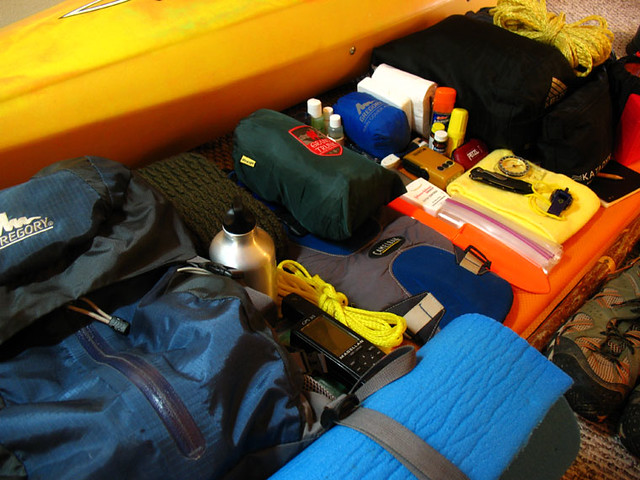 |
| My first set of gear, all of which has been replaced |
Today, I'll just talk about the backpack, but eventually I'll post about each item. I'll give advice for buying gear, suggest tips for saving money, and in some cases, give detailed instructions on how to save money by making your own gear.
Most of my advice will be for new backpackers (especially those wanting to save money on their first set of gear), because with experience your gear gets modified and minimized until it is unique to your own comforts and needs. Mine certainly has evolved over the years.
Nevertheless, I hope I can also give a few ideas to a seasoned pro to consider or criticize. Please leave any thoughts and suggestions in the comments below.
|
|
|||||

A Backpacker's Life List by Ryan Grayson is licensed under a
Creative Commons Attribution-NonCommercial-NoDerivs 3.0 Unported License.
What I'm Carrying With Me Out There
For me, one of the great aspects of the backpacking life, is the freedom you feel when you only have what you can carry on your back. I get asked what I have on mine quite a bit, so below you'll find a list.
The advice below is mostly for new hikers, or people just curious about what I take, because with experience your gear will be modified and minimized until it is unique to your own comforts and needs. Mine certainly has evolved over the years. Nevertheless, I hope my list can help out a new hiker, perhaps save them some money, or give new ideas to a seasoned pro to consider or criticize.
With new ideas, products, and materials becoming available every year, adapting your gear list is a never-ending process, so please feel free to email me your ideas or advice at grayson.ryan@gmail.com, or post a comment below. I will never learn enough, so this page will change as I change.
Click on an item below to get more information.
► Backpack - Kind of essential to carrying all my belongings on my back.
► Backpack Liner - Two Trash Compactor Bags, to keep my gear dry and as a ground cloth for a tent
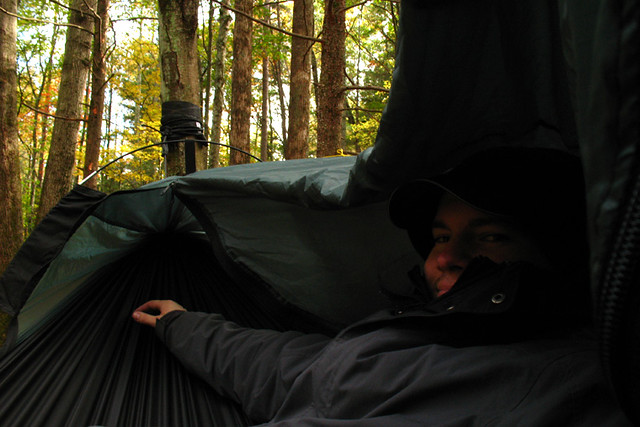
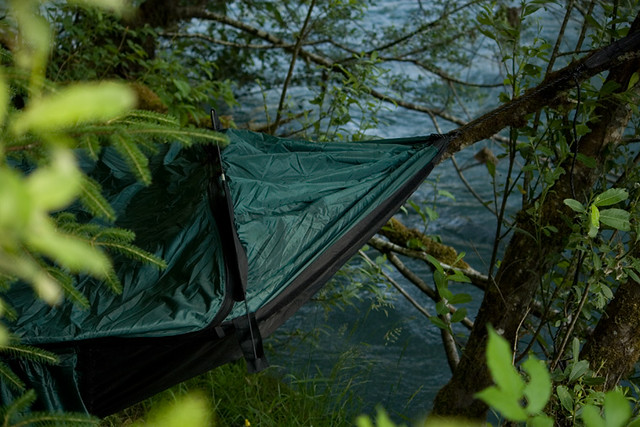
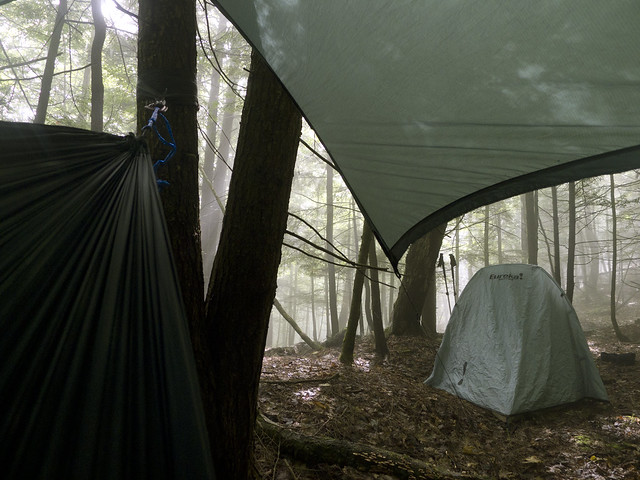
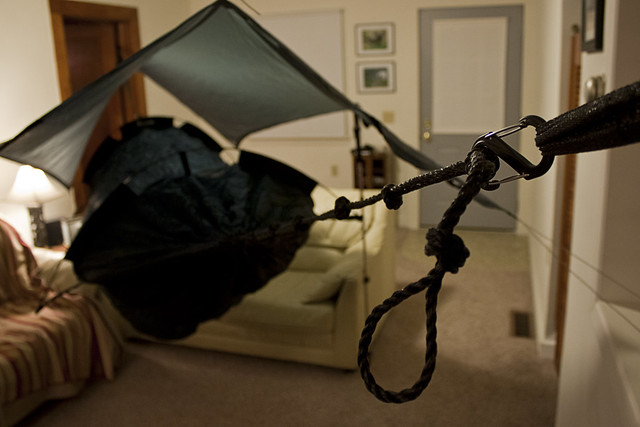
► Shelter - One of two hammocks with a rain tarp, or a lightweight solo tent, depending on where I'm hiking.
► Sleeping Pad - For warmer, more comfortable sleep
► Sleeping Bag - One of two bags, depending on weather
► Cooking Supplies
► Food Bag/Bear Canister - To keep my food contained and safe from wildlife
► Water Treatment and Containers
► Clothing
► First Aid Kit
► Zip Lock Bag for Laundry
► Bandanna - Tons of uses. Probably the most versatile thing in my pack.
► Headlamp - with an extra set of batteries
► Zip-Lock Wallet - With a credit card, debit card, cash, photo ID, and health insurance card.
► Mini Bic Lighter - They are easier and more convenient than matches, and it lasts me a very long time.
► Matches - Good to have a backup.
► Kindle - I keep it inside a zip-lock bag and a homemade foam protective sleeve. If I'll be on a long distance hike with a resupply, I take the charger as well. I can carry hundreds of books, maps, first aid and survival information, and any document I created myself. And it never weighs more than 7 oz. The battery can last a couple weeks on a charge.
► Cell Phone - with Extra Batteries and a set of ear buds. I take short charging cable if on a long distance hike with a resupply.
► 40' of rope - I use paracord, mostly to hang a bear bag at night.
► 15' of braided mason's cord - Strong for it's weight. I use this mostly as clothes line, but it comes in handy for other purposes too, like tying water bottles together when going to fill them up, lashing sticks together for making a variety of things, or to repair a broken guy line on a tent or rain tarp.
► Toilet Paper - Kept in a zip-lock bag. It's better than leaves, and makes a fantastic fire starter.
► Bug Repellent - 100% DEET in an eyedropper bottle goes a long way. Just a dab on the back of my neck, wrists, and ankles. Nothing repels bugs completely, but it helps. DEET may dissolve some plastics, rayon, spandex, other synthetic fabrics, so I apply with a plastic baggie turned inside out. I ruined a raincoat with DEET on the back of my neck, so I wipe off my neck if putting a rain coat on (mosquitoes aren't a problem in rain anyway). This doesn't necessarily mean it's bad on your skin though. Vodka and Coke can dissolve a number of things too, but it's not harmful to the skin. Like all things, follow directions, wash off at the end of the day, and use in moderation.
► Camera - with extra SD cards, lens cleaning cloth, extra batteries, charger if on a long trip, and mini Gorilla Grip tripod.
► Journal and Pen - I just use a Pilot G2 ink refill as a pen. It's lighter and fits in my pocket better. I use a heat shrink tube to give it a nice feel. I write a lot.
► Map or Guidebook
► Compass - I only take one if going off trail, or if a trail may not be marked well. I can always use the compass app on my cell phone as a backup, and some knowledge about the sun and stars.
► Safety Pins - For hanging wet clothes onto my pack or on a clothes line to dry if wind might blow them off. Also, they may come in handy for gear repair someday.
► Knife or Razor Blade - If in the middle of nowhere, or backpacking off trail, a good knife is probably the most essential survival tool you can carry. I'm usually on a well-marked trail though, and needing one for survival is unlikely, so to save weight, I'll just put a razor blade in my box of matches. I rarely need to cut anything bigger than what a razor blade can handle.
► A Few Extra Zip-lock bags - I always find a use for them. Mostly used for waterproofing, food storage, and organizing.
► Trekking Poles - With some handy duct tape wrapped around them.
That's it. It's amazing what you can live without.
The advice below is mostly for new hikers, or people just curious about what I take, because with experience your gear will be modified and minimized until it is unique to your own comforts and needs. Mine certainly has evolved over the years. Nevertheless, I hope my list can help out a new hiker, perhaps save them some money, or give new ideas to a seasoned pro to consider or criticize.
With new ideas, products, and materials becoming available every year, adapting your gear list is a never-ending process, so please feel free to email me your ideas or advice at grayson.ryan@gmail.com, or post a comment below. I will never learn enough, so this page will change as I change.
Click on an item below to get more information.
► Backpack - Kind of essential to carrying all my belongings on my back.
► Backpack Liner - Two Trash Compactor Bags, to keep my gear dry and as a ground cloth for a tent
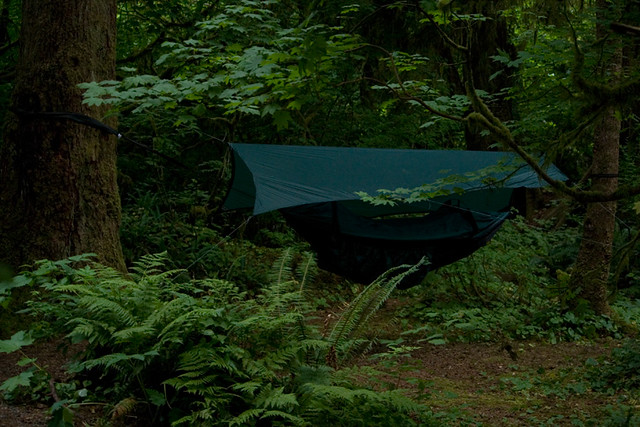
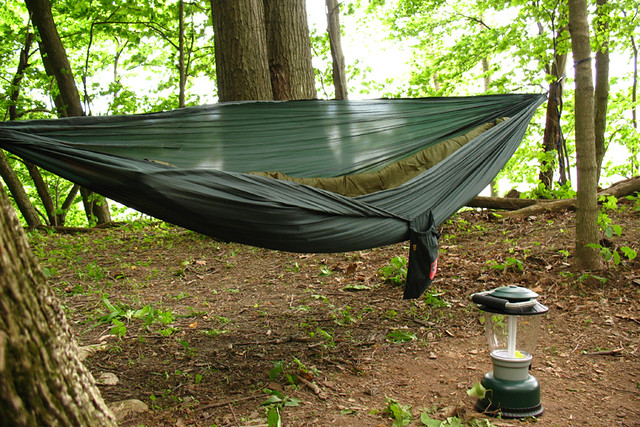
► Shelter - One of two hammocks with a rain tarp, or a lightweight solo tent, depending on where I'm hiking.
► Sleeping Pad - For warmer, more comfortable sleep

► Sleeping Bag - One of two bags, depending on weather
► Cooking Supplies
► Food Bag/Bear Canister - To keep my food contained and safe from wildlife
► Water Treatment and Containers
► First Aid Kit

► Zip Lock Bag for Laundry
► Bandanna - Tons of uses. Probably the most versatile thing in my pack.
► Headlamp - with an extra set of batteries
► Zip-Lock Wallet - With a credit card, debit card, cash, photo ID, and health insurance card.
► Mini Bic Lighter - They are easier and more convenient than matches, and it lasts me a very long time.
► Matches - Good to have a backup.
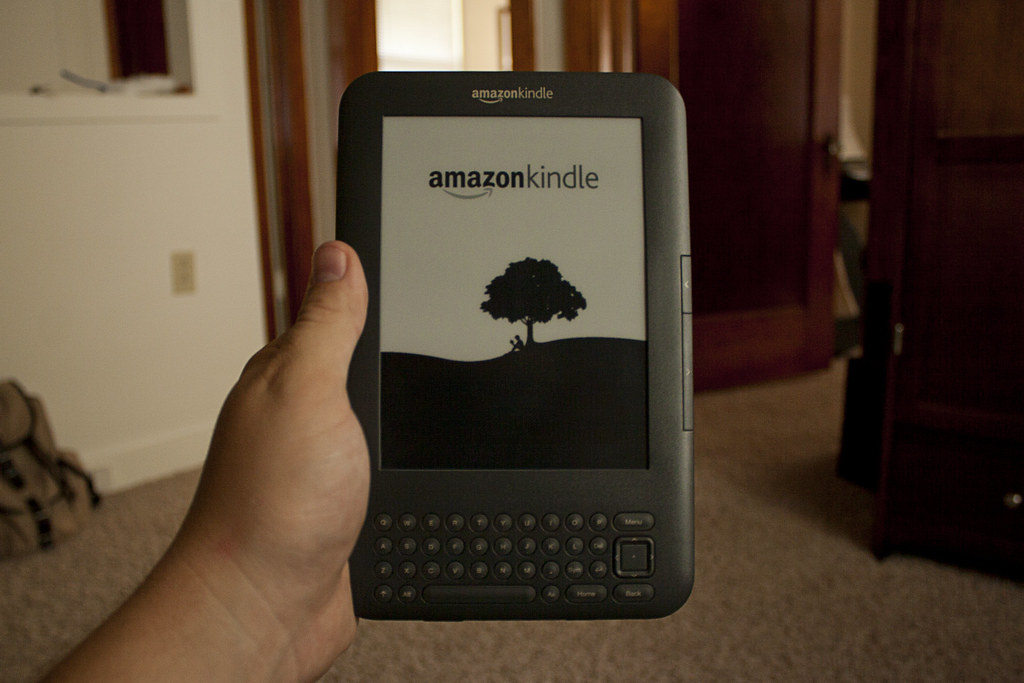
► Kindle - I keep it inside a zip-lock bag and a homemade foam protective sleeve. If I'll be on a long distance hike with a resupply, I take the charger as well. I can carry hundreds of books, maps, first aid and survival information, and any document I created myself. And it never weighs more than 7 oz. The battery can last a couple weeks on a charge.
► Cell Phone - with Extra Batteries and a set of ear buds. I take short charging cable if on a long distance hike with a resupply.
► 40' of rope - I use paracord, mostly to hang a bear bag at night.
► 15' of braided mason's cord - Strong for it's weight. I use this mostly as clothes line, but it comes in handy for other purposes too, like tying water bottles together when going to fill them up, lashing sticks together for making a variety of things, or to repair a broken guy line on a tent or rain tarp.
► Toilet Paper - Kept in a zip-lock bag. It's better than leaves, and makes a fantastic fire starter.
► Bug Repellent - 100% DEET in an eyedropper bottle goes a long way. Just a dab on the back of my neck, wrists, and ankles. Nothing repels bugs completely, but it helps. DEET may dissolve some plastics, rayon, spandex, other synthetic fabrics, so I apply with a plastic baggie turned inside out. I ruined a raincoat with DEET on the back of my neck, so I wipe off my neck if putting a rain coat on (mosquitoes aren't a problem in rain anyway). This doesn't necessarily mean it's bad on your skin though. Vodka and Coke can dissolve a number of things too, but it's not harmful to the skin. Like all things, follow directions, wash off at the end of the day, and use in moderation.
► Camera - with extra SD cards, lens cleaning cloth, extra batteries, charger if on a long trip, and mini Gorilla Grip tripod.
► Journal and Pen - I just use a Pilot G2 ink refill as a pen. It's lighter and fits in my pocket better. I use a heat shrink tube to give it a nice feel. I write a lot.
► Map or Guidebook
► Compass - I only take one if going off trail, or if a trail may not be marked well. I can always use the compass app on my cell phone as a backup, and some knowledge about the sun and stars.
► Safety Pins - For hanging wet clothes onto my pack or on a clothes line to dry if wind might blow them off. Also, they may come in handy for gear repair someday.
► Knife or Razor Blade - If in the middle of nowhere, or backpacking off trail, a good knife is probably the most essential survival tool you can carry. I'm usually on a well-marked trail though, and needing one for survival is unlikely, so to save weight, I'll just put a razor blade in my box of matches. I rarely need to cut anything bigger than what a razor blade can handle.
► A Few Extra Zip-lock bags - I always find a use for them. Mostly used for waterproofing, food storage, and organizing.
► Trekking Poles - With some handy duct tape wrapped around them.
That's it. It's amazing what you can live without.
A Backpacker's Life Listt by
Ryan Grayson is licensed under a
Creative Commons Attribution-NonCommercial-NoDerivs 3.0 Unported License.
Creative Commons Attribution-NonCommercial-NoDerivs 3.0 Unported License.
Why I use plastic soda or water bottles
- I carry 2-3 plastic water bottles. One 16 oz and one or two 32 oz. That way, I can lose or break a bottle and still have a way to transport water. A hiker with a dog came to my shelter on the Long Trail in Vermont, and the dog decided one of my water bottles was a fun chew toy. I'm glad I had a backup.
- Plastic soda/water/gatorade bottles are free, lighter than Nalgene or aluminum bottles, and they are readily available and otherwise destined for a landfill. One argument I've heard for not reusing plastic soda bottles is that they release dioxins in your water. This is an urban legend. There are no dioxins in plastic soda bottles. That being said, a group of chemicals called phthalates are sometimes added to plastics to make them flexible and less brittle. These can leach into water if you heat up the plastic. I don't cook with them, so I'm not worried about this. (Reference)
Another reason I've heard, for not reusing plastic soda bottles, is that bacteria can develop under the cap, but these get cleaned regularly during my bleach treatment, so I'm not concerned about that. If you know of any other reasons I shouldn't reuse soda bottles, please let me know at grayson.ryan@gmail.com.
- Nalgene and other hard plastic or aluminum bottles cannot be squeezed to fill my cook pot with the Squeeze Filter. Or to get all the air out to treat the cap and threads when chemically treating the water.
- I've never been a fan of hydration bladders, since they are difficult to get in and out of my backpack, hard to see how much water you have left, and not easy to attach to the outside of any of my packs.
Safe Drinking Water in the Backcountry, Part 2: Filtration
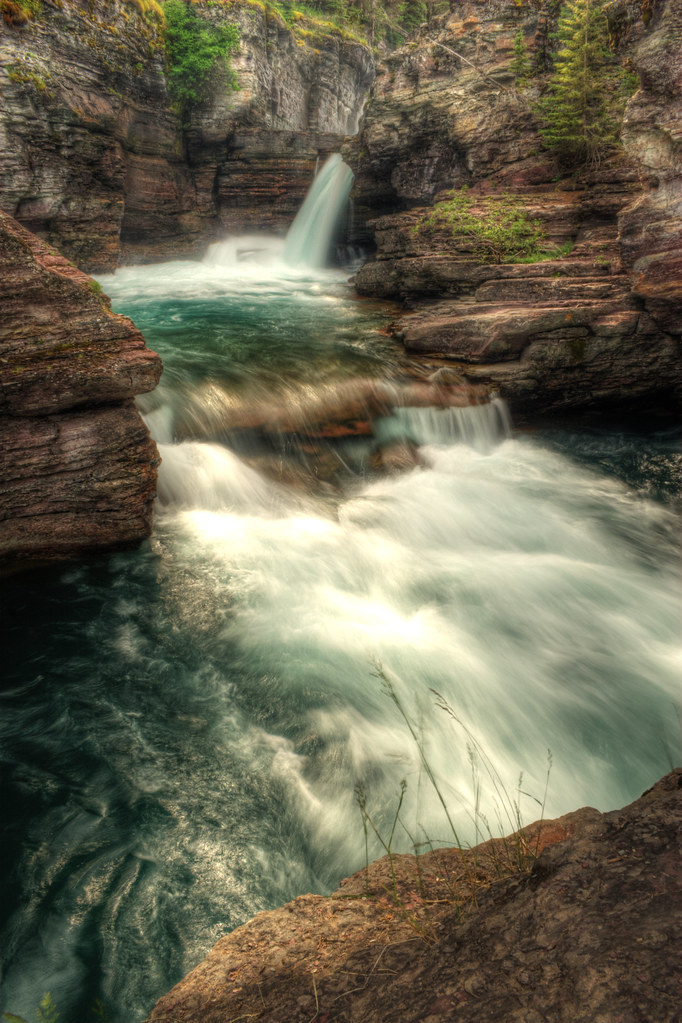 |
| Saint Mary Falls, Glacier National Park |
If I was only going to take one treatment method, it would be a .1 micron inline or straw filter every time, but below are good arguments for carrying both.
- It's good to have a backup method... read more >
- Filters allow me to drink up at the source and carry less... read more >
- An eyedropper of bleach only weighs 1 ounce, so even though I prefer an inline or straw filter, 1 ounce isn't a noticeable addition to my pack.
- Filters, unlike any chemical treatment, are very effective at removing Cryptosporidium and Giardia, the two most common water-born illnesses in American backcountry... read more >
- Bleach is very effective at removing viruses and bacteria, filters are not... read more >
- Bleach can be used to sterilize my toothbrush and eating utensil... read more >
- Filters improve taste... read more >
My preferred filter:
 |
| Sawyer Squeeze Filter |
 |
| 4-Way Filter Bottle |
When on a trail with plenty of water sources, it's not inconvenient to get water, so I don't carry around as much water weight. In addition, the inline filters themselves are also lighter than a pump filter. My favorite inline/straw filter is the Sawyer Squeeze Filter or the Sawyer 4-Way Filter Bottle. Here is why:
- They have a .1 micron filter... read more >
- Multiple ways to use... read more >
- Easy to use... read more >
- Small and Lightweight. The Squeeze filter with a pouch weighs about 3 ounces, the 4-Way Bottle, about 5.
- Sawyer has a one million gallon guarantee!... read more >
- Easy to clean/backwash... read more >
- Cons, because there is always one, right?... read more >
The 4-Way Filter Bottle is currently $36.86 at Amazon (Click here to order or read more reviews). For that price, you will get: a 1L water bottle, Sawyer 0.10 Absolute Micron Hollow Fiber Filter, faucet attachment for backwashing, extra straws, hose adapter for hydration bladders, and the 1 Million Gallons Guarantee.
See the Sawyer Squeeze Filter in action:
See the Sawyer 4-Way Filter Bottle in action:
More water related information:
Why I don't use Sterilizing Pens... read more >
How much water to carry... read more >
Using Bleach To Treat Water in the Backcountry... read more >
Why I use plastic soda or water bottles... read more >
Gear Reviews
 |
 |
More Reviews Coming Soon... |
|
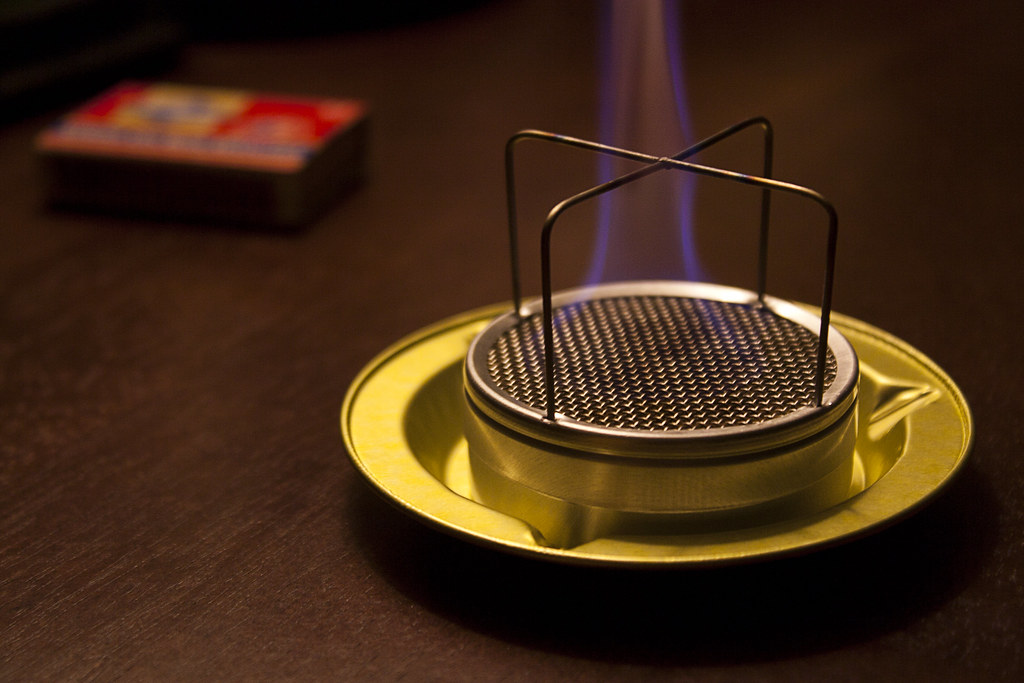
| Zelph's SS Starlyte Alcohol Stove | Kindle E-Reader | ||
Safe Drinking Water in the Backcountry, Part 1: Using Bleach
- - -
As many of you know, this blog has primarily been a place to share stories and photos from
my trips, but my next trip won’t be for at least a couple months. So until that time comes, my blog will be more of a practical guide to backpacking. Or with the direction my life has taken, a practical guide for the deliberately homeless.Either way, I've learned a lot from my experiences and I love to chat about this stuff. I get a lot of questions and could spend hours answering them, as many unfortunate people have realized after asking me a seemingly simple question.
Many of the questions I get involve obtaining safe drinking water in the backcountry. When I tell people I use common household bleach, they often look at me like I have a death wish. So that's where I'll start.
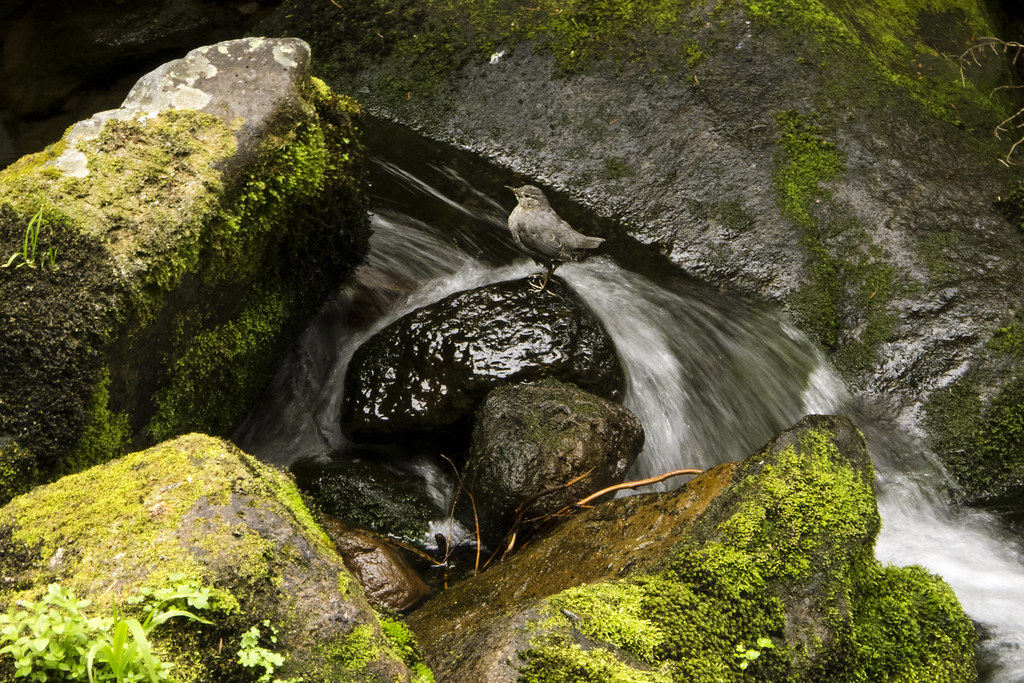
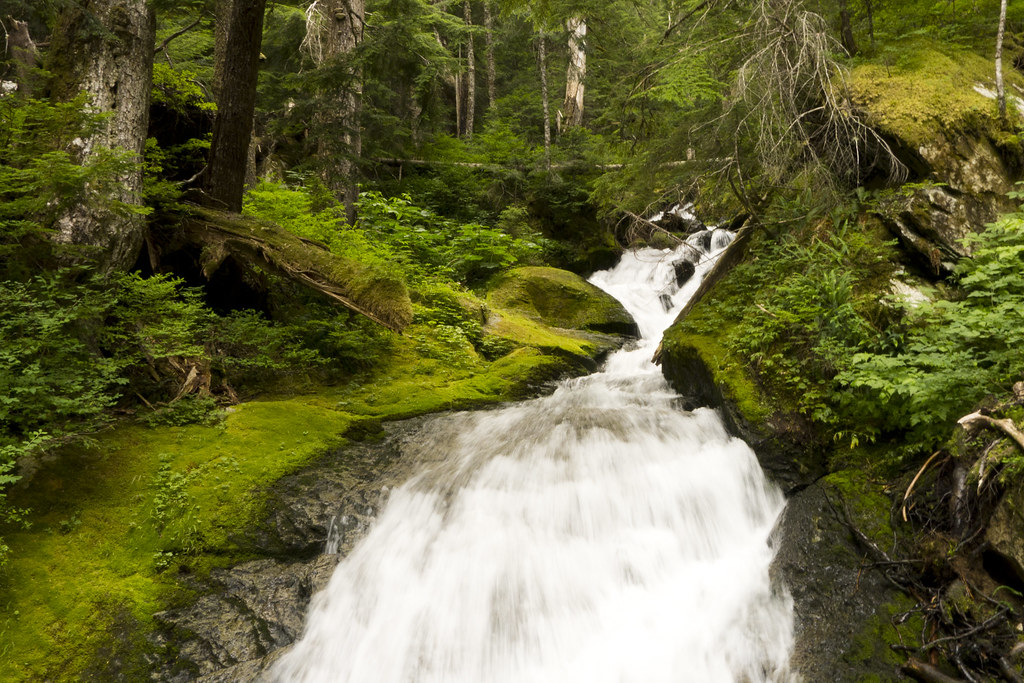
If you are smart about choosing your water source, you could go for days, weeks, or even years without treating your water and never get sick. It's a gamble, but after spending a few days stepping over moose poop, or seeing a bloated dead animal floating in a water source, or worse yet, having to witness your friend doubled over with stomach pains and running off into the trees to decorate that beautiful foliage in vomit or explosive diarrhea... I'm getting a bit off the rails here... what I'm trying to say is, that stuff kind of diminishes the "all-natural" romanticism of drinking from a cold mountain stream. So, I treat my water.
Everyone has their own preferred method, but here’s what I do:
My Water Treatment Method:
My method for treating drinking water in the backcountry is a combination of household bleach (one drop per 16 oz.) and/or an inline or straw filter. And don't forget the often skipped step of cleaning your hands after touching potentially contaminated water. I carry a small bottle of hand sanitizer for this. Not doing so could negate everything you do to treat your water.
First, I should say that nothing is more effective as boiling to treat water in the backcountry. Boiling water vigorously for 60 seconds, or three minutes at altitudes higher than 6,500 feet, will kill everything. No other safe chemical or filtration method can claim that. If you're already boiling water for cooking, it's great. For drinking water, however, it is perhaps the most impractical method... read more >
.
Why I use bleach:
1. It's safe... read more >How I use bleach:
2. It's effective... read more >
3. It's cheap... read more >
4. It's easy to find... read more >
5. It's lightweight... read more >
My method is based on recommendations by the Centers for Disease Control, the American Red Cross, and hours of additional reading. If you find any mistakes or have questions or suggestions, please contact me at grayson.ryan@gmail.com. I will always be happy to learn something new and will update this information accordingly.
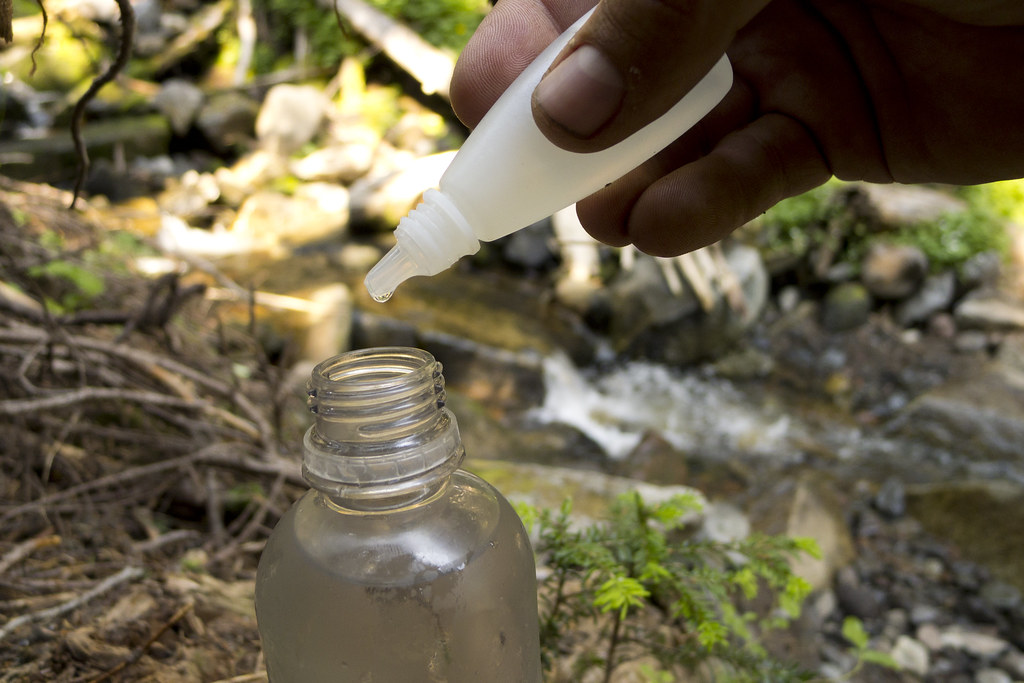 1. Fill an eyedropper with bleach. 1. Fill an eyedropper with bleach.Before heading out, I fill an eyedropper bottle with common household bleach. I use an old Visine bottle or breath drops bottle. Since bleach will degrade in direct UV light and become less effective, consider covering the bottle in duct tape, or paint, or something. To fill the bottle without spilling bleach, I often use a ZipLoc bag as a funnel. Put the desired amount of bleach in the bag. Hold it by one of the top corners, so one of the bottom corners is above the bleach. Cut a tiny bit of the corners off, then tip the bag and pour the thin stream of bleach into the dropper bottle. I keep the bottle in a ZipLoc freezer bag or in an empty wide-mouth Gatorade or Powerade bottle to prevent damage to gear and clothes. So far, I have not had a problem. Also, keep in mind, the decomposition rate of bleach increases by a factor of 3.5 for every 18° F increase in temperature, so if not stored at 60-80 degrees, it's probably a good idea to dump it out and replace it after a couple weeks to be safe. |
|
 2. Fill your
water bottle with water. 2. Fill your
water bottle with water.The best water source is actually the top few inches of lake water. The longer time under the sun’s UV rays does a lot of the sterilization for you. Otherwise, a spring or swift moving creek will be fine. If the water source is not clear, I tie a bandanna around the top of my bottle when filling. If your water is still cloudy, let it sit until all sediment has settled, then pour the clear water into another bottle before treating. Chemical treatments are much less effective if the water is not clear or contains free-floating organic material. Organisms that are clinging to free-floating particles are harder to kill. |
|
| 3. Add one drop of bleach per 16 oz. of
clear water. Use two drops if the water is really cold, cloudy, or discolored. If your bleach is not the common 4-6% solution of sodium hydrochlorite you may have to use more or less. The amount of sodium hypochlorite added to bleach may depend on the season. More may be added in the summer to compensate for the higher temperatures. It could be as high as 10%, so check your bleach bottle’s label and adjust dosage accordingly. |
|
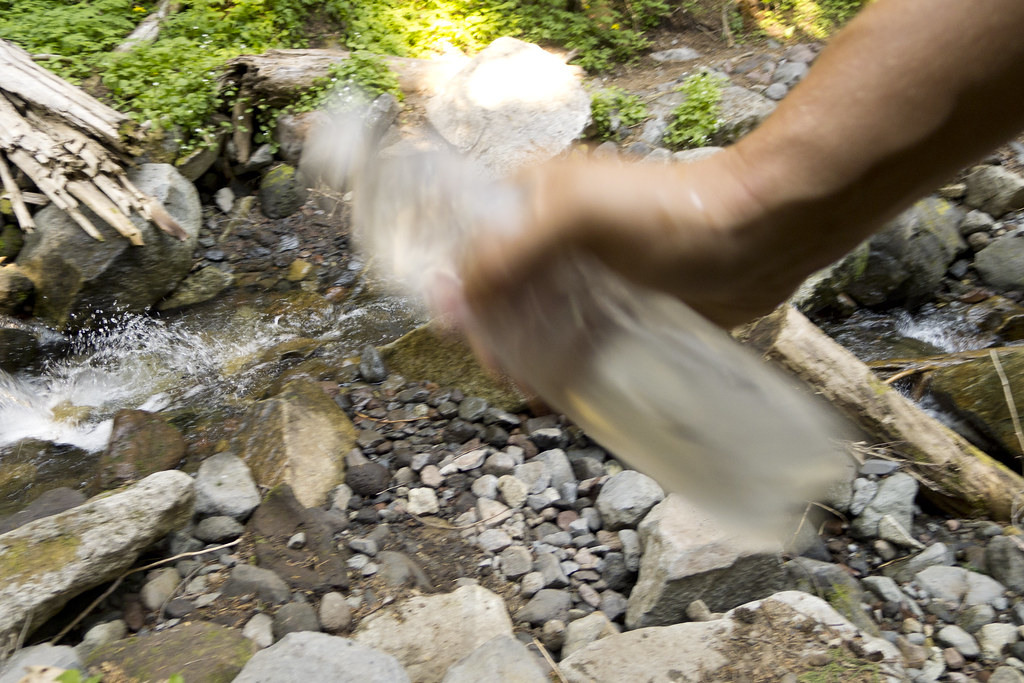 4. Shake it like a Polaroid. 4. Shake it like a Polaroid. |
|
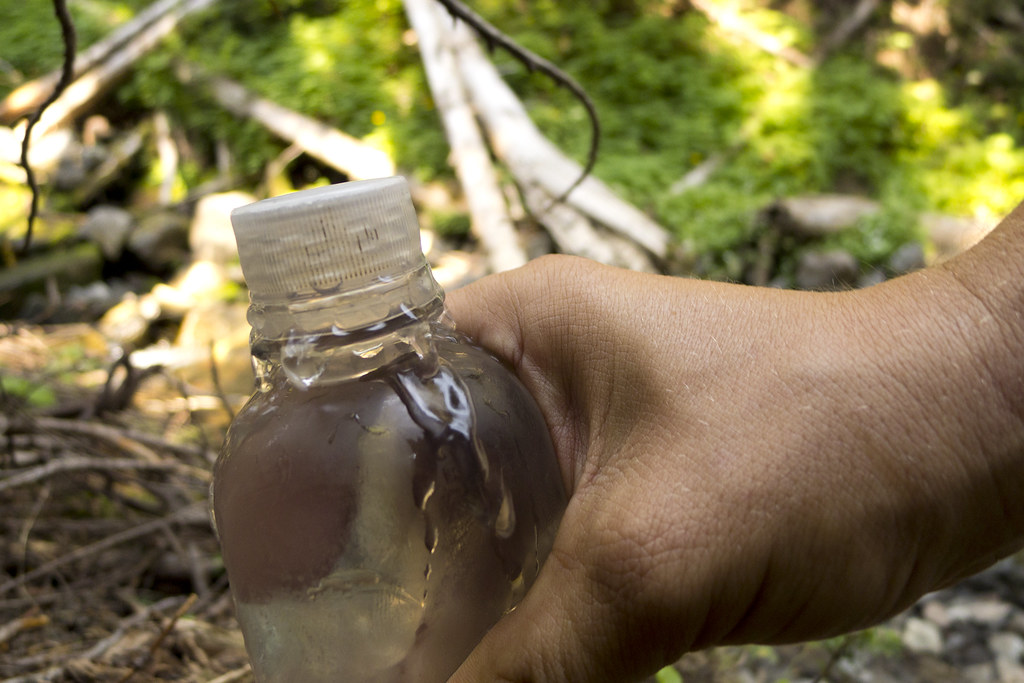 5. Screw the cap nearly all the way on, then
squeeze the bottle until it starts to pour out, and then tighten the lid. 5. Screw the cap nearly all the way on, then
squeeze the bottle until it starts to pour out, and then tighten the lid.
This ensures that the entire bottle, including the cap and threads, get disinfected. |
|
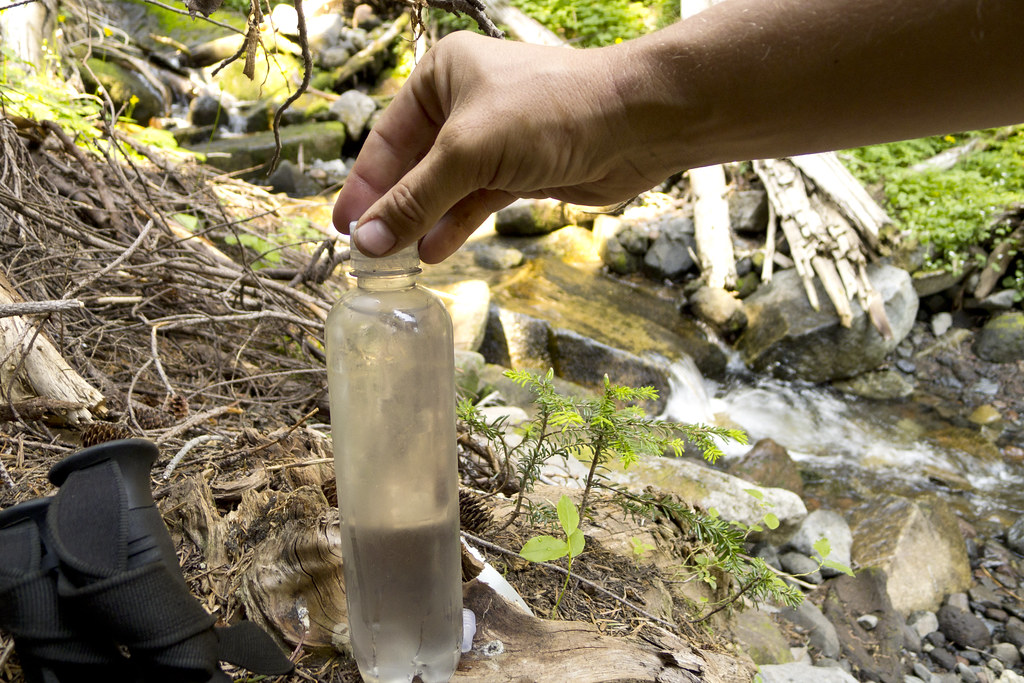
| 6. Wait 30 minutes. And in the meantime, clean your hands with a hand sanitizer. Not cleaning your hands after touching a contaminated water source could negate everything you have done to prevent a water-borne illness. If after 30 minutes, your water does not have a slight chlorine smell similar to municipal tap water, repeat steps 3 through 5. Think of bleach as an army of soldiers you're sending into battle. They kill organisms, but die in the process. The more organisms there are to kill, the more soldiers you need. That's why it may be necessary to treat a second time. And why sometimes you'll smell or taste more chlorine than other times. Keep in mind though, this isn't the fault of bleach alone. It's true for any chemical treatment. |
More water related information:
Why I don't use Sterilizing Pens... read more >
How much water to carry... read more >
Using Filters To Treat Water in the Backcountry... read more >
Why I use plastic soda or water bottles... read more >
Sixteen Months of Wandering

Used to be, a year and a half would pass by frighteningly fast, but life doesn't seem as short anymore. I credit that to doing more in 16 months than all my previous years combined.
I backpacked through 3,000 miles of wilderness and the occasional small mountain town. That's over six million footsteps with nothing but the bare essentials on my back. These trails had a cumulative elevation gain of more than 675,000 feet or 130 miles, twice the distance to outer space, or more than the height of 23 Mount Everests.
I'm not sure which has received more wear-and-tear though, me or my worn-out Honda Civic. It racked up 26,000 miles on American highways since March of this year. The car is one of the few things in my life that hasn't changed, although we are much more acquainted now.
If you haven't read every post on my blog, here's what I've been up to. On June 10, 2011, I quit my job, packed a backpack, left everything else behind, and then....
- Hopped on a train to Washington D.C.
- Saw the Smithsonian, the Jefferson Memorial, Lincoln Memorial, Washington Memorial, the White House, the Library of Congress, the Capitol building, The Constitution, Declaration of Independence, and every other D.C. monument, artifact, and museum on my life list
- Stayed in the first of many hostels and met people from all walks of life
- Took a bus to New York City
- Roamed aimlessly around Time Square and Broadway
- Heard a never publicly performed piece of music played by a symphony in Central Park
- Got lost in Central Park at night. It took a few hours to find my way, but after thinking about my upcoming hike from Maine to Georgia, you can rest assured, I fully appreciated the dramatic irony.
- Then, at two in the morning, I went to the top of the Empire State Building to see the lights and bustle of the city that never sleeps
- The next day, I took the subway to Ground Zero
- Saw the Statue of Liberty from the Staten Island Ferry
- Unexpectedly witnessed Will Smith filming Men in Black 3 in Battery Park
- Strolled down the "pre-occupied" Wall Street
- Walked to Brooklyn on the Brooklyn Bridge
- Watched a taping of the Late Show with David Letterman, with Eddie Vedder and Cameron Diaz
- Took a train to Boston
- Walked the Freedom Trail and saw every historical site I know of in Boston, and some I didn't know of
- Bought tickets from a scalper in Fenway Park and watched a Red Sox Game
- From my stadium seat, sang Sweet Caroline and yelled YOUUKK!, without understanding why
- Helped a schizophrenic homeless man update his blog (I always knew I would someday)
- Took a bus to Maine
- Met my new friend Erik (a.k.a Red)
- Hiked the 2,181-mile Appalachian Trail from Maine to Georgia, through 14 states. On the trail I...
- Met Sam and Liv (a.k.a. Bambi and Thumper), who became my favorite people in the world
- Backpacked through the Hundred Mile Wilderness in Maine
- Hitchhiked for the first time
- Spent the night behind an abandoned bank, a city park dugout, and many other random places like a hobo
- Backpacked through the White Mountains in New Hampshire
- And the Green Mountains in Vermont
- Hiked through Hurricane Irene and Tropical Storm Lee
- Had lots of fun in random mountain towns drinking with trail friends
- Hiked along the Housatonic River through Massachusetts and Connecticut
- Then through New York, New Jersey, Pennsylvania, and Maryland
- Slept under Jefferson Rock National Historic Landmark in West Virginia
- Met my new friend Gregg (a.k.a Lightfoot)
- Backpacked the length of Virginia's Shenandoah National Park during the peak of fall colors
- And in the snow in Tenneesee and North Carolina's Great Smoky Mountains
- Encountered several black bears, a wild boar, and interesting mountain people
- Fell in love with a new and exciting way of life
- And a girl
- Reached the AT's southern terminus in Georgia 183 days after leaving the northern terminus
- I went back home for the holidays and recovered from injuries
- Then I went to Kentucky to visit Sam and Liv on their family farm
- I was lucky enough to convince Liv to quit her job and go on an 8,200-mile road trip on old Route 66 from Chicago to Santa Monica, California. After an early morning start on March 3rd we...
- Toured Chicago, Illinois
- Visited Lincoln’s Tomb and the Lincoln Home National Historic Site
- Accidentally went into a gay bar in Springfield, Illinois
- Saw numerous aging roadside statues, attractions, and museums
- Played legendary games of pool in the bars of Tulsa, Oklahoma with a level of skill that we have never been able to repeat
- Trespassed on private property, so we could sleep in an 80-foot concrete blue whale in Catoosa, Oklahoma
- Hiked into Palo Duro Canyon, the second largest canyon in the United States, near Amarillo, Texas
- Found Billy the Kid's Grave
- But found no aliens while in Roswell, New Mexico
- Sled down bright white gypsum sand dunes in Southern New Mexico's White Sands National Monument
- Tossed a football on a vacant desert road in Southern New Mexico, and car camped under a dark starry sky
- Explored the caves of Carlsbad Caverns National Park
- Had to deal with the exhaust pipe falling off the car in a New Mexico ghost town in the middle of the night
- Found a saloon next to a mechanic's shop in Magdelina, New Mexico who we hoped could fix it, so we played pool, drank beer all night, and then slept in the car.
- Drove with a loud muffler-less car to the Very Large Array Radio Telescopes near Socorro, New Mexico
- Stared out into Arizona’s Painted Desert National Park
- Hiked in Arizona's Petrified Forest National Park
- Climbed a volcanic crater in Arizona’s Sunset Crater Volcano National Monument
- Saw ancient ruins at the Wupatki Monument in Arizona
- Watched the sunset while driving through the Mojave Desert in Southern California
- Peered into the deep and magnificent Grand Canyon
- Listened to Grand Canyon tourists mutter about "that crazy girl" (Liv) boulder scrambling so I could get a better picture of her
- Lived in our car for a couple days in Southern California’s Slab City
- Drove many miles in silence while Liv concentrated on writing an epic poem about the trip
- Hiked around Joshua Tree National Park and climbed a mountain named Ryan
- Arrived at the end of Route 66 on the Santa Monica Pier
- Drove up the Pacific Coast Highway
- Walked along the Pacific Ocean in Big Sur State Park
- Had dinner with Liv’s sister in Monterrey, California who she hadn't seen in two years
- Hiked on 3 feet of snow to see the world’s largest tree in California’s Sequoia National Park
- And more giant trees in Kings Canyon National Park
- Sat on the ground at the lowest point in North America, 282 feet below sea level, in California’s Death Valley National Park
- Backpacked in Utah’s Zion National Park and woke up with snow on our tents
- Nervously watched Liv climb up rocks in Southern Utah’s Capitol Reef National Park without a rope, and had to have her rescue me when I got stuck in a “pothole”
- Saw the rock formations in Utah’s Arches National Park
- Then watched the sun set in Canyonlands National Park
- Toured ancient cliff dwellings in Colorado’s Mesa Verde National Park
- Climbed sand dunes in Colorado’s Great Sands National Park
- Then, after regretfully taking Liv back home in Kentucky, I picked up my AT friend Red to hike Vermont’s 273-mile Long Trail, from Massachusetts to Canada.
- But first I spent a few days in New York City to meet Red's friends and family
- Took a tour of Long Island's wine country
- Then headed to the southern terminus of the Long Trail
- Slept in stranger's homes and a college "social house" during pledge week, to get out of bad weather
- Got a free night's stay and a steak dinner at a fancy lodge
- Spent the night on a Big Lots department store loading dock
- Arrived at the northern terminus of the Long Trail and stepped into Canada
- Took Red home and went to visit Sam and Liv in Kentucky again, the closest thing to home these days
- Backpacked in Kentucky’s Red River Gorge
- Then my second westward road trip began
- I camped at Badlands National Park in South Dakota
- Hiked around Devil’s Tower in Wyoming
- Backpacked for five days along the Teton Crest Trail in Wyoming’s Great Teton National Park
- Saw Old Faithful, the Grand Prismatic Spring, and many other amazing natural wonders in Wyoming’s Yellowstone National Park
- Backpacked a 75-mile loop in Montana’s Glacier National Park
- Circumnavigated Washington’s Mount Rainier on the 93-mile Wonderland Trail
- Climbed Garfield Peak for a bird’s eye view of Oregon’s Crater Lake
- Drove down the northern half of the Pacific Coast Highway that Liv and I didn't get to see
- Hiked while staring up at the towering trees in California’s Redwood National Park
- Cruised down the “Avenue of Giants” in Humboldt Redwoods State Park
- Watched Pacific Ocean waves crash on several beaches along the highway
- Drove over the Golden Gate Bridge in San Francisco, California
- Visited Port Reyes National Seashore in California
- Thru-hiked the 219-mile John Muir Trail. On that Trail, I....
- Backpacked through Yosemite National Park
- Sat by a campfire with a backdrop of a moonlit Half Dome
- Then backpacked through Tuolumne Meadows
- Then the Ansel Adams Wilderness
- The John Muir Wilderness
- And alongside Devil's Postpile National Monument
- Got to hike with my AT friend, Lightfoot, again
- Took a 30-mile side trip over Italy Pass to resupply in Bishop, California
- Then backpacked through Kings Canyon National Park
- And Sequoia National Park
- Climbed above treelines and over mountain passes
- Sometimes while the sun was setting
- Once while lightning streaked through a dark anvil shaped storm cloud
- Was brought nearly to tears from another mountain view
- Never got tired of the miles or sleeping on the dirt
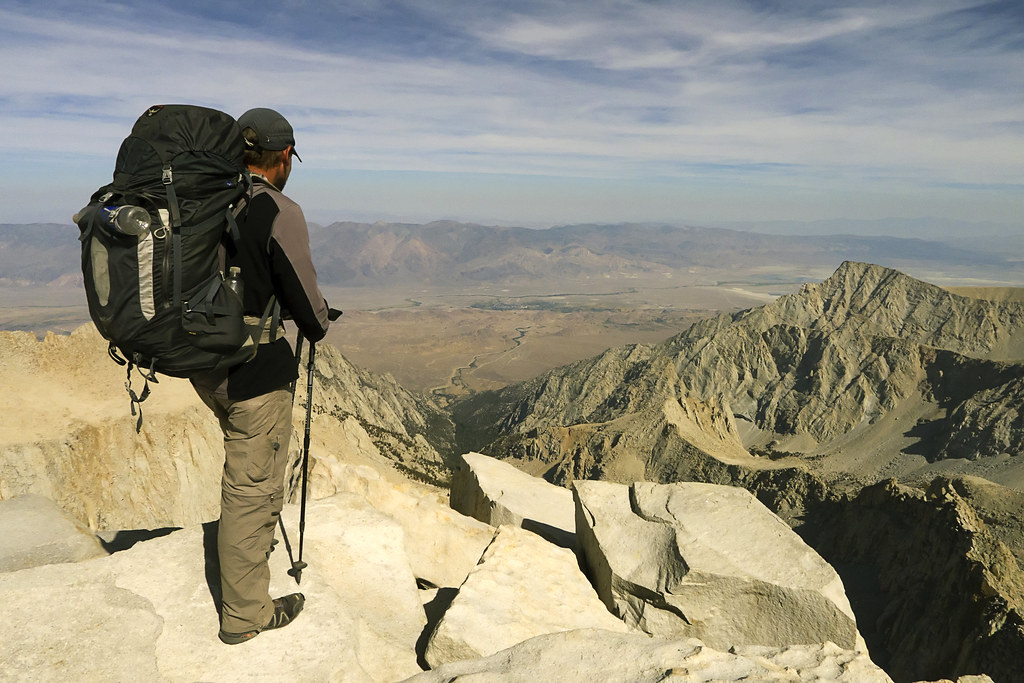
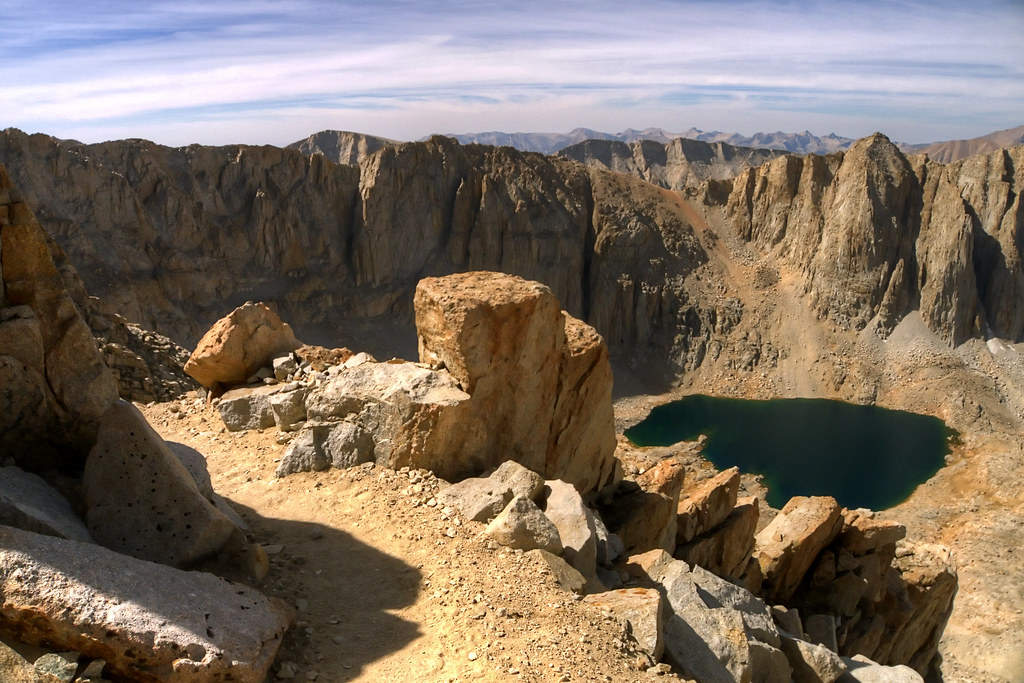
- Summited Mount Whitney, the highest mountain in the Contiguous United States
- Hitchhiked, for the couple-hundredth time, back to my car
- On my drive back I stopped to see friends I wish I could see more often, then went back to see the girls in Kentucky, and family in Indiana
- And finally… spent many nights wondering how I could ever go back to that old day-to-day life ever again
I thought I knew the country before leaving home last year, but I really didn't. I know now that it is beautiful beyond imagination. And even though bad things occasionally happen, its citizens are overwhelmingly good and caring. The number of people who went out of their way to lend a hand, a ride, a home, or home-cooked meal, were too numerous to count. They were people that knew nothing of me other than I was dirty, smelly, unshaven, and probably hungry or tired. And it seemed that the less they had, the more they wanted to help.
Ignore the news. Ignore the partisan politicians that get us worked up over nothing like they’re starving pit bulls just to win a dogfight. Ignore people that want us to believe we are divided. I learned that my favorite people and places align with me the least politically, scientifically, or religiously.
Ignore overzealous preachers and doomsayers. Our country is far from evil. I have to believe that anyone who believes it is has not made much of an effort to really see it. Other than on a television screen, which is a lot like listening to a symphony on blown-out cellphone speakers then believing music is a dreadful thing.
Ignore the news. Ignore the partisan politicians that get us worked up over nothing like they’re starving pit bulls just to win a dogfight. Ignore people that want us to believe we are divided. I learned that my favorite people and places align with me the least politically, scientifically, or religiously.
Ignore overzealous preachers and doomsayers. Our country is far from evil. I have to believe that anyone who believes it is has not made much of an effort to really see it. Other than on a television screen, which is a lot like listening to a symphony on blown-out cellphone speakers then believing music is a dreadful thing.
I've learned a few other things in these sixteen months. I know that I don't need much to be happy. I could lose all my possessions and be alright, and possibly happier because of it. And I learned that no matter how many unknowns my future holds, or how daunting something can be, I know I can get through it and come out just fine on the other side.
Perhaps the biggest lesson I learned in these sixteen months, is that you have to follow your bliss, whatever it may be. Life isn't permanent. I will continue to follow mine and continue to write about it.
I guess a better title for this post might be, "Sixteen Months of Wandering... and counting."
Perhaps the biggest lesson I learned in these sixteen months, is that you have to follow your bliss, whatever it may be. Life isn't permanent. I will continue to follow mine and continue to write about it.
I guess a better title for this post might be, "Sixteen Months of Wandering... and counting."
A Backpacker's Life List by Ryan Grayson is licensed under a Creative Commons Attribution-NonCommercial-NoDerivs 3.0 Unported License.
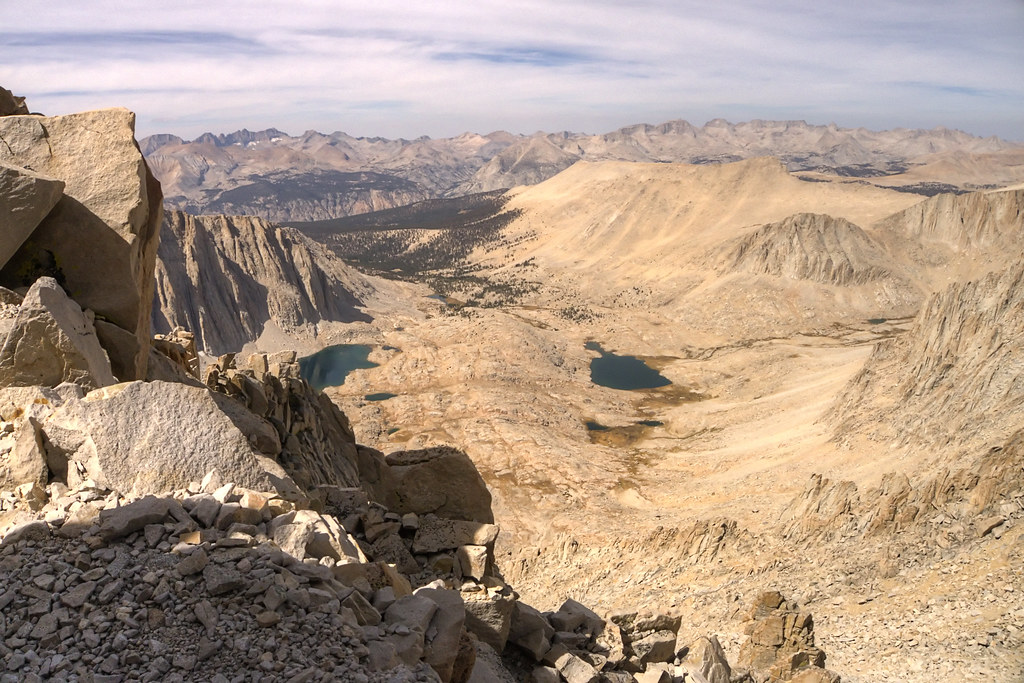
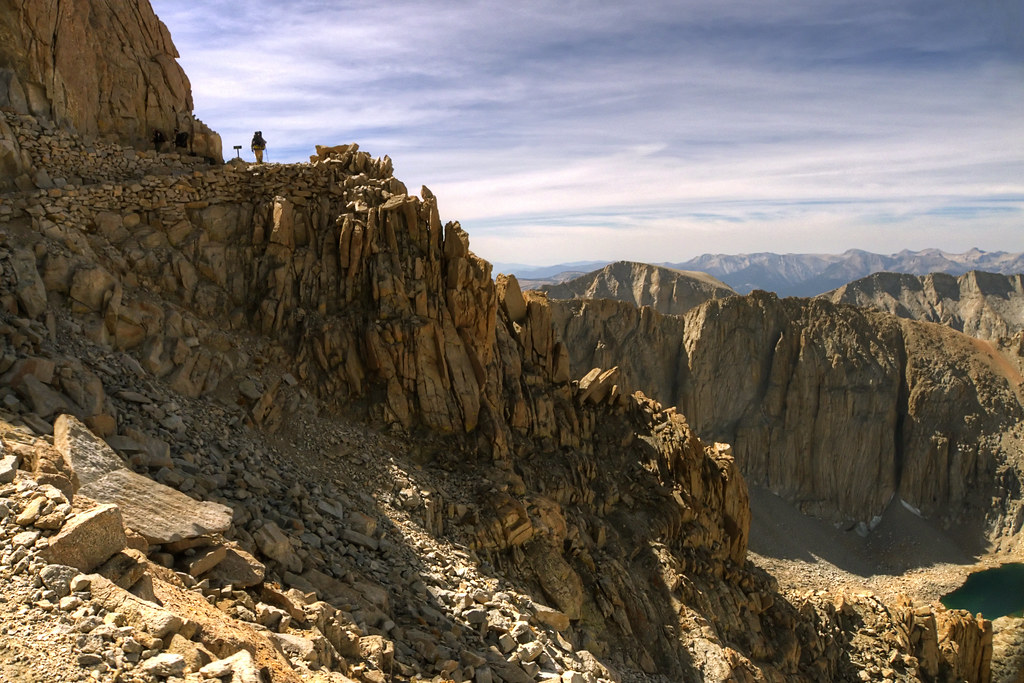
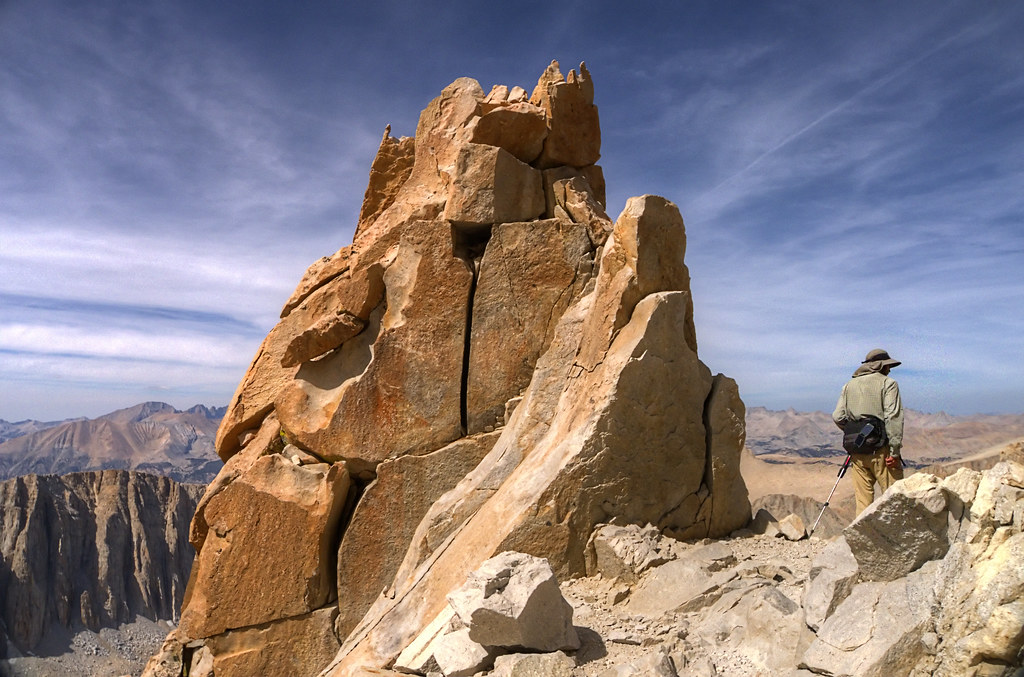
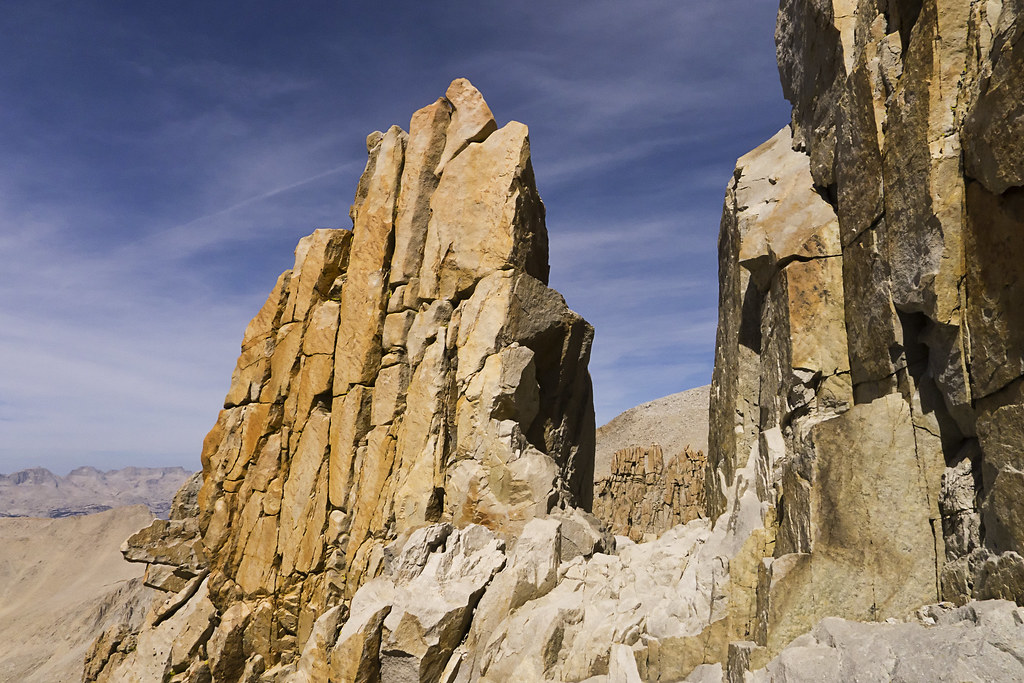
John Muir Trail Photos, Day 18: Mount Whitney
That's how much my life has changed since I decided to hike the Appalachian Trail last year, I just used, "Time off," to refer to the time when I'm working.
|
| ||||
|
|
||||
|
|
||||
|
|
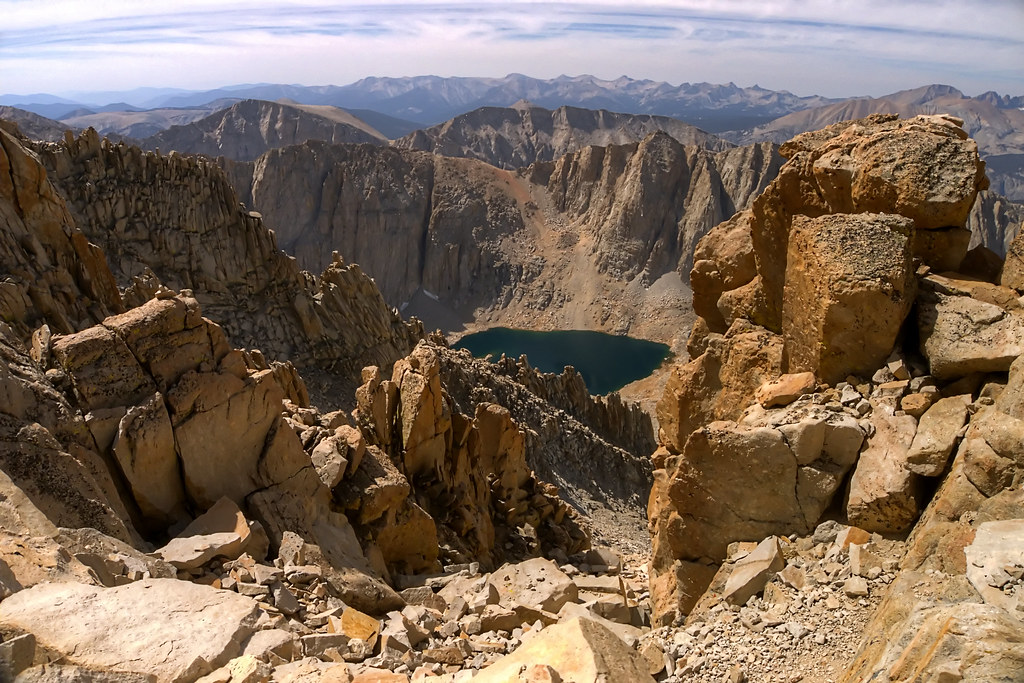
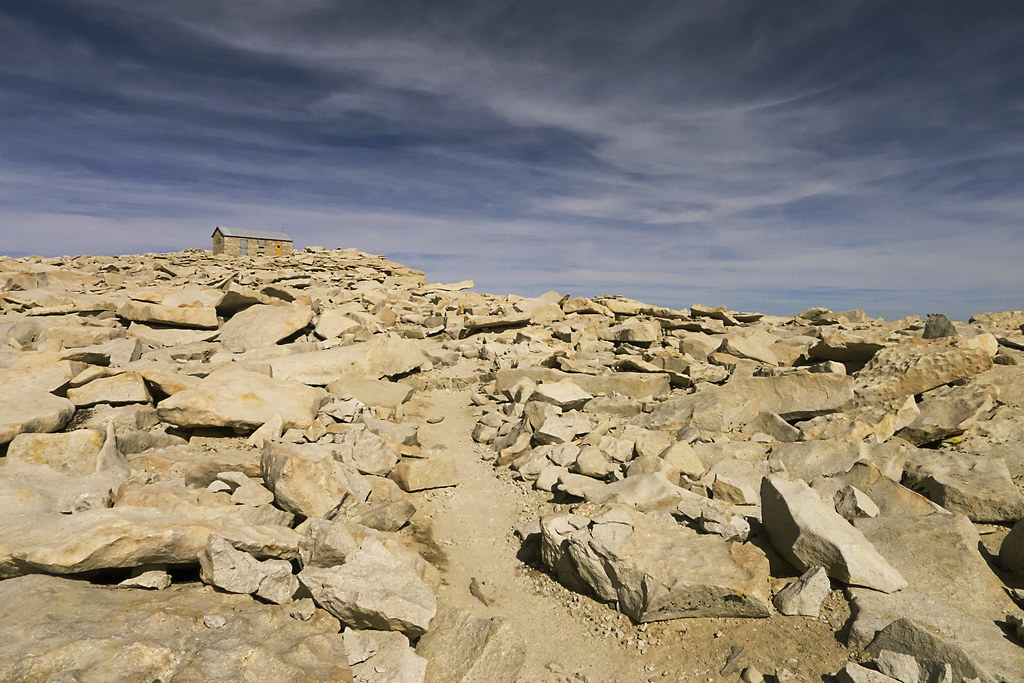

|
|
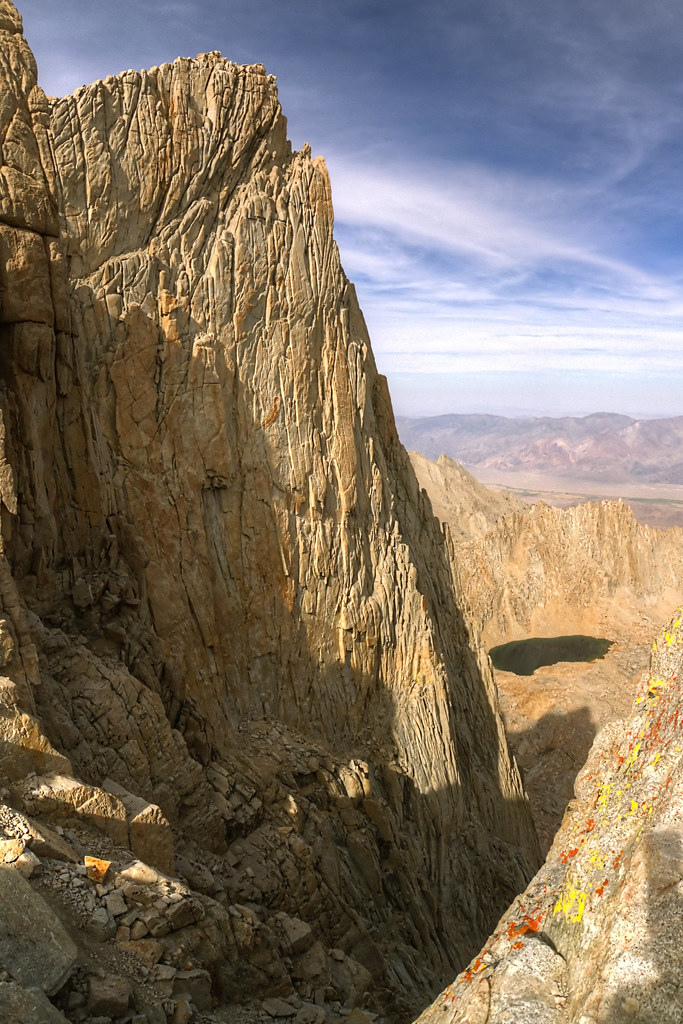
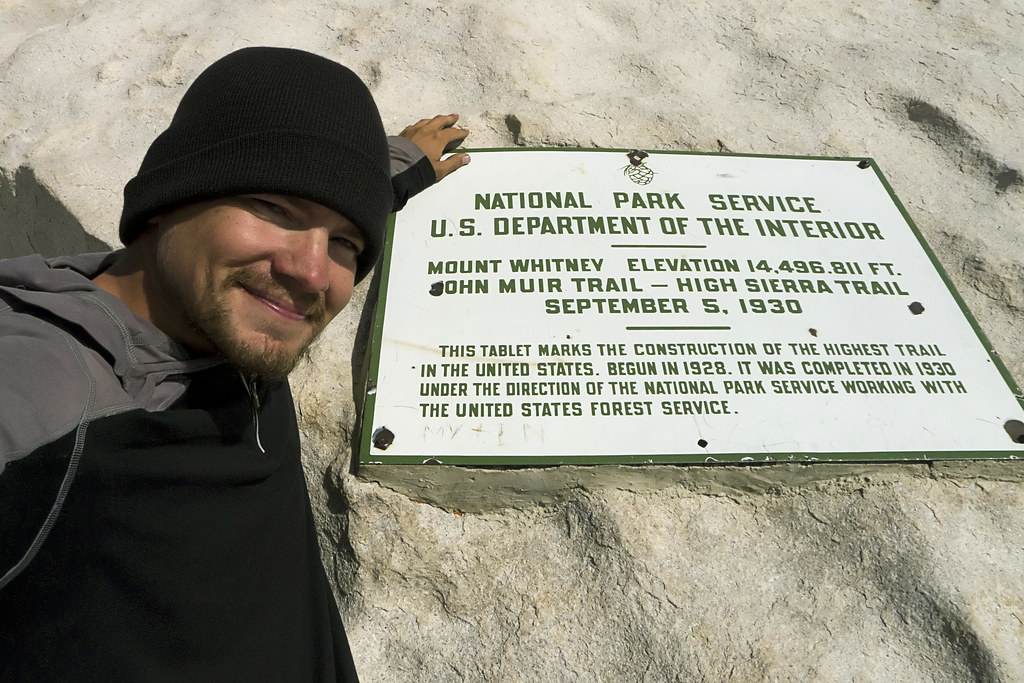
A Backpacker's Life List by Ryan Grayson is licensed under a Creative Commons Attribution-NonCommercial-NoDerivs 3.0 Unported License.
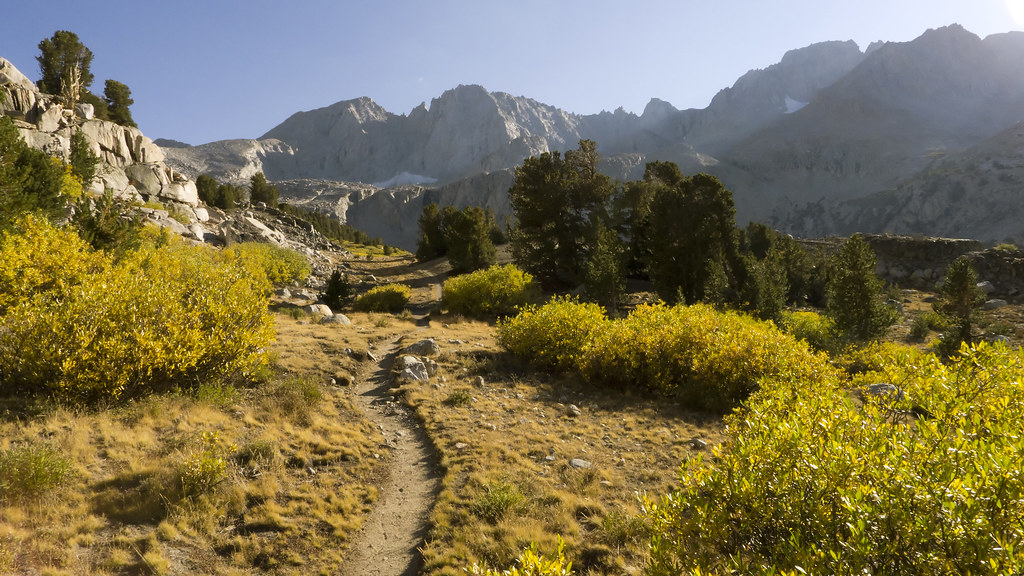
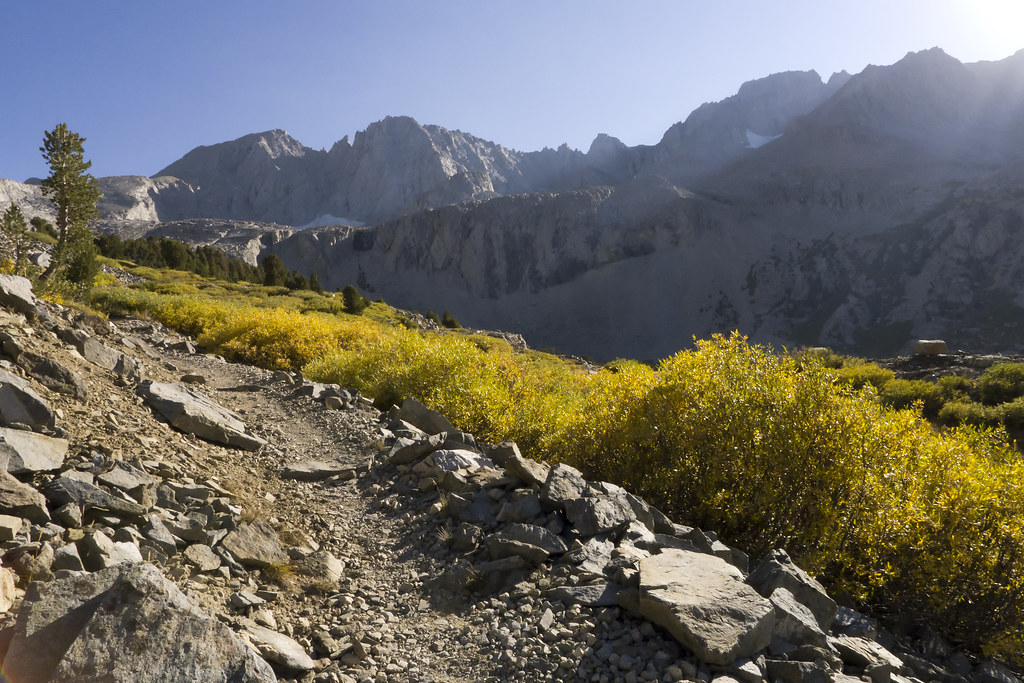
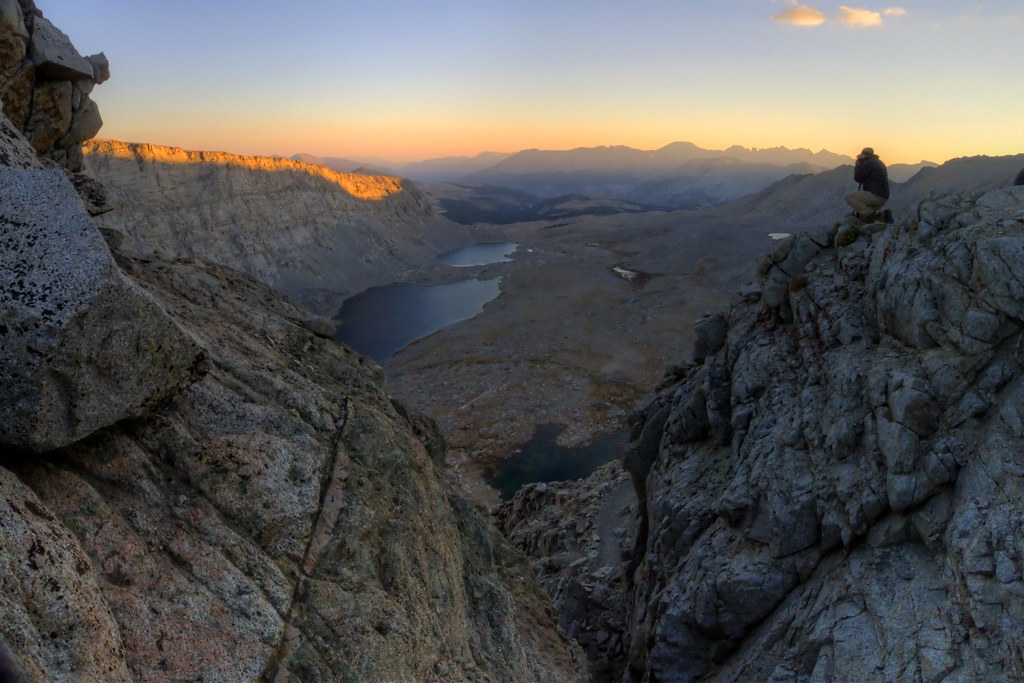
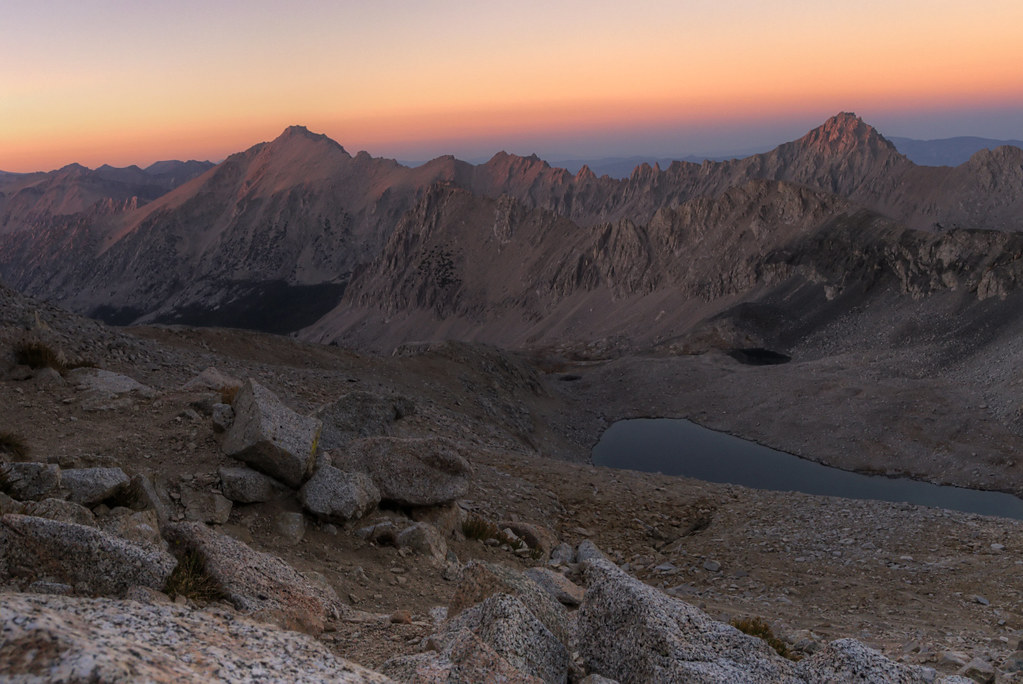
John Muir Trail Photos, Day 17: Forester Pass

This road trip lasted three months, but it feels like at least double that. When I told someone that I was surprised only three months had passed, they were surprised it had been that long. To them it seemed like I left only a month ago. Six months to one. I think I discovered the secret to longevity. I've been going at it all wrong. I had been trying to live a healthy lifestyle to extend my life, but that doesn't guarantee longevity. Killing monotony and repetition, however, does.
In the words of the great philosopher, Eddie Vedder, "I escaped it, a life wasted. I'm never going back again."
|
| ||||
|
|
||||
|
|

A Backpacker's Life List by Ryan Grayson is licensed under a
Creative Commons Attribution-NonCommercial-NoDerivs 3.0 Unported License.
John Muir Trail Photos, Day 16: Independence, CA
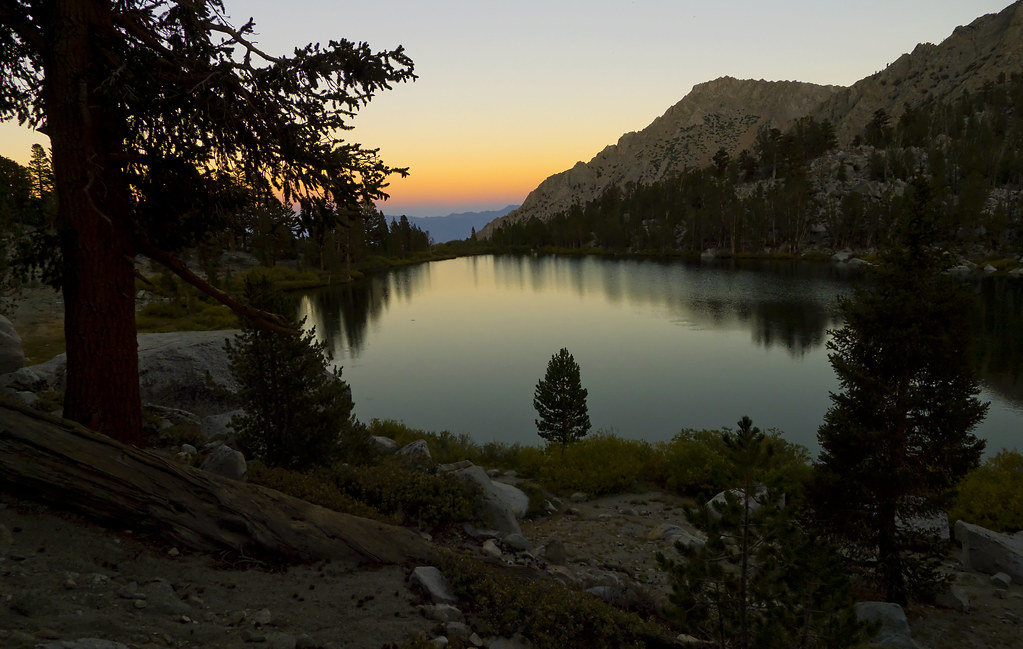 |
| Lake Near Kearsarge Pass |
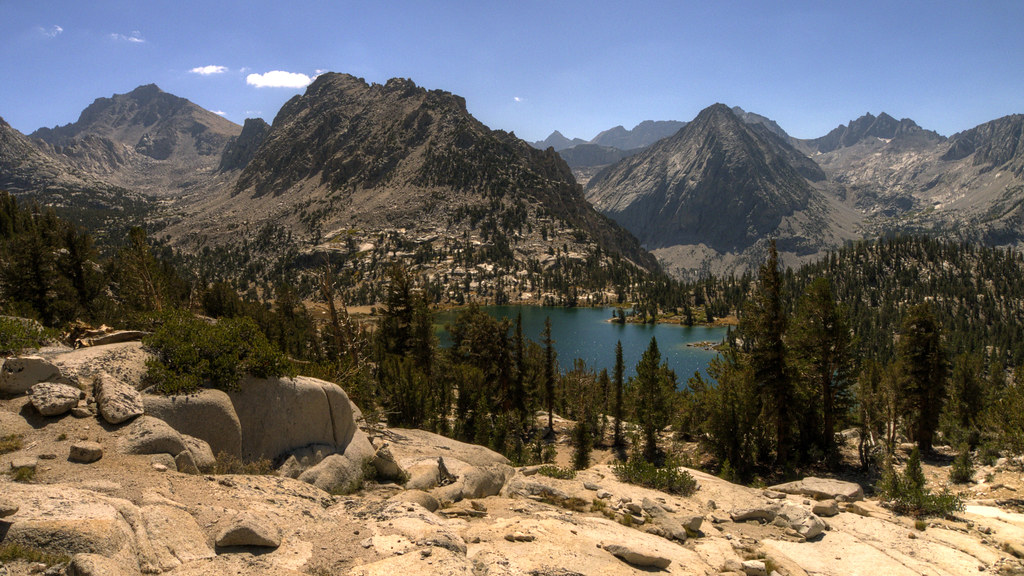
After four miles of descending switchbacks, I got to a trailhead and campground parking lot. A couple I met on top of Kearsarge, who were also hiking the JMT, were pulling food out of bear lockers that they stashed before starting their hike. I still had fifteen miles of road between food and me. It reminded me that I used to be a planner. I used to have every detail of a trip figured out before I left the house, but when I left the house nearly three months earlier, I didn’t even know I would be in California or hiking the John Muir Trail. I’ve grown to love not having a plan.
A half mile down the road, I heard cars behind me. I turned and put out my thumb. A defeated-looking gold Ford Taurus, that was riding the bumper of the SUV in front of it, skidded to a halt on the side of the road.
 |
| Me on Kearsarge |
I tossed my gear in the back, next to all her mountain climbing gear, and got in. She put her heavy foot on the gas pedal and got back on the road, spitting gravel behind us. Every hairpin curve meant slamming on her breaks to slow down, then revving the engine to get back on the SUV’s bumper.
“So where do you want dropped off?” she asked. “I’m going to Bishop, but I’ll be going through Independence.”
“Anywhere in Independence is fine. I don’t really know where anything is anyway, so it doesn’t really matter," said the man without a plan.
As with most hitches, we talked about traveling, what we’ve done and where we’ve been. I noticed that my list is getting really long.
After she dropped me off, I thanked her for the ride and hoisted my pack onto my shoulders. It didn’t take long to find a cheap place to eat. Actually, in a town with a population of 600, there is only ever one place for cheap food. The Subway in a gas station.
 They had everything I needed in addition to cheap food: washing machines, showers, and groceries. After doing all that, there wasn’t time to hitch back to the trail before dark, so I hung out in the Subway for hours. I wrote in my journal, updated my blog, and ate two feet of sandwich. (Hey, backpacking burns a lot of calories, don’t judge me.)
“If you were homeless, hypothetically-speaking, where would you sleep in town?” I said to the woman closing up the sandwich shop. We’d gotten to know each other pretty well by this point.
“Umm, well, there is a park just up the road,” she said while leaning on her mop handle. “And the only cops we have are from Bishop. They never come here unless they’re called."
The word homeless is such a misnomer. I had a home that night, a bare patch of ground in a thicket of shrubs and trees in a small town park. I rolled out my sleeping pad and slept like a baby.
It’s easy to sleep like a baby when you have no debt, no plan, and the knowledge that you could lose everything and still be okay.
A Backpacker's Life List by Ryan Grayson is licensed under a
Creative Commons Attribution-NonCommercial-NoDerivs 3.0 Unported License.
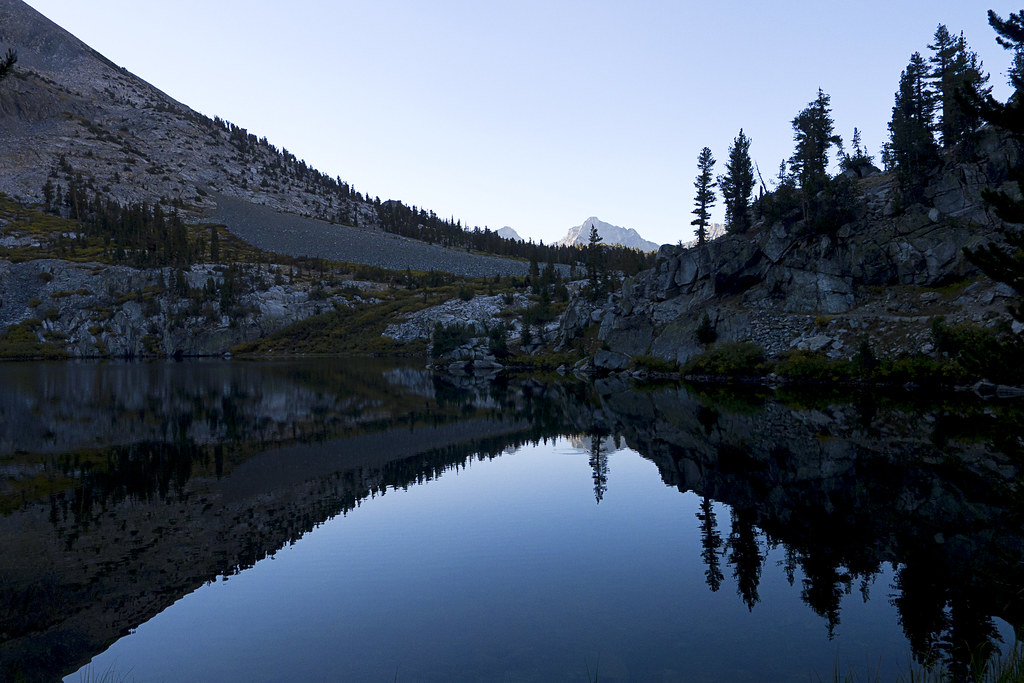
John Muir Trail Photos, Day 15: Rae Lakes and Kearsarge Pass
|
| ||||
|
|
||||
|
|||||
|
|
||||
|
|
||||
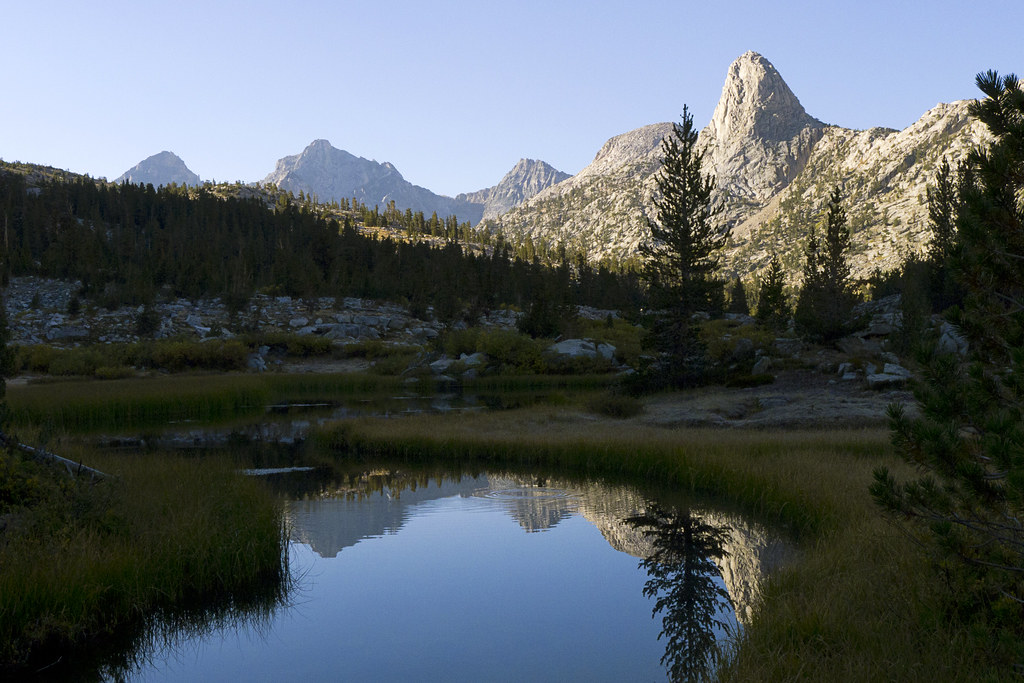

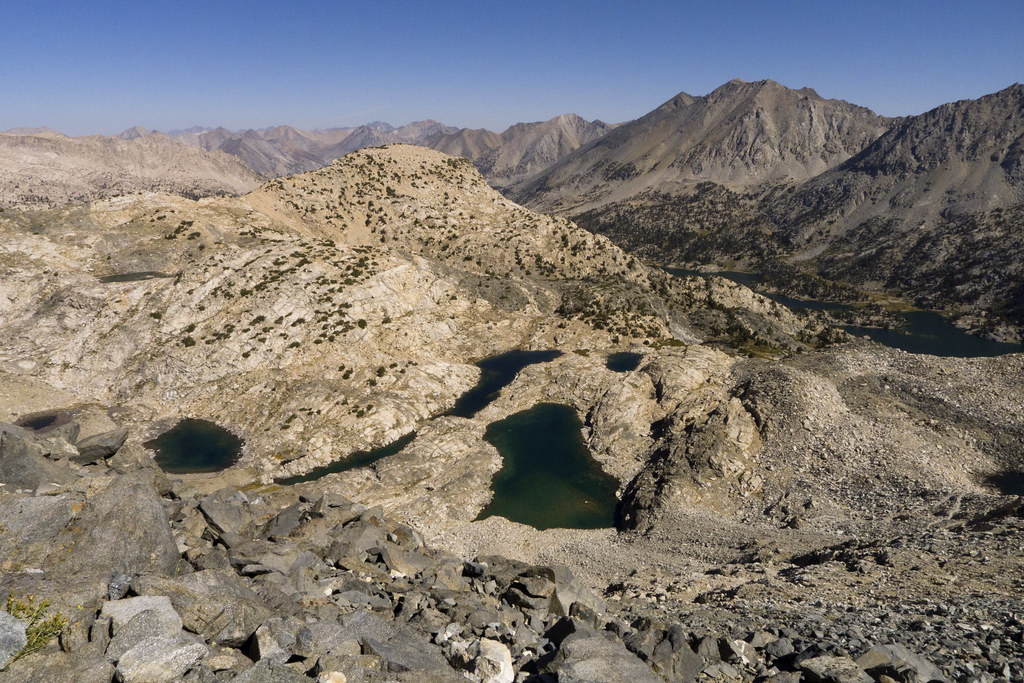
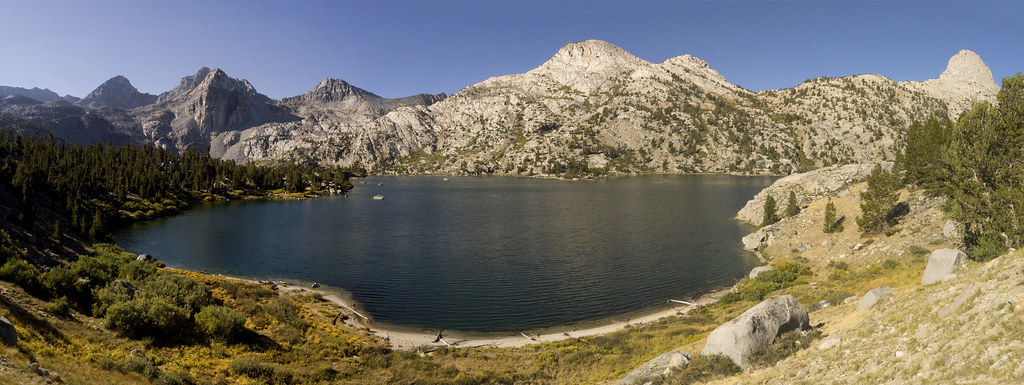
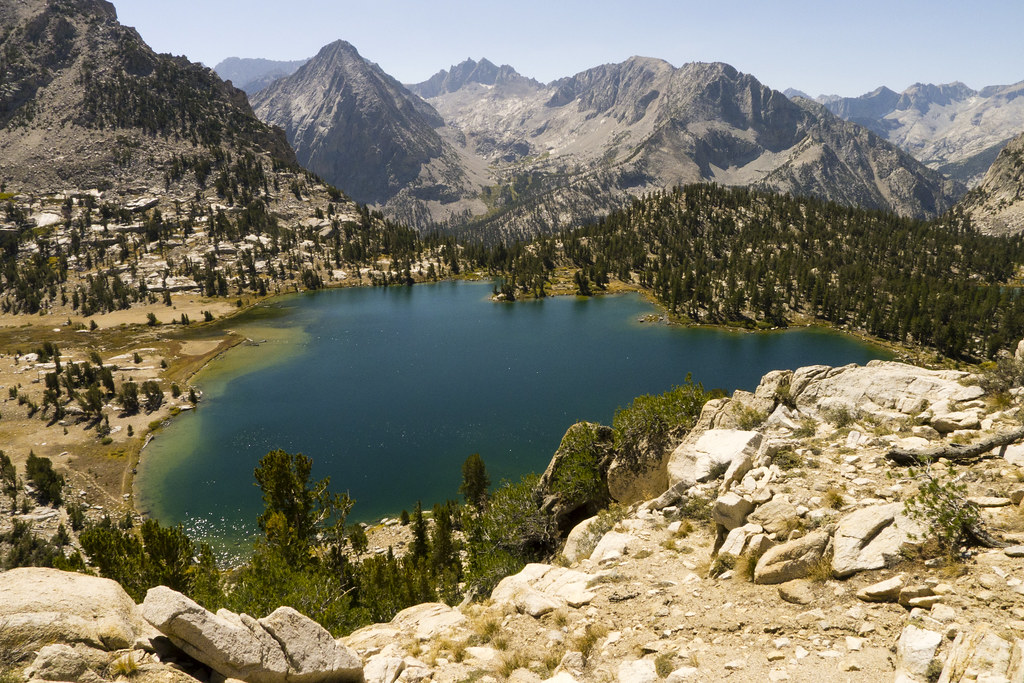


A Backpacker's Life List by Ryan Grayson is licensed under a
Creative Commons Attribution-NonCommercial-NoDerivs 3.0 Unported License.
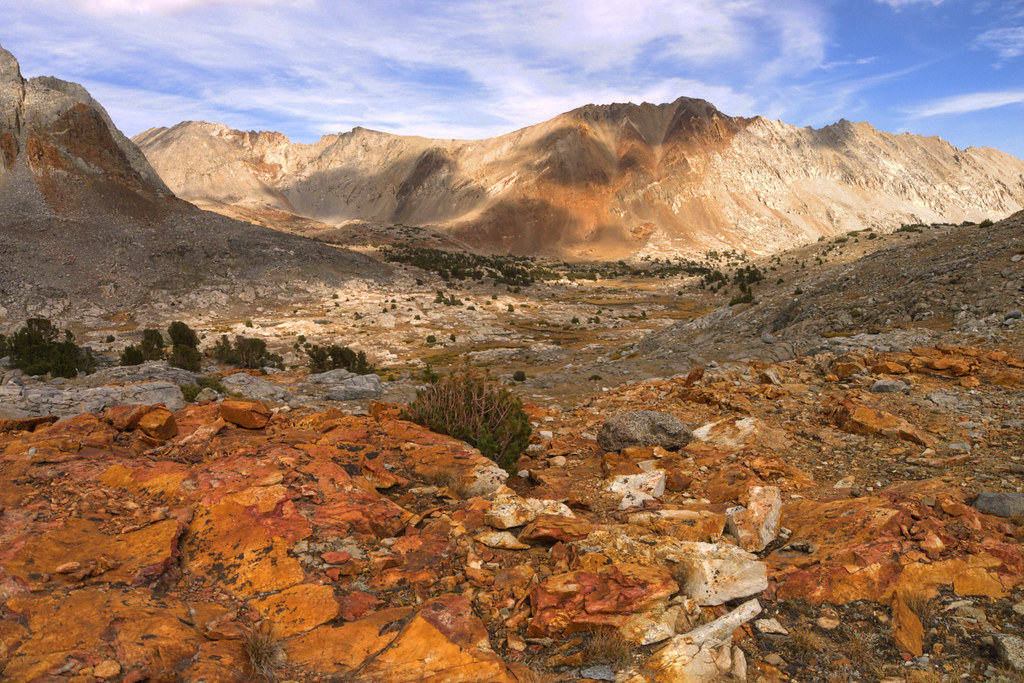
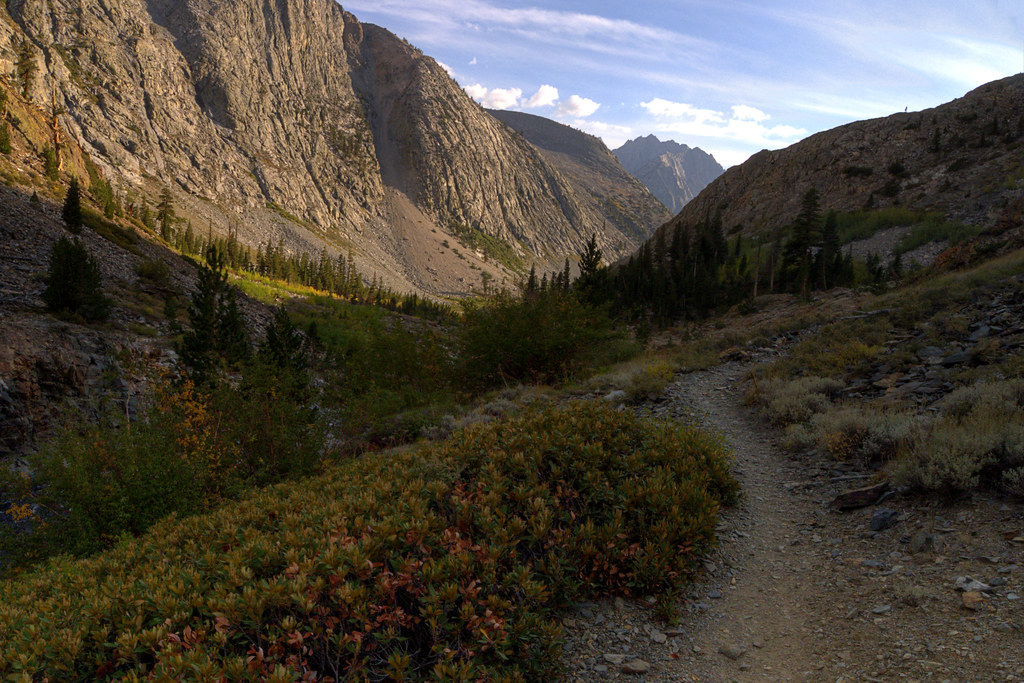
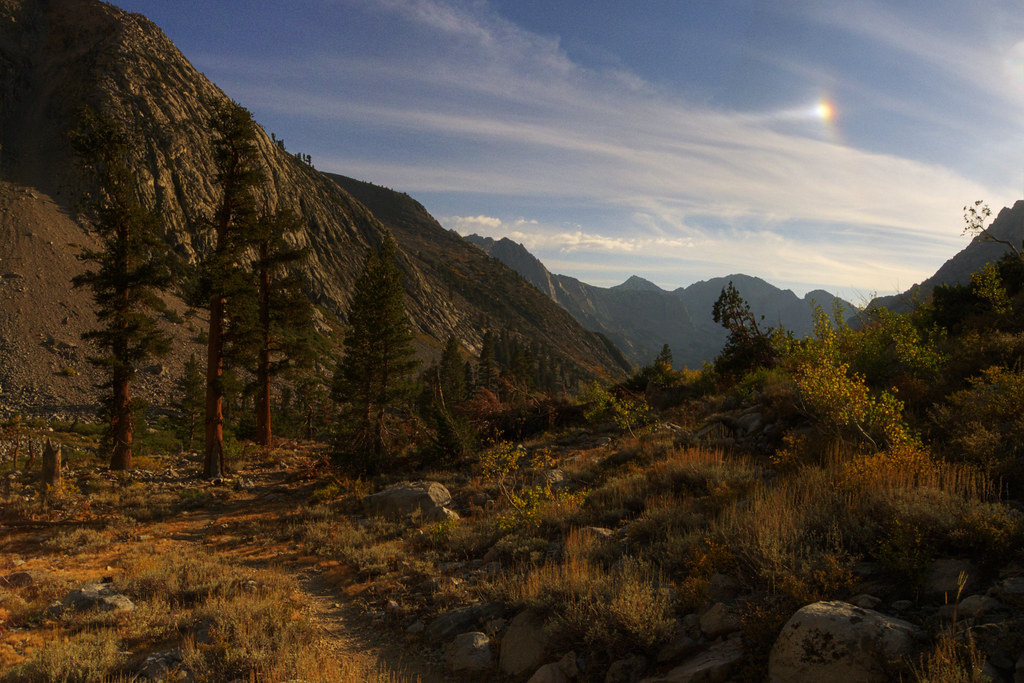
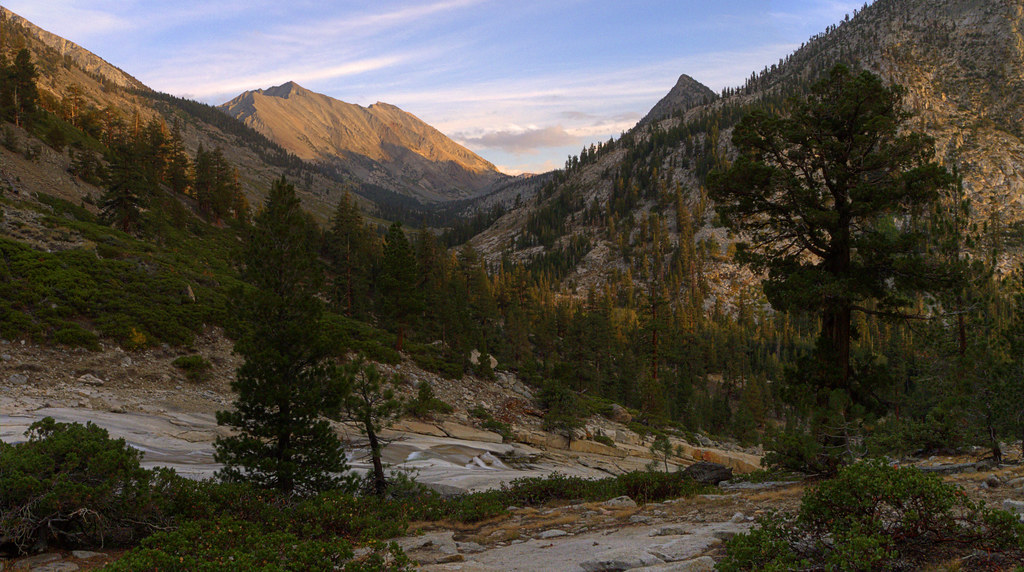
John Muir Trail Photos, Day 14: Taboose and Pinchot Passes
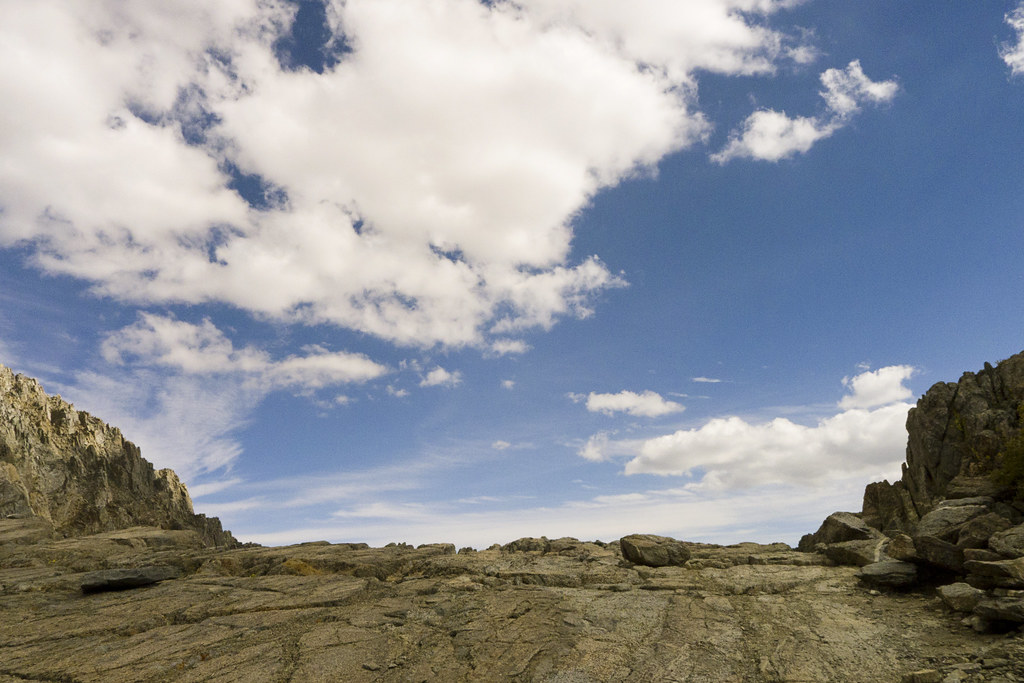
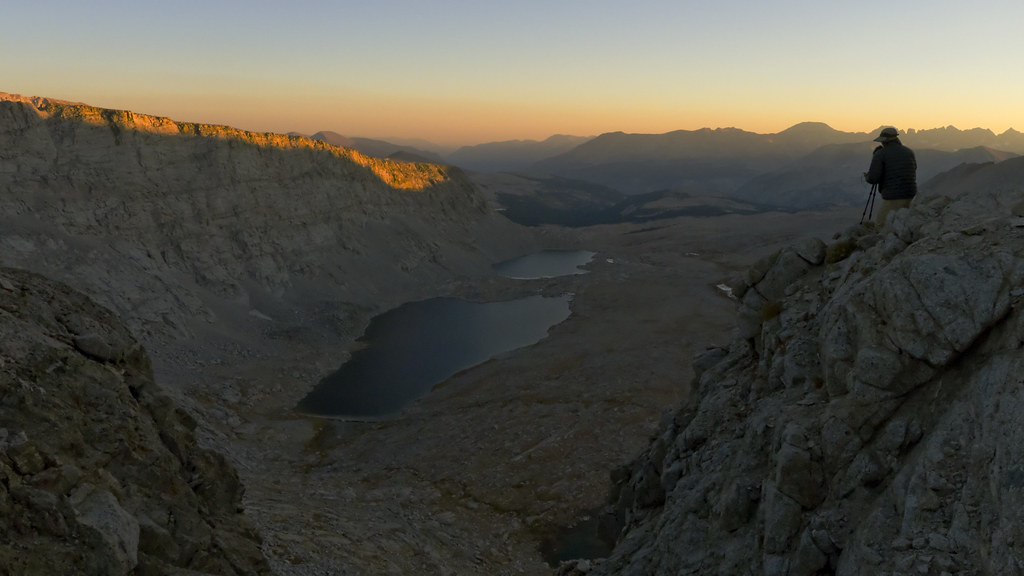
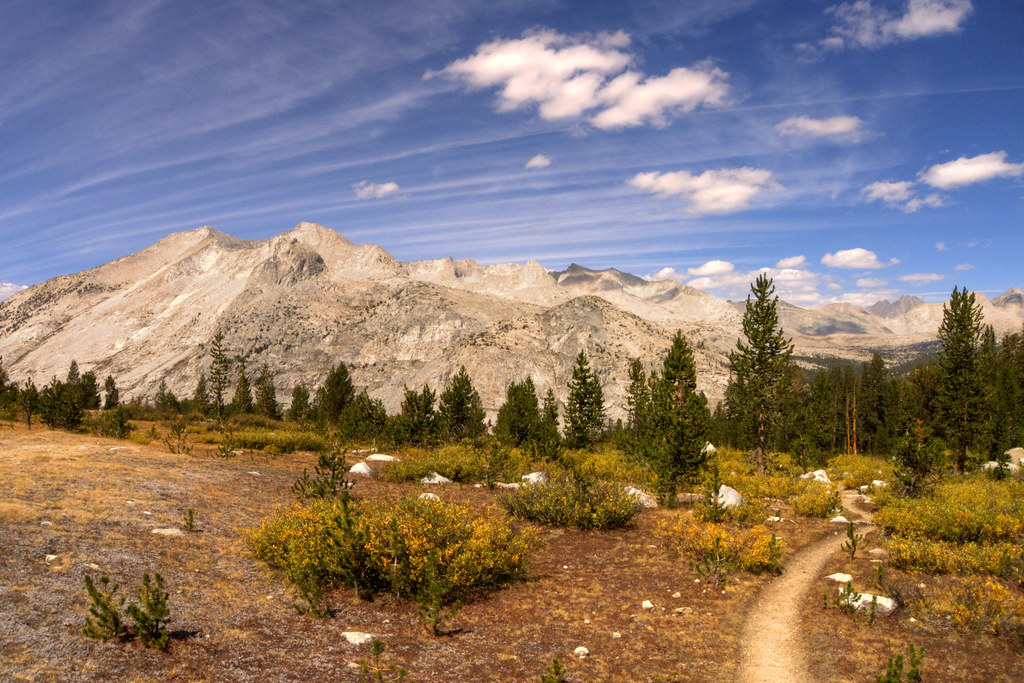
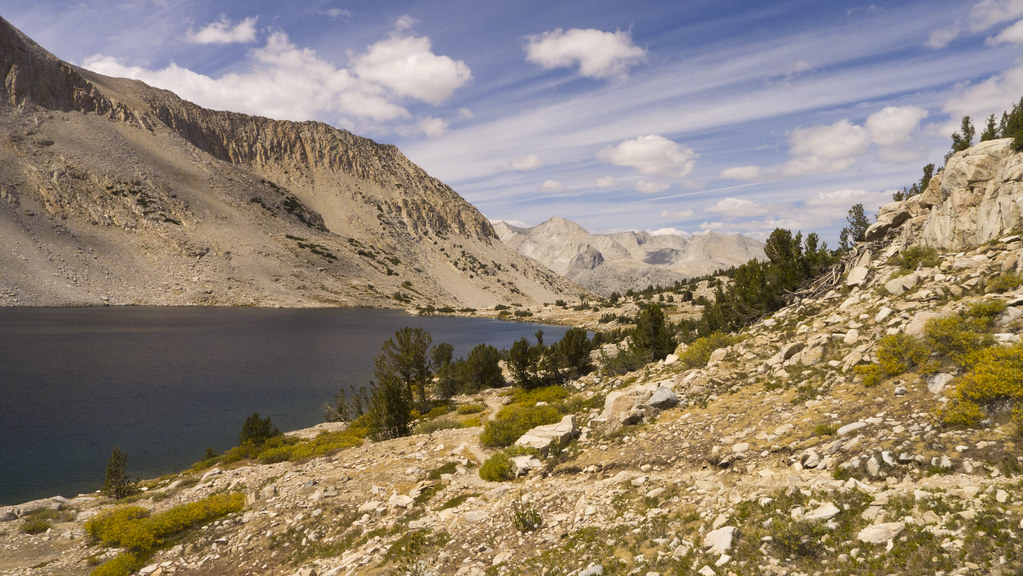
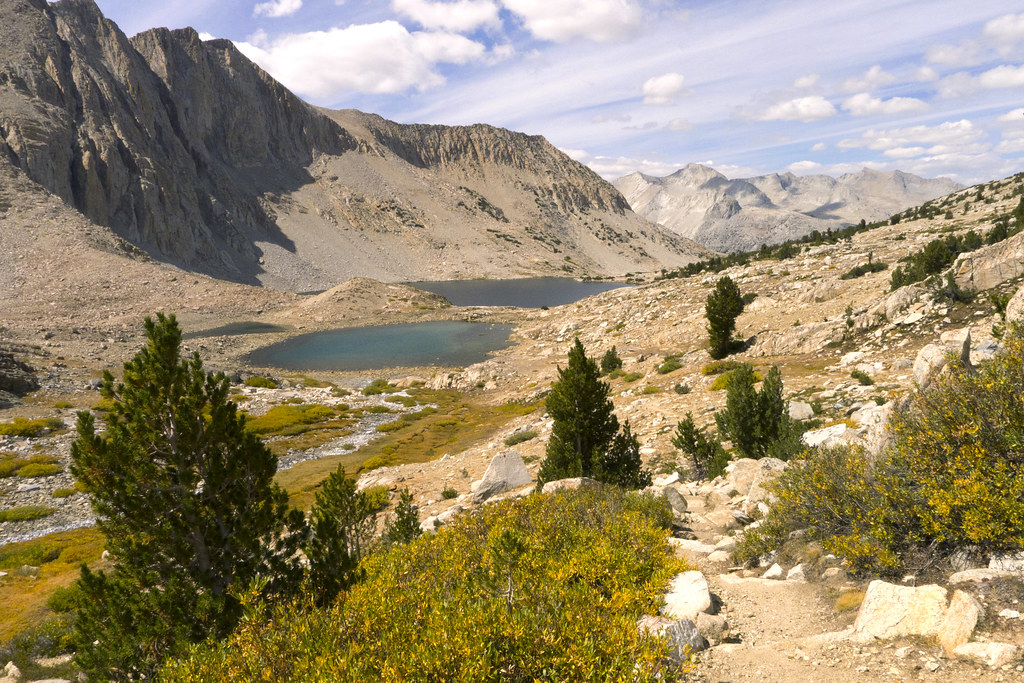
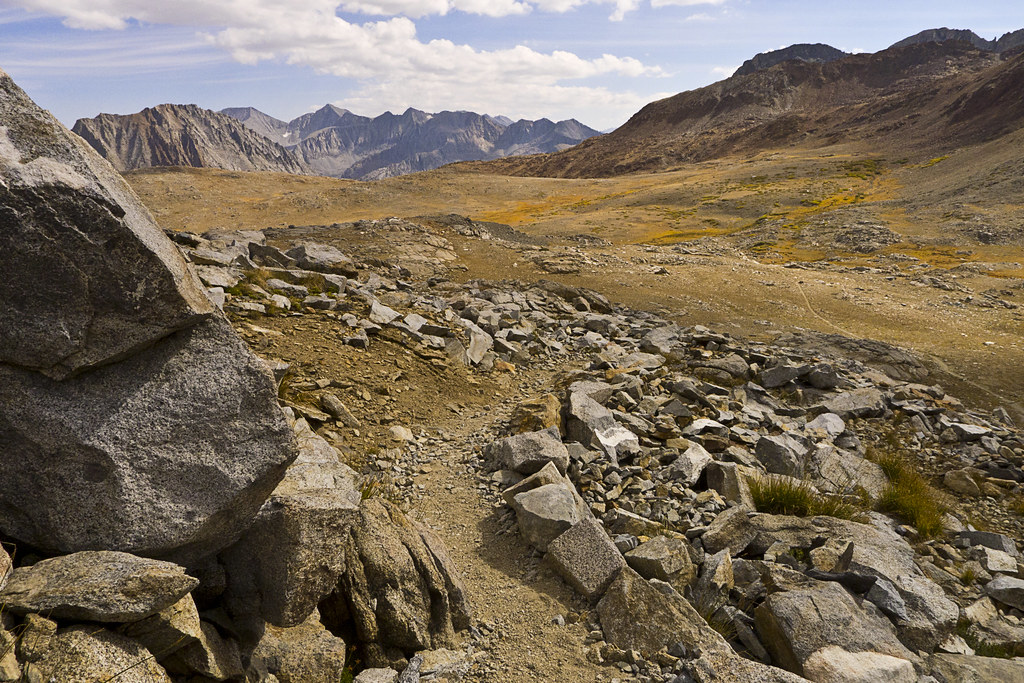
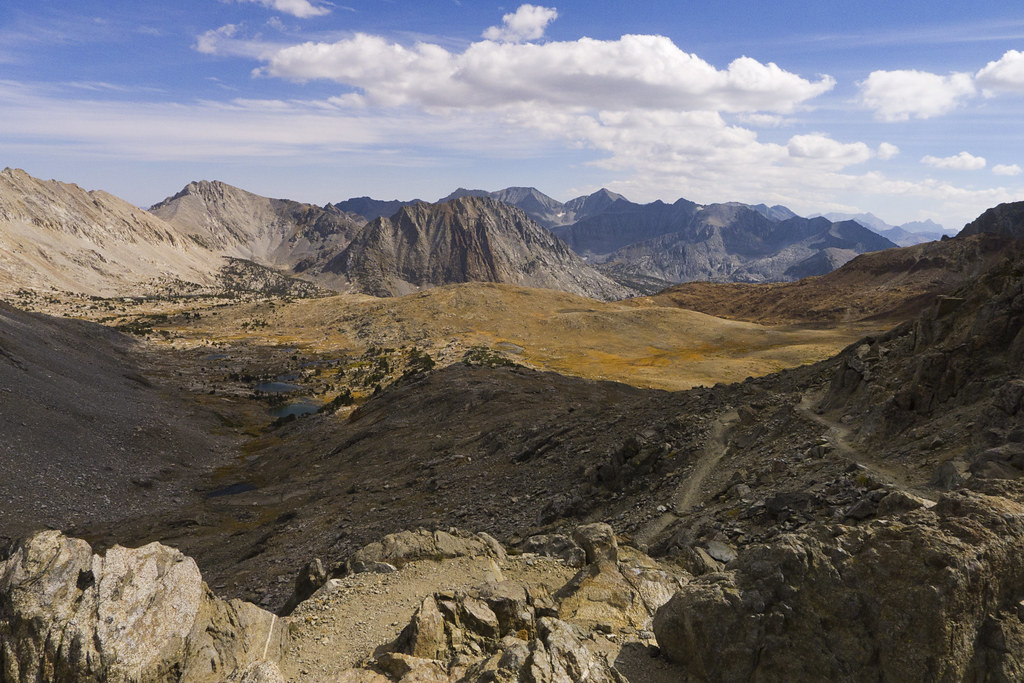 I pulled out my camera right before crossing over Pinchot
Pass. What will be on the other side? I wanted to remember the moment, those seconds between not knowing and knowing. While backpacking, that transition is always good and exciting. What will be on the other side? On the trail, knowing is always better. That's yet another reason it's so hard to return to a normal life, where I have been reminded that sometimes ignorance is bliss.
I pulled out my camera right before crossing over Pinchot
Pass. What will be on the other side? I wanted to remember the moment, those seconds between not knowing and knowing. While backpacking, that transition is always good and exciting. What will be on the other side? On the trail, knowing is always better. That's yet another reason it's so hard to return to a normal life, where I have been reminded that sometimes ignorance is bliss.
|
| ||||
|
|
||||
|
|
||||
|
|
||||
|
|

A Backpacker's Life List by Ryan Grayson is licensed under a
Creative Commons Attribution-NonCommercial-NoDerivs 3.0 Unported License.
John Muir Trail Photos, Day 13: Mather Pass
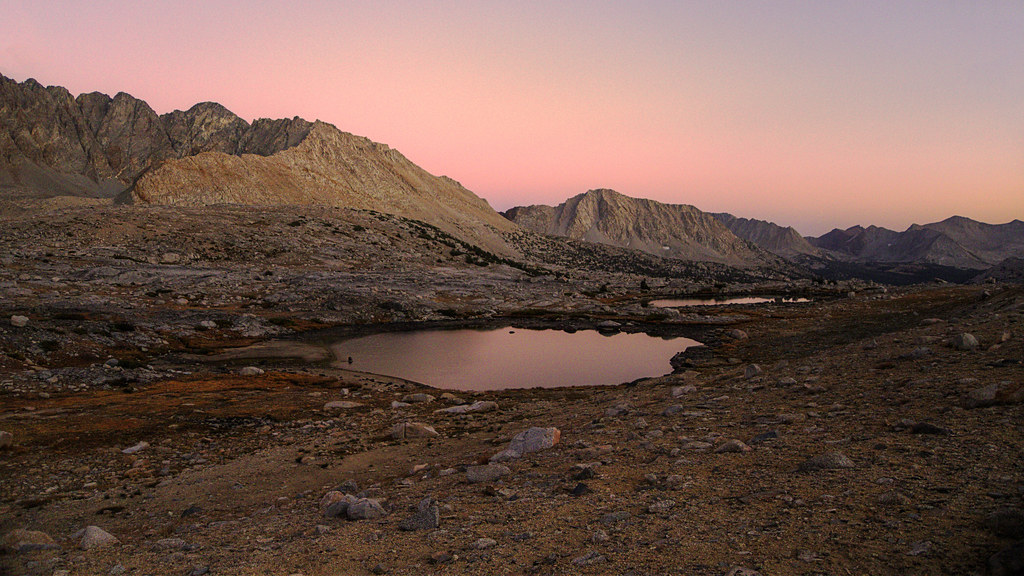
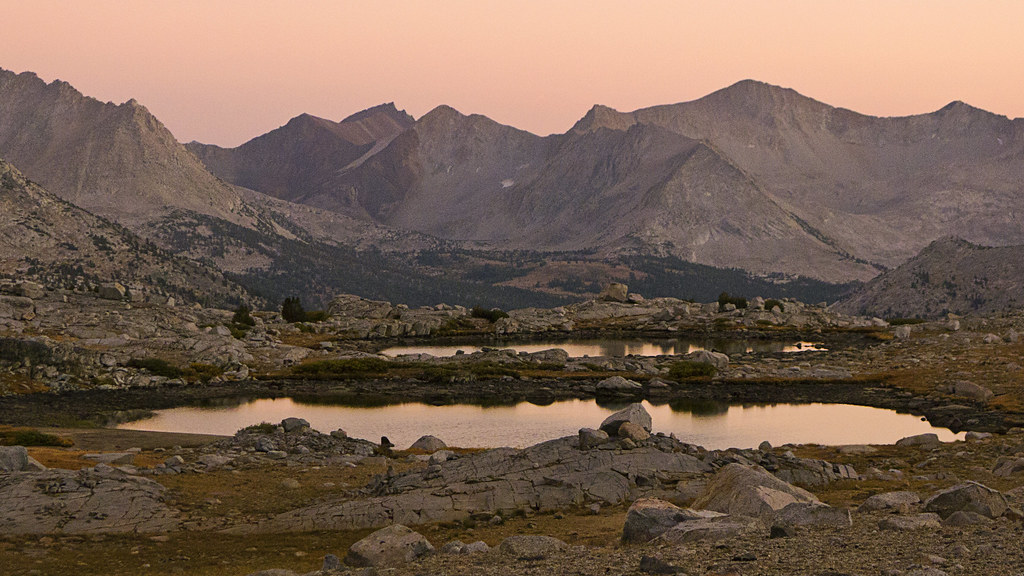
By the time I got to the valley on the other side, the sunset turned the sky pink and the lakes purple. None of the plants were green, but golden yellow. It was dead silent and there were no other hikers as far as I could see. It was easy to imagine I was traipsing over some other uninhabited planet.
Nope, still not tired of this.
|
| ||||
|
|
||||
|

A Backpacker's Life List by Ryan Grayson is licensed under a
Creative Commons Attribution-NonCommercial-NoDerivs 3.0 Unported License.
John Muir Trail Photos, Day 12: Evolution Basin
|
| ||||
|
|
A Backpacker's Life List by Ryan Grayson is licensed under a
Creative Commons Attribution-NonCommercial-NoDerivs 3.0 Unported License.
John Muir Trail Photos, Day 11: King's Canyon
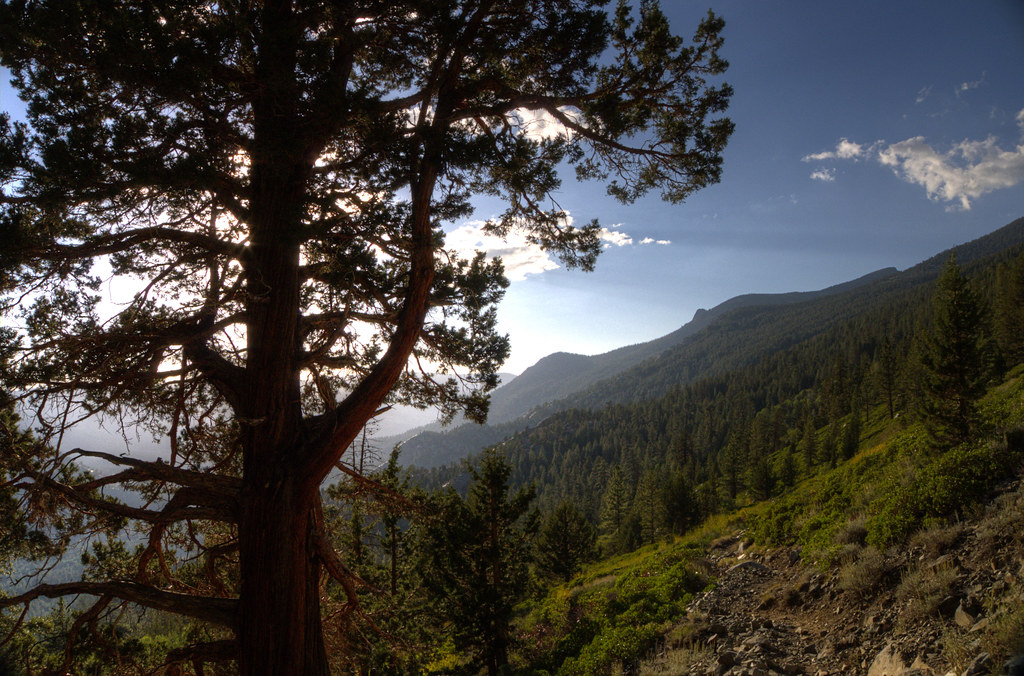
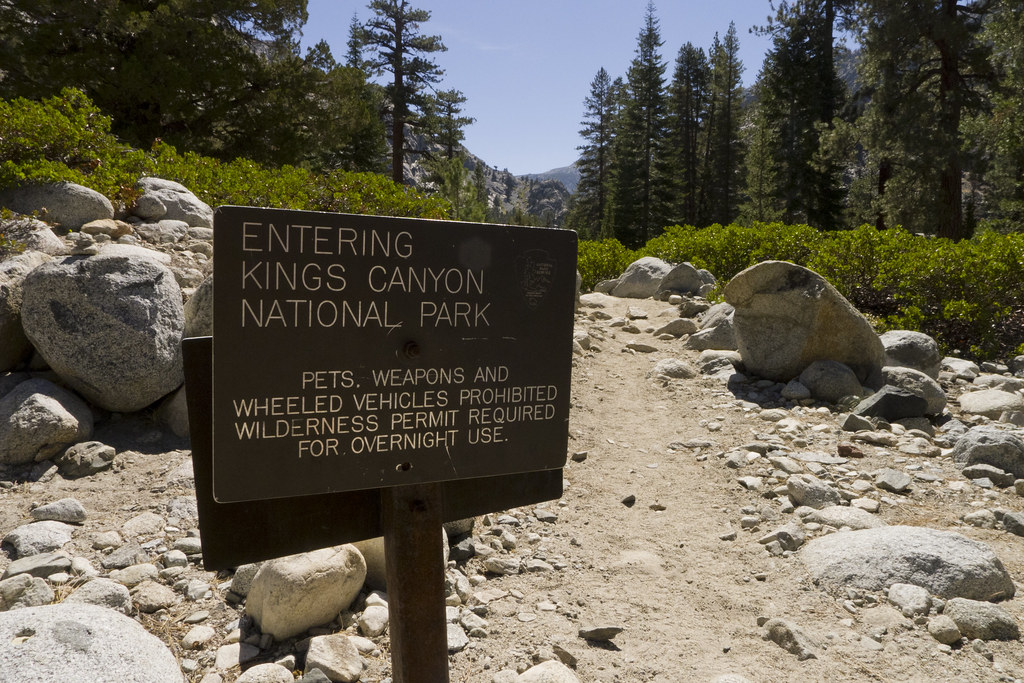
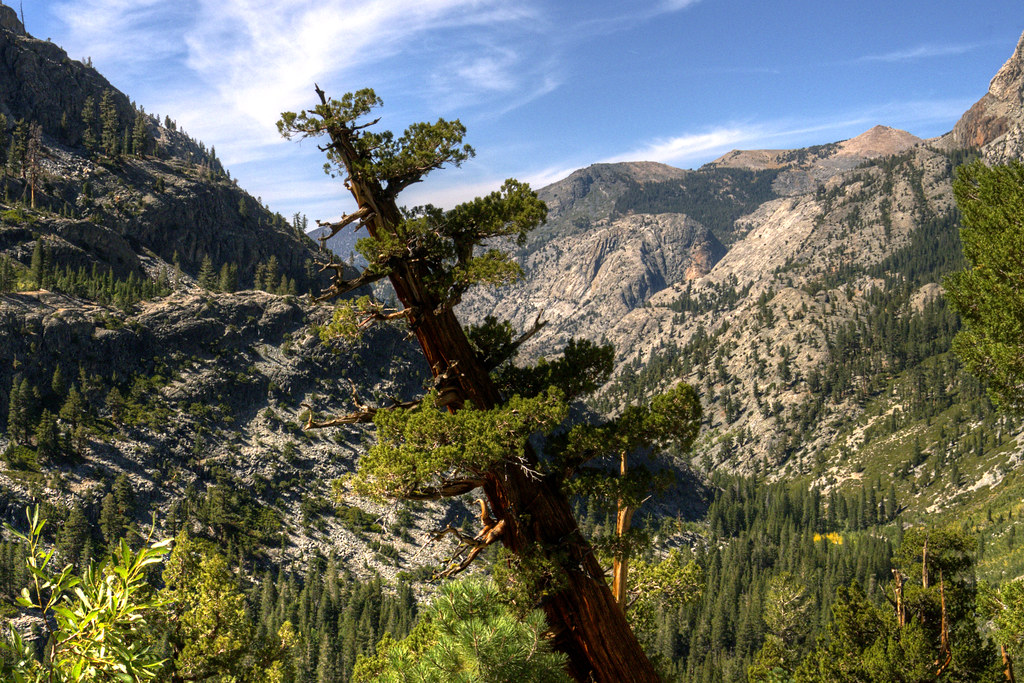
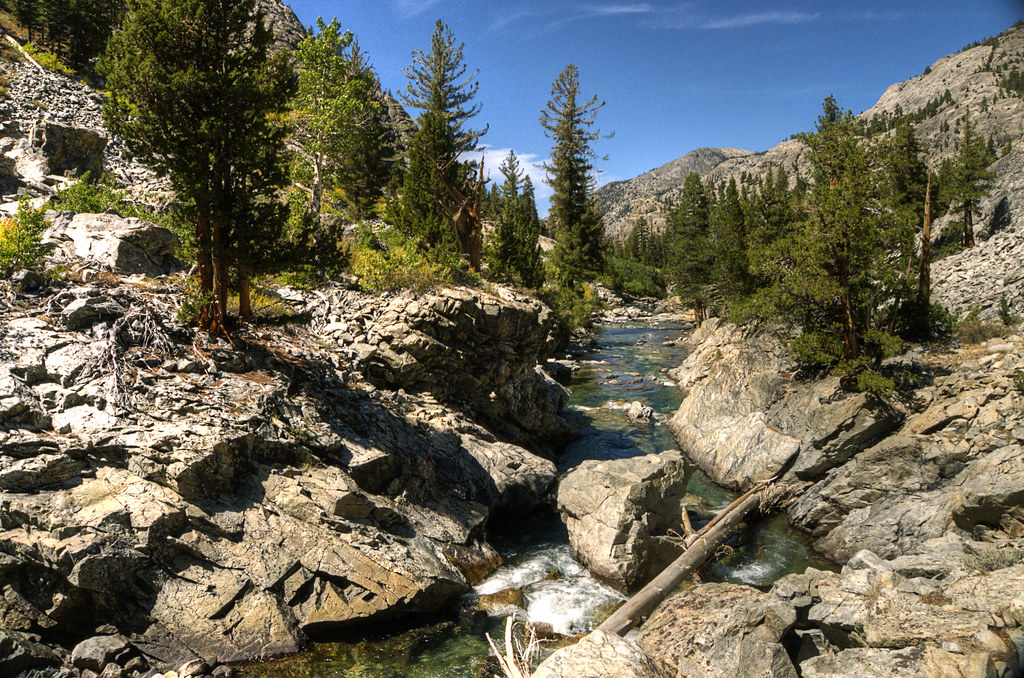
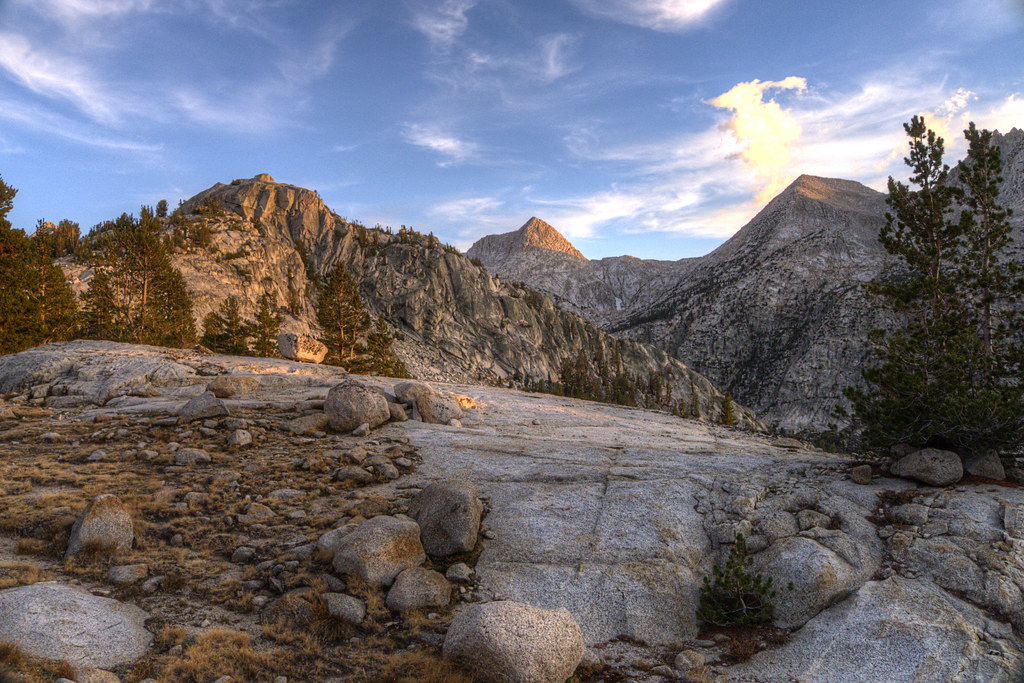
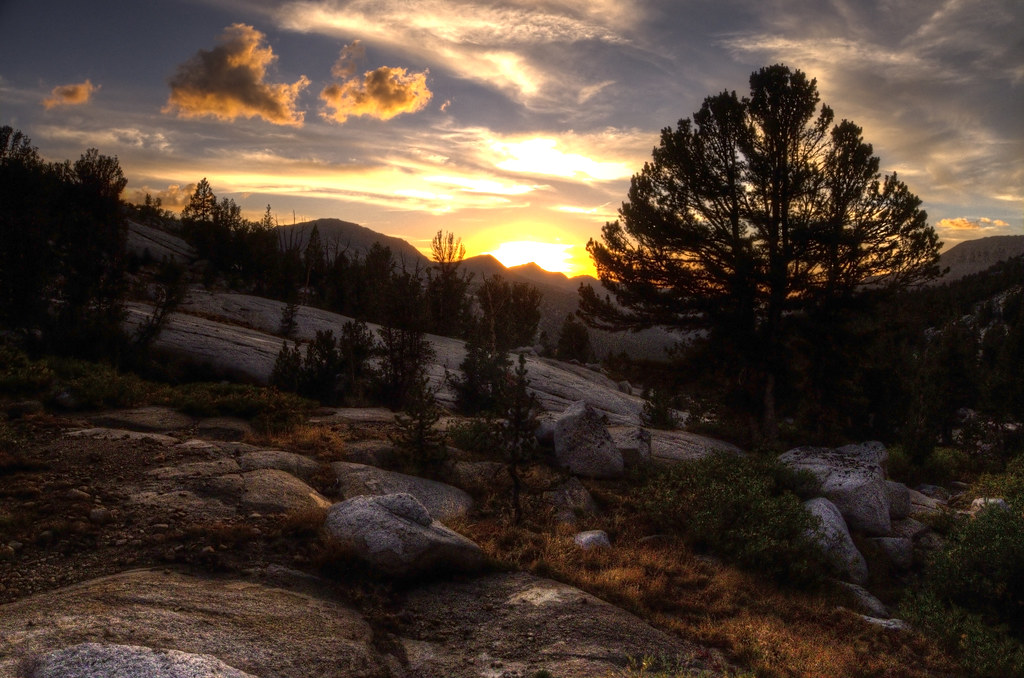
My guidebook didn't tell me when I crossed a park boundary, but deer are only this tame in national parks and I knew I was getting close to Kings Canyon National Park. It was confirmed when I later realized I was in a forest of giant sequoias. I setup camp under the towering trees and crossed into Kings Canyon the next morning.
|
| ||||
|
|
||||
 |
|
||||
|
|
||||


A Backpacker's Life List by Ryan Grayson is licensed under a
Creative Commons Attribution-NonCommercial-NoDerivs 3.0 Unported License.