


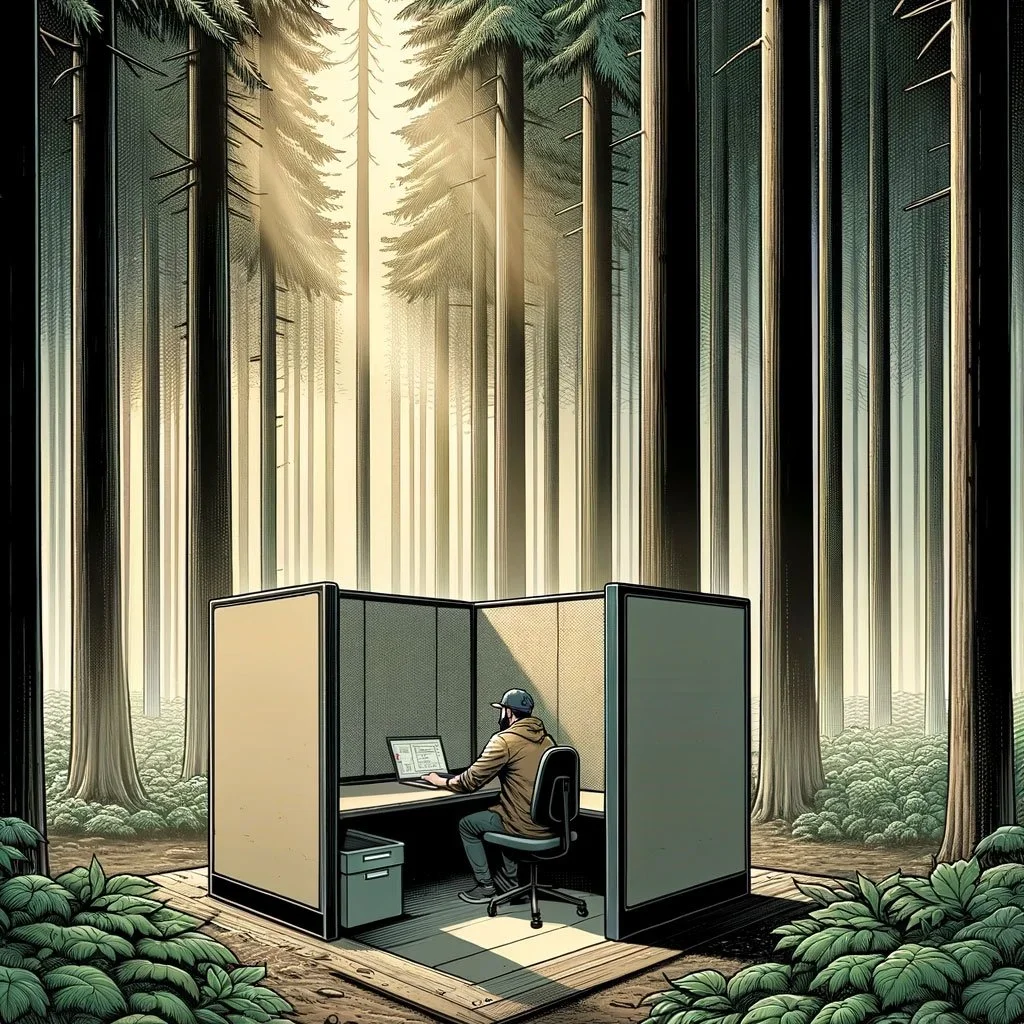

I am a time traveler, living in the future’s past. My time machine sits in a discreet space on a mezzanine above an electrical panelboard factory. To the casual observer, it would seem unremarkable, nothing more than an inconspicuous office cubicle tucked away in a neglected corner of a cinder block room, but nobody knew it as well as I did.
The office space itself exuded an air of abandonment, filled with vacant desks, outdated mainframe hardware unused for three decades, a workbench adorned with disassembled computers, and various peripherals neatly arranged on metal shelves. It was a space that blended seamlessly into the fabric of anonymity, the type of room an old factory sticks their IT guy.
Despite its mundane surroundings, the cubicle couldn’t manage to stand out. The only time I recall it garnering any attention was during a debate between two co-workers over the precise color of its walls. One called them gray; the other insisted they were beige. They were both wrong, of course. The walls were obviously gray and beige without fully committing to either.
For years, I failed to notice the cubicle’s effect on time. Its lack of lights, levers, or even the slightest hint of ominous warbling rendered it rather inconspicuous. Its grandiosity, if any, resided in subtlety. It wasn’t even bigger on the inside like the more ostentatious time machines. If anything, the inside was unnecessarily small. I had the entire office to myself, yet I never bothered to dismantle the partitions and have them carted away. I supposed I found solace in the additional layer of privacy they provided. Here, in the ceaseless rush of identical days, they provided a space where I could exist, nearly invisible.
The hum and drum of the factory floor fell silent.
“Lunchtime already?” I glanced at the wall clock, shocked to see it was actually 3:30—the end of the shift. This wasn’t the first time jump that I had noticed, but as the years passed, they occurred with greater and rather alarming frequency.
The previous time jump I encountered while passing the factory sign that proudly displayed the number of days since a lost-time accident had occurred.
“Seventy-five?” I thought, “Jesus, has it really been that long since that guy almost severed his finger?”
When I reached my thirtieth birthday, the truth about the cubicle became undeniable. Time moved faster on the inside. I had been a fool to presume that this enigmatic box ever had my best interests at heart. And it was as clever as it was insidious. You could sit inside and watch the clock all day, and the seconds ticked away unhurried, at the expected rate of one second per second, but let your attention falter for a few measly months, and one day you emerge and realize another full calendar year was gone.
I am not, by any means, special. Many cubical time travelers exist—too many, in my opinion. However, I am an uncommon one. Not because I perceived time moving faster. That phenomenon was often lamented by those who reach an age ending in zero. What set me apart was my acute awareness and appreciation of the dangers inherent in living in the future’s past. Even the most trivial act could set off a cascading chain reaction, leading to unpredictable and irreparable harm to our futures, yet nobody else seemed to give it a second thought. Instead, they smiled and said things like, “Well, I guess it wasn’t meant to be,” or “Everything happens for a reason.” The more religious had their own versions, like “The Lord works in mysterious ways” or “God has a plan for you,” but they all served the same purpose—self-soothing platitudes for when things didn’t go to plan, allowing them to believe that there was still a plan in motion, just not their plan—a plan with even greater importance.
“There are no coincidences” was the version I found the most obnoxious, because of course there are coincidences. Causes always precede events; envisioning a universe where this principle didn’t hold true is inconceivable. And given our species’ innate knack for finding patterns, even where they don’t exist, ensures there will be countless opportunities to find seemingly significant coincidences amidst all the chaos. That we occasionally make connections between two unrelated events says more to me about human nature than the nature of the universe.
Most events in our lives go unnoticed or are dismissed as meaningless. Others we shape and manipulate, often without even realizing. We subtly adjust the timelines, omit certain details, or embellish dialogue, all to heighten the emotional impact. This is the essence of storytelling and, ultimately, what shapes our long-term memories. With every recollection or retelling, we reassess, restructure, reconsider, reinterpret, and rewrite our experiences.
I know this is heresy to all the romantics out there, but I think the true beauty in human life lies in our ability to find meaning in everything, even in purposeless events. And phrases like “Everything happens for a reason,” I can’t help but feel diminish our unique and remarkable talent for transforming random events into stories.
On my drive home, I found myself stuck behind a slow-moving apple truck, an utterly mundane occurrence, easy to ignore, despite the odds of being trapped behind that particular apple truck at that precise moment being as astronomical as any plausible random event. But if I had happened to be contemplating a job offer from Apple, mustering the courage to ask someone out to a Fiona Apple concert, or if it simply reminded me of my grandma’s apple pie, I could have convinced myself that this apple truck had significance, that the universe or a higher power was trying to tell me something.
If only finding one’s way in life could be so straightforward. Maybe it is; who am I to say? My knowledge is severely limited, but I do know that if a coincidence didn’t happen every once in a while, that would be a much harder phenomenon to explain.
I stopped at a red traffic light, torn between turning left or going straight. Going straight meant a more pleasant journey along a meandering two-lane country road shaded by trees. However, its seclusion meant fewer police officers, so motorists felt emboldened to disregard safety. I have witnessed some of them taking the inside lane around curves or accelerating past slower drivers, occasionally playing a dangerous game of chicken with oncoming traffic. Moreover, the straight path increased the chance of innocent Indiana wildlife darting out in front of me, leaving no time to stop.
Oh god, I will never forget the look on that squirrel’s face.
Turning left, on the other hand, led to a monotonous four-lane highway, but undeniably a safer route as long as you could stay awake. Not to mention, it got me home nearly three minutes quicker.
Normally, I made this decision on autopilot, but today was different. Overwhelmed by the anxiety of making the wrong choice, irrational fears crowded my mind. Even as it happened, I knew that the fear was unfounded, but I couldn’t help but think of those fellow time travelers whose lives were forever altered by a car accident. They must endlessly ruminate on every moment leading up to the tragedy. If only I didn’t have to go back for my keys. If only I didn’t have that second cup of coffee. If only I hadn’t hit snooze that morning. If only I had gone left instead of straight, that squirrel would have made it home safely to her kids.
Or maybe they just smile and say, “Everything happens for a reason.” The fucking sociopaths. I envy them all.
An approaching driver impatiently tapped his horn behind me as the light turned yellow. Feeling pressured, I stepped on the gas and turned left, trapping him at the next red light. I’ll never know how my indecision changed the course of his life.
When you’re acutely aware that every choice you make carries the potential to shape your future, even the most inconsequential decision weighs heavily on you. If I were to convince myself that everything happens for a reason, I might live in delusion, sure, but perhaps I would also possess the confidence to make resolute decisions. On the other hand, I might use it to absolve myself of blame, telling myself that certain things were simply “not meant to be,” rather than face the truth that fear or laziness prevented me from pursuing the life I truly desired.
Maybe it would be worth it, though, if it meant I could find the strength to get out of bed in the morning?
I woke up wincing at the sunlight flooding into the room. Without my ex-girlfriend’s photographs on the walls, my bedroom seemed brighter, emptier. She had taken the photos during her globe-trotting years as a photography student. I would have replaced them with my own if I had any. Instead, all I had were unsightly nail holes scattered across the stark white walls of my apartment.
As I lay there, a memory replayed in my head, her nuzzling up next to me on the sofa after pressing play on the next episode of our Doogie Howser, M.D. binge, her smile when the theme song’s synthesizer melody began to play, and her singing the lyrics that we made up for it.
“He’s only sixteen but he has a degree, the boy with a stethosco-oh-oh-ope.”
The next line of the song escaped me, but the memory of her laughter, bright like a Colgate ad, didn’t. It was those simple, silly moments, that suddenly seemed like the most important details of our time together.
She left when she realized we would never walk down the aisle together. It wasn’t the first time my indecision had ruined a relationship. She had convinced herself that I would change my mind once we were out of debt and financially stable, but after I landed a decent job and erased my debt, I still wavered.
We didn’t need to rent anymore. We could have mortgaged a house and furnished it with our choice of unused furniture, not just our hand-me-downs that others had deemed outdated or uncomfortable. There could be a dog eagerly waiting for me by the window when I returned home from work, or maybe even a human child, excited to see me and my new car pulling up the drive. Well, maybe not new, but something with windows you didn’t have to crank. Most of our friends had these things. Why not us?
Deep down, I knew the reason. It was rooted in a lifelong daydream of one day leaving everything to live a life of adventure, an idea sparked long ago during a visit to my grandparents’.
My grandpa, reclining in his favorite chair, had his gaze fixed on the television screen. “They had a lawyer on the news who quit his job to hike from Georgia to Maine,” he said. He must have been daydreaming because the news wasn’t on the TV, it was probably some old western.
“He walked so long, he had to stop for new shoes along the way." He smiled then, his infectious, joyful smile, the same one I’d catch in the rearview mirror when we rode in the back of his pickup, after he gunned the engine at a hill’s crest to give us that rollercoaster churning in our stomachs. It was an era when the thrill of imperiling the lives of children for a fleeting rush was considered, by all accounts, an absolute delight.
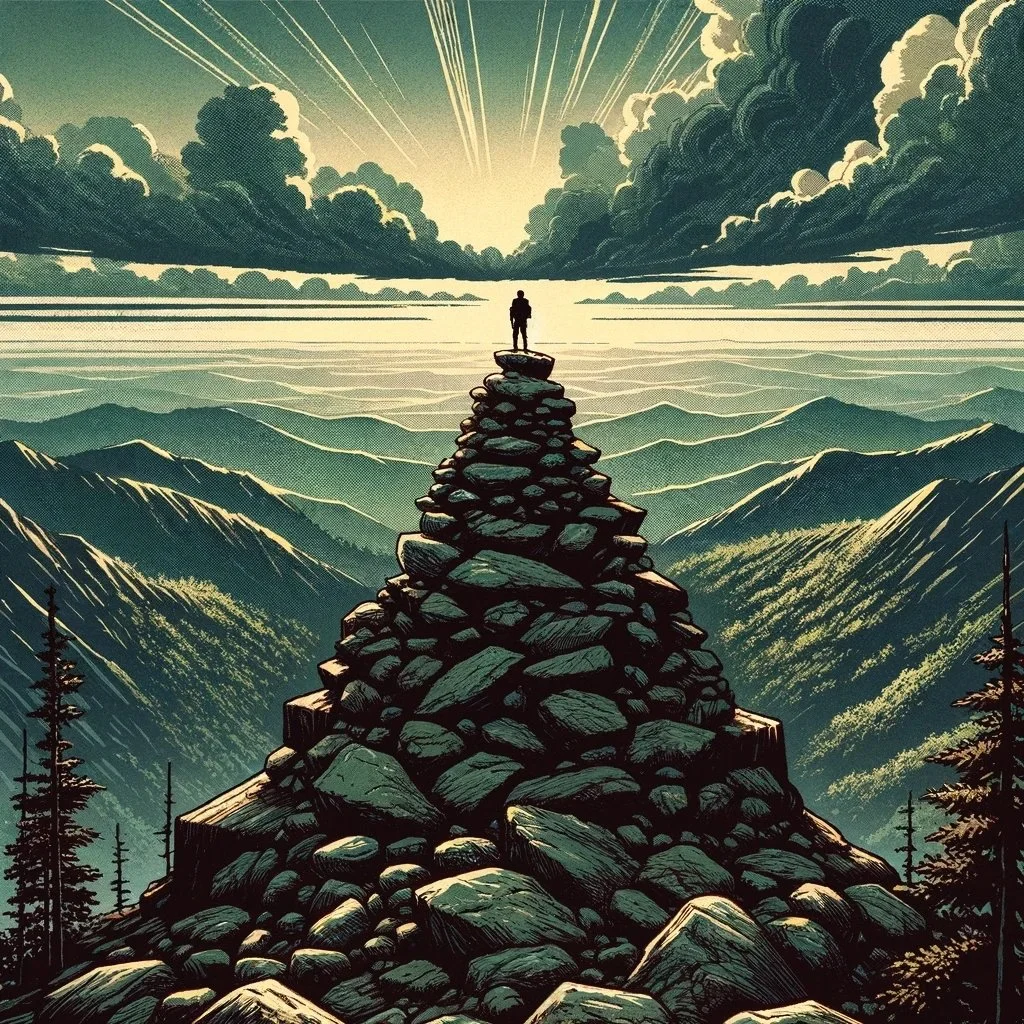
At that time, I was too young to comprehend the two thousand miles that spanned Georgia and Maine, but I imagined this hiking lawyer’s pyramid of worn-out shoes piled up on the floor and considered how one pair lasted me a whole school year. I was hooked ever since. Suddenly the possibilities of life seemed infinite.
Getting married, having children, human or otherwise, are dangerous decisions for the conscientious time traveler. Whenever I considered one possible future, I watched all other possibilities fade, like siblings in Marty McFly’s photograph.
If I wasn’t careful, I could spend the whole morning like this, lost in thoughts, watching the sunlight creep across the walls, but it was Saturday, a day theoretically brimming with potential. Still, I found myself paralyzed by the sheer lack of desire to do anything. My plan for the day was as empty as my photograph-less walls. However, buried beneath my indecision was a simple truth: No matter how I chose to start the day, it would undoubtedly need to start with a shower, so I threw off my blanket and got out of bed.
As the water fell over me, I decided if I didn’t come up with anything else by the time I got dressed, I’d default to my usual: a thirteen-mile hike on a familiar trail just outside town. It’s my go-to activity whenever my mind draws a blank on how to fill the empty canvas of a day.
Walking the trail, I made the realization that I had built a life with none of the benefits of settling down and none of the advantages of being free. I was in a holding pattern, unwilling to commit to anything until I’ve had that grand adventure.
Returning home, I felt a determination I hadn’t felt in a long while. I went online and ordered backpacking gear and a new digital camera.
Back in my cubicle, I received a request to fix a woman’s computer in the main office, which was a much larger room packed with dozens of grayish-beige cubicles. As I walked up the aisle between partitions, she stood up from her chair, offering me her spot at the keyboard.
“How you doing today?” she asked.
Imagine you’re at a symphony, completely absorbed in the music, only to realize that your wallet was missing. That’s how I’m feeling. That is how I’m always feeling: acknowledging that I’m surrounded by indescribable beauty yet gripped by a constant mild panic.
“Fine, how are you?” I said instead.
She sat on the edge of her desk beside me. I could feel her staring at me.
“You know, I should set you up with my daughter,” she said casually.
I never talked about my personal life at work, so there was no reason for her to know I was single, so I assumed it oozed out of my every pore.
A laugh came from a nearby cubicle. “How do you know he even wants to be set up?” The disembodied voice was right. My backpacking gear would be here in a matter of days, so there wasn’t time to start another relationship, become emotionally distant, and wait for them to leave me.
“I think they would hit it off,” she said, then turned back to me. “I’d want to date him. If I was her age.”
I fixed my eyes on the screen. I felt warmth creep into my face. I longed for my cubical walls.
I’d met her younger daughter, who worked in the building as an intern and was much too young for me to date. I knew she had an older daughter, possibly five years younger than me. I based this entirely on the framed photo sitting on her desk.
“She just finished her first year at IU. She’s going to study archeology,” she said.
“Oh,” I interrupted. “You mean your younger daughter who works here?”
“Yes, just for the summer. Anna. You’ve met her, I’m sure.”
“So, do you realize I’m thirty-one years old?”
“Oh my god! Are you thirty-one? I was trying to set my daughter up with an old man!” she said louder than necessary, turning to other cubicles as she said it, like an oscillating desk fan.
“Did you know he was thirty-one? I thought you were about twenty-three, just out of college. You have such a baby face.” She turned to the room again. “I can’t believe I tried to set my daughter up with an old man!”
Somehow, without a conscious thought or glance at the passing landmarks that dotted my usual route, I found myself on the final road to my apartment.
Inside, the evening unfolded in a sequence of domestic rituals: laundry churned in the background as I cooked a pot of soup, a recipe found online. After eating a bowl, I ladled the rest into portion-size jars and lined them up on an empty shelf in my refrigerator, a single front-facing row to make the fridge look more filled, like the shelves at a grocery store in decline.
While sitting on my bed, diligently folding laundry, a sense of melancholy washed over me as I stared forlornly at a pile of balled-up socks. Didn’t I just do laundry? I thought. What did I do with all of these days?
The waning days of August heralded the arrival of my thirty-second birthday, and the persistent thought of wasting another summer. Warm, sunny days can be oddly judgmental, subtly nagging you to get outside and engage in physical activity. It reminds you of the neglected yard work or the outdoor gatherings with friends or family you could be organizing, making you feel guilty for wanting to do none of those things.
Frigid snowy days, on the other hand, welcome you inside with a warm mug of cocoa, gently suggesting that it’s okay to relax and put your feet up. This contrast is like the partner you think you want, one that will whisper sweet and soothing reassurances that it’s perfectly fine to revel in solitude and laziness, and the one you ought to be with, who inspires you to overcome it.
That Friday, with the day’s work behind me, I finally surrendered to the persistent nudge of good weather. I packed my trunk with backpacking gear, digital camera, and enough food to last the weekend. Then, I set off on a four-hour journey south, toward a trail that allowed overnight backcountry camping.
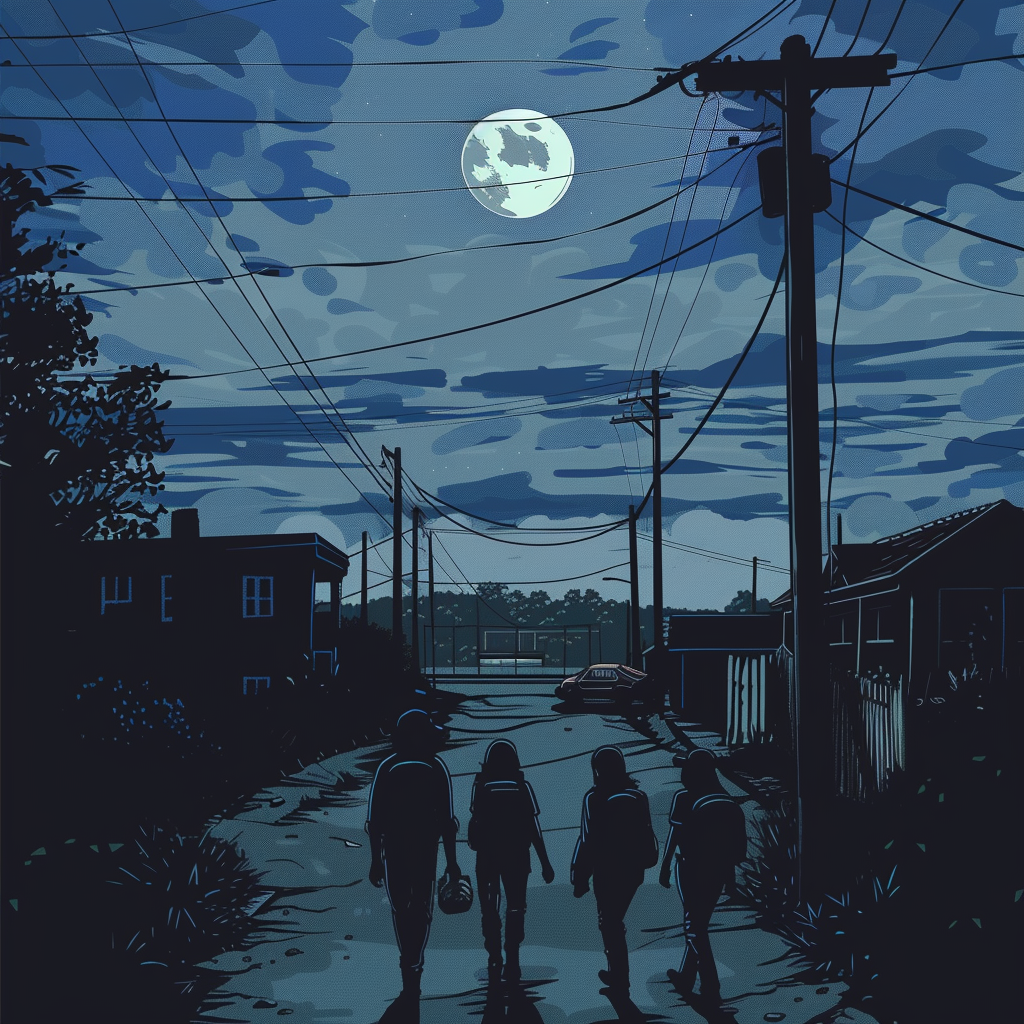
I reached the trailhead late, parking next to an old fire tower. Rather than look for a campsite in the dark, I locked my doors and reclined my seat. Sleep came in fits and starts, interrupted by car doors slamming and footsteps clambering up the metal fire tower steps. Apparently, I found a popular haunt for local teenagers to smoke weed and howl at the moon.
A gentle rain drummed on the roof, granting me a few hours of fragmented sleep before the faint light of daybreak nudged me awake. Giving up on more rest, I grabbed my gear from the backseat and ventured into the green tunnel of trees.
Dewdrops and the remnants of light rain dripped from leaf to leaf, filling the forest with a constant lively crackle. Birds had also risen early—lots of birds. The chittering and chirping gradually grew into a chorus until it transformed into something entirely different from birdsong. As different as a clap is from applause.
Why wasn’t I hiking every weekend? Once again, I berated myself for wasting another year in a cubicle.
I covered sixteen miles that day, occasionally stopping to capture a moment on my camera: a caterpillar’s patient crawl across the trail, or a spider spinning a web. It reminded me of my childhood fascination with creepy crawlies, when I would try to hand feed spiders, or put fireflies in jars with a few sticks and blades of grass. The fascination never entirely went away as an adult. I simply stopped paying attention to them. It wasn’t just the bugs I’d stopped noticing; I’d allowed a myriad of life’s experiences fade into the background.
On my lunch break, I purposely decided to pay close attention to everything around me, something that would become a ritual on the trail. I sat against a log concentrating on the feeling of the grass tickling my skin and the earthly scent of the soil. Gradually the invisible become visible. I watched an ant navigate the rugged terrain of a tree trunk, I marveled at its tiny and utterly unrelatable existence. A daddy-long-leg spider appeared, running the length of the tree trunk. To this ant, each tree was a planet inhabited by monsters. What must it be like when they encountered an eight-legged creature the size of a suspension bridge running toward them. I put my head against the tree trunk with one eye closed, trying to imagine what the world looked like from its perspective. The ant disappeared under shingles of bark and perhaps into wooden tunnels.
Just as often, I overlooked the plants living among us, dismissing them as static backdrops, as lifeless as gravel or mud, even though we share DNA. If they moved in a time-lapse visible to our eyes, twisting eagerly toward the sun, would I perceive them as sentient beings, worthy of names and conversation. Would I notice that they had individual personalities? Would I hesitate before plucking a flower or eating a salad?
Just before dusk, I came to a clearing by a lake and slid out of my backpack. I hung my hammock, angling it for a view of both the lake and the ring of charred stones left by previous hikers, where I would gather a pile of kindling and firewood.
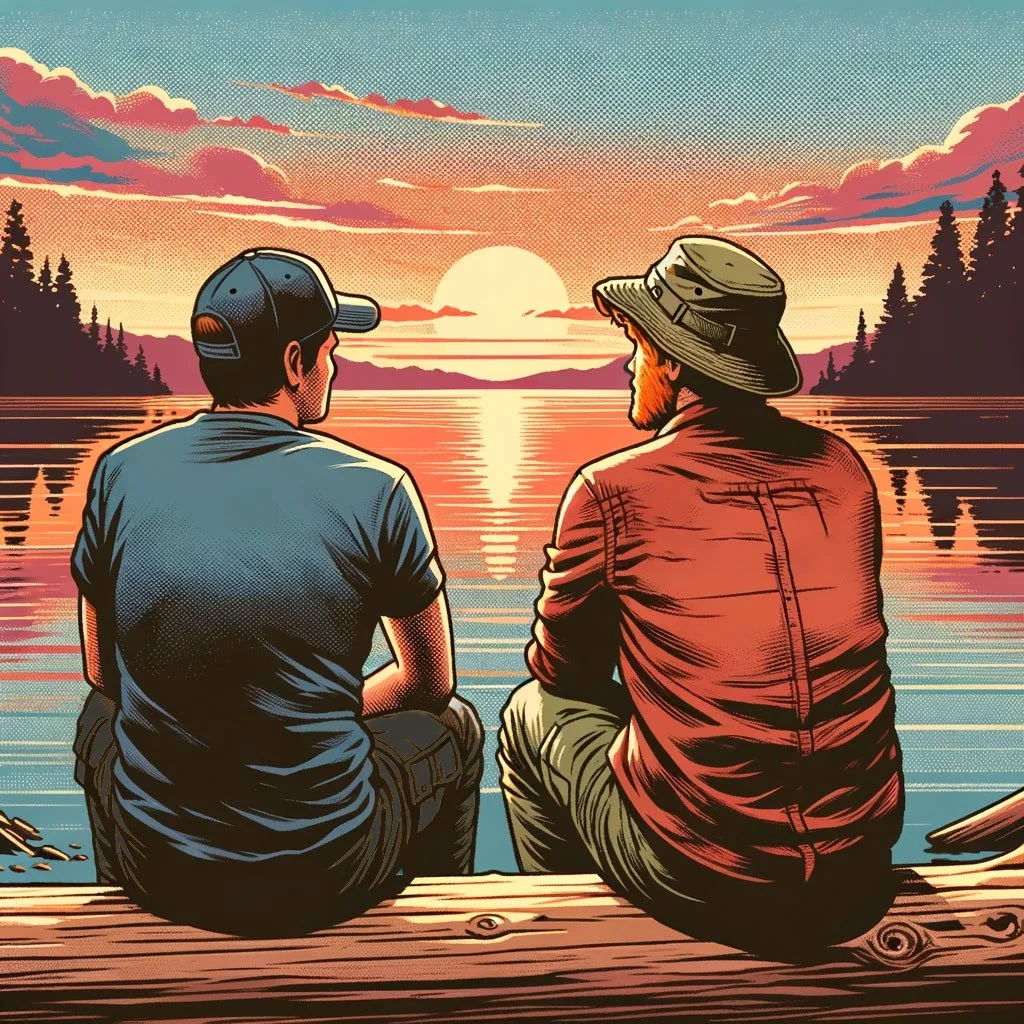
As the sun reached the horizon, I walked along the shoreline to watch the clouds turn fiery orange. I settled down on a mix of sand and pebbles, then leaned back on my elbows until all that remained in the clouds was the faint glow of light pollution from a town miles away.
I hadn’t planned on swimming. The last time I swam in a lake I was a kid, and even then, it had been so the other kids wouldn’t think I was afraid; afraid of the slippery tangle of aquatic plants, the soft sludgy sediment that grasped at your feet, or the slimy creatures you couldn’t see but felt slithering across your skin. In many ways, I was still that child, and I didn’t even bring a change of clothes or a towel, but once night fell, the inky black surface of the lake compelled me. Stripping down to boxer briefs, I felt exposed even in the pitch black and in the middle of nowhere, so I didn’t hesitate to inch my way into the water.
The water felt cool. The smooth algae-covered stones required careful maneuvering. The chill crept up my body as I descended into the depths, acclimating a little bit of skin at a time from my feet to my chest. When the chill reached my shoulders, the lake’s floor turned soft and sandy, not the sludge of a pond I expected. I pushed off from the bottom and floated onto my back, extending my arms and legs like a log adrift on the water’s surface. The water pressed against my ears, that paradoxical sound that seemed both quieter and louder than the world above.
A break in the clouds revealed a fleeting glimpse of the stars, reminding me of Carl Sagan’s words about being just a speck on a lonely speck in the great enveloping cosmic dark.
Descending into a vertical position, I allowed my legs to sink, treading water while losing touch with the lake’s bottom. I filled my lungs with air, pulled my arms in, and descended further into the murky depths. I cracked my eyes open, but I could see as much with them closed. I imagined the lake’s surface going perfectly still, smooth like black volcanic glass. I was invisible to the world. A comforting thought, the utter solitude, the feeling of being truly alone. Of being free.
Though the moment was brief, I already knew the memory, as imperfect and evolving as they are, would stick with me until the end, long after my memories of sitting in a cubicle had mostly faded.
I swam toward the shore until my feet could touch solid ground. When I began to emerged from the water, my body had to acclimate all over again, prompting me to crouch to keep the water level at my neck. Once shallow enough, I settled down, resting on my elbows, and gazed at the sky for a time, not wanting to moment to end.
Thinking of a warm campfire and hammock, I braved the cold air and gathered my clothes. Back at camp, I struck a match and dropped it into the kindling, and soon flames engulfed the wood and crackled the dry pine needles. I stood next to it until dry, then got dressed and retreated to my hammock and sleeping bag.
Cicadas chirped, and water lapped against the shore. The thought of wasting so many spring and summer weekends didn’t return that night. I was there now, and that seemed to be all that mattered.
On Monday I had this feeling that I had been gone for more than two days. It occurred to me that if a long string of identical days could make time seem to go faster. It stood to reason that it could be made to go slower.