





You always remember where you were when you received bad news. Hard to tell if these memories are more vivid because they're etched differently in our brains, or if we just replayed them so often they just feel that way.
In my mind's eye, the Challenger Space Shuttle is forever exploding. Sitting in the lunchroom with my second-grade class, we watched on those old TVs rolled in on AV carts, as the shuttle broke apart in the sky over Cape Canaveral.
On my morning drive to work on September 11, 2001, my phone rang with my mom on the other end.
“Did you hear about what’s happening in New York?”
I knew it had to be bad. I’ve never been one to start my morning with the news, but my old Nokia only rang for telemarketers or tragedies.
As I switched on the radio, I was met with Dan Rather’s somber disbelief at the North Tower’s collapse. Dan Rather’s a TV guy, so odds are it wasn’t even him, but I have a vivid memory of sitting alone in my Jeep sharing a moment of stunned silence with him.
When I heard my friend Nathan had died, I was sitting at my desk in front of a server rack.
After graduation, I was hired to help get the school’s new computer network up and running, and to train teachers on the new tech. Mr. Kirkpatrick, my former chemistry teacher, walked into the office while I was mid-conversation with a co-worker. The smile on my face clearly tipped him off that I was oblivious to the news he carried.
“Did you hear about Nathan?” he asked, his tone heavy.
He was well aware of my connection to Nathan; throughout high school, it seemed more people knew me as Nathan’s friend than by my own name.
When my family moved into his neighborhood a few years earlier, he quickly became one of my closest friends. He possessed a rare ability to draw me out of my shell, making me feel like I could be my true self around him. Even now, I can count on one hand the people who make me feel that way.
Being the youngest in my circle due to an early start in kindergarten, I was the last to get my driver’s license. Consequently, Nathan became my daily ride to school. Some mornings, when I walked over to his place, I’d hear the distant songs of Danzig, Candlebox, or Snoop Dogg blaring from his stereo—a sure sign his parents had already left for work.
I’d knock and he’d yell for me to come on in, barely pausing his energized morning routine—singing, head banging, playing air guitar—a vigor I couldn’t muster at the peak of the day let alone the ass crack of dawn.
I’ll always remember our first ride to school, when Nathan gunned the engine before a sharp turn. My heart was in my throat, certain we were heading off the road. Yet, Nathan, fully aware that the turn’s sharp angle was just an optical illusion, maneuvered around the curve easily by using the opposite lane.
Catching my wide-eyed terror, he erupted into laughter.
“God dammit! I thought we were about to die!” I managed to say between laughs, my fear dissolving into relief, as my legs turned to jelly.
I always thought of Nathan as our school’s Spicoli, embodying that laid-back stoner vibe from Fast Times at Ridgemont High. But behind that façade, he hid an intellect that often took me by surprise.
We shared seven of our nine classes together in our junior year. Whenever we paired up on an assignment or studied together before a test, he’d rattle off the answers from memory while I had to flip through the textbook. I once asked him how he remembered all this stuff and he just smiled and tapped the side of his head with his finger.
As lab partners in Mr. Kirkpatrick’s chemistry class, we were a constant pain in his ass for always talking, laughing, and generally taking nothing seriously. I remember one lesson that had us veering off into a discussion about the Unabomber.
“So, just to be safe, don’t open any packages the size of a video cassette,” Kirkpatrick said, half-jokingly.
With a perfectly straight face, Nathan raised his hand and said, “Hold on. VHS or BETA?” then he glanced at me over his shoulder, seeing if this got a laugh out of me. This assuredly wasn’t the most hilarious thing Nathan had ever said in class, but I remember it vividly now because of that glance. I didn’t disappoint, I was the only one that laughed, but for Nathan, it seemed like that was enough.
Sometimes, on our way to school, we'd take a detour—grabbing fast food breakfast or hanging out in the park listening to music. We often missed the first few periods, or in a few instances, not show up at all. Those adventures contributed to thirteen missed days of school our junior year, dangerously close to jeopardizing my 1996 graduation schedule, but Nathan's friendship had been worth the risk.
One day in chemistry, Nathan whispered that a classmate had a crush on him, subtly gesturing towards her with his chin. Skeptical, I said, “Yeah right. She’s way out of your league,” half-teasing, half-serious.
“Just watch,” he insisted. After Kirkpatrick’s reprimands for our chatter, I caught glimpses of her stealing looks at Nathan, confirming his claim.
Later, we met up with her at a party, the only high school party I ever attended. When peer pressure to drink alcohol and smoke weed mounted, he whispered to a friend about my supposed past with drug and alcohol addiction, saying they’d be dicks if they tried to offer me anything.
“He was at White’s for a while,” he told them, meaning a nearby correctional and rehabilitation facility for underage kids. This was actually true, but he left out the part about me only living there for a year when I was ten because my step-dad was a live-in house-parent, so we had a little apartment in the same building as the thirteen-year-old boys.
Surprisingly, although I was barely sixteen—and looked twelve—he convinced them.
Initially, I thought Nathan simply enjoyed the joke of casting me—the rule-abiding introvert—as someone who partied hard and harbored a shadowy history. And to be clear, he undoubtedly did find it hilarious, evidenced by his uncontrollable laughter on the drive home, but I’d come to realize there were deeper motives.
Fully aware that I abstained from drinking and smoking at the time, Nathan cleverly removed peer pressure from the equation, making me feel at ease among his other circle. This newfound intrigue even caught the attention of girls who previously overlooked me. When a girl started talking to me and then cozied up next to me on the sofa, Nathan caught the moment and gave me a smirk and nod.
On the drive back home, near the optical illusion curve, Nathan’s truck collided with a skunk, and instantly, the overpowering stench engulfed us. The moment he parked at home, we bolted, each to our own house, desperate to wash off the smell.
The next morning, I knocked on Nathan’s door as I always did. The stereo was silent. His mom—with her waist-long red hair and those signature long denim Pentecostal skirts—answered the door without her usual friendly smile.
“Nathan won’t be driving anytime soon, so you’ll have to find another way to school,” she said, her voice void of the usual warmth and sparing no details.
Nathan broke it to me later that I was stuck riding the bus to school for the next few weeks.
“After I hit that skunk, I ran in the house, threw my clothes in the washer, and got in the tub. I forgot about the fuckin’ bag of weed in my pocket! She’s pissed, man. She took my keys!”
That’s my recollection, at least. But truth be told, the sound of his voice is slipping away from me now. Him singing Welcome to the Jungle like Axl Rose on our drive to school remains vivid, but the nuances of his everyday speech grow dimmer. It’s a loss that weighs heavily on me; I’d trade almost anything for a clip of him simply speaking, sharing a laugh. Regrettably, we came of age in a time before smartphones captured every fleeting moment.
Another memory is coming back to me, of him approaching me at school, itching to ditch early. Together, we hatched a plan: I’d feign illness, and ask my mom to call in with permission for me to leave. Then I’d parked Nathan’s truck by a rear exit. I don’t think I even had my license yet, but I backed the truck up and watched the back door in the rearview. Moments later, Nathan burst out of the door, vaulting into the truck bed, laying flat as I drove down the nearest country road. Once out of sight, I pulled over to let him in the driver’s seat.
I suppose in hindsight we could have just walked out calmly and got in his vehicle, but I think Nathan was just after the thrill—or maybe just eager to inject a bit of rebellion into my life.
Nathan never made it to graduation alongside the rest of us. Not for a lack of intellect, he just didn’t show up enough or do the work, I suppose. But, this didn’t appear to trouble him much. I think another year in the place he seemed to love, suited him just fine.
As an employee of the school after graduation, I’d catch glimpses of Nathan in the halls now and then. But with our shared classes, and those morning drives a thing of the past, our paths diverged, and our close bond gradually faded.
Just a day before Kirkpatrick delivered the heart-shattering news, I dashed into the school, intent on calling Christy about the purse she’d forgotten in my car. En route, I sped past Nathan, who appeared to be flirting with a girl in the hallway.
He called out, “Hey,” but I could only respond with a raised index finger, signaling “just a minute,” but the bell would ring and he’d be off to class before then.
His voice echoed down the hall, “Why don’t we ever talk anymore? Are you too good for me now?”
It irked me that the bearer of such news was Kirkpatrick. This was the same man who had once pulled me aside after Chemistry, cautioning that Nathan was a bad influence. “He’s holding you back,” I think he said.
“Did you hear about Nathan?” he now said, sympathetically.
Through the floor-to-ceiling windows of the technology center, I saw the girl from the hallway, crying into the shoulder of another classmate.
“He was killed in a motorcycle accident yesterday,” he said.
I went behind the rack of computers, away from the eyes in the halls, to be alone and cry.
Later I’d learn he used the opposite lane to take a sharp turn at high speed and hit an incoming car head on.
“Are you too good for me now?” echoed in my mind. I wish the good moments in life were as vivid in my memory as the tragedies.
The funeral home was a sea of familiar faces that I didn’t really know, each with their own Nathan stories to tell. Despite his best attempts to bring me into his wider circle, my memories were mostly of just Nathan and me.
Sitting there, the realization struck me hard that I had become the sole custodian of those memories. His version would be different, seen through a different lens. He’d remember things I didn’t and have a different point of view. We contain multitudes, each of us hosting a universe inside our heads, and that universe inside of his, where the other half of our stories lived, had also vanished into the ether.
I fought back the tears; I don’t know why in a room full of people who loved him, I needlessly hid my emotions and mourned alone.
I’m certain I have these details wrong, but it doesn’t matter, as they ring true to me. The girl I thought Nathan had been flirting with in the hallway, told a story that happened shortly before that moment. She had been going through a lot and she confided in him that she was going to run away.
Without missing a beat, Nathan said, “Alright let’s do it. I’ll drive.”
“Where would we even go?” she asked.
“Doesn’t matter, let’s just go.”
So they hopped in his truck and headed down an unknown road. They drove across the state line before stopping, then got out somewhere and sat on the hood.
He asked her if things seemed different now, with some distance between her and home.
Seeing things from a distance can change your perspective. Like when you’re too close to a painting, all you see are the brush strokes and the imperfections. But if you step back, you see the whole picture, how everything can come together to create something beautiful. Perhaps he knew that helping her get some distance from her problem, might help her see the beauty in her life’s painting.
“So, what do you think?” he asked. “Are you ready to go back and face it, but this time, not alone?”
--==--
When I got the call about my grandpa, I was sitting on the sofa at Thumper’s parents’ house, watching the show Survivor with her mom, dad, and Bambi. Behind the façade of this normalcy, my relationship with Thumper was quietly disintegrating.
One day, when she was at work, I set about tidying the yard—raking leaves, collecting sticks, and mowing the grass. It desperately needed it and I had a lot of restless energy.
I found a ladder under leaves next to the house, so decided to keep going, clearing the gutters and sweeping debris from the roof. I discovered the front porch’s roof bore unmistakable signs of rot, threatening imminent collapse.
She pulled into the drive just as I was making my way down from the ladder.
“Hey,” I said.
“Hey,” she mirrored me, but didn’t seem particularly happy to see me.
“The roof over the porch has rot,” I said.
“I don’t care.”
“It’ll eventually collapse,”
“You smother me sometimes.”
“What?”
“The way you’re always trying to do everything for me! I didn’t ask you to mow the grass or check the roof!”
“Well, I didn’t have anything else to do today.” She went inside. “I was just trying to be useful,” I said to myself.
I've always been better at doing things to show someone that I care, rather than just saying how I feel. I'm just built that way. Saying it invited a response I maybe didn’t want to hear. And I get all teary, every single time, like it’s a reflex I can’t shake. I can’t stand that part of myself. And I knew she’d hate it in me, too.
Thumper once dumped a guy for crying during Forrest Gump— that scene where he’s talking to Jenny’s grave. Hell, I’ve cried there too. More than once. Movies just have their way with my tear ducts. And if Thumper and I made a go of it, I kept thinking, how many years could I avoid tearjerker scenes? I could try the usual tricks. You know, avoiding the actors eyes, stare a little to the side, chew on my cheek, jab my arm with a fingernail. Whatever it took to hide this side of me.
She obviously needed a hand with the yard. Maybe I made her feel less for it, like she couldn’t handle a house on her own. I guessed I pushed too far. It was clear I wore out my welcome.
Sometime after we returned from Route 66, we were playing another chess match, perched at the bar in her basement. I dropped a hint about maybe moving to Kentucky permanently, to see how she’d react. Said threw out that maybe we weren’t right for each other, just too adventurous and loved our freedom too much for it to work. She had a point, but I wasn’t ready to throw in the towel.
She was thinking rationally and I was running completely on emotion. Then she asked if I remembered that time in Vegas when she had to grab something from my trunk. I said, “Yeah, I remember.”
“When I told my dad about our Route 66 trip, he made a crack about me coming back hitched. That's why I needed in the trunk—to put the white dress I'd brought into my bag, just in case you'd ask."
Tears rolled down her cheeks. For her, Vegas was supposed to be more than just the drunken blur that it turned out to be, which ended with us sleeping it off in the car before we hit the road again. Stacking reality against her expectations, I was gutted. Seeing her like that, I couldn’t keep it in. I cried with her, saying I loved her too.
She wouldn’t meet my eyes after that. “Oh god,” she muttered, tears cutting off as quick as they came, and she bolted from the bar. It left me feeling like some sorry excuse for a man.
Some days, it was like she really saw us together, dreaming up plans to someday trek across New Zealand. On other days, it felt like she wished we'd never met.
Besides, sitting down for dinner at her parents’ and watching Survivor together, it often seemed like we were an item.
“Wait, so they’ve only been on this island for three weeks?” I asked. With all their moaning, I assumed they had been there for months. “Sounds like a vacation,” I said just as Thumper shooshed me.
My phone lit up with my brother’s number, I steeled myself for bad news and slipped into another room to answer it.
“Did you hear about grandpa?” he said. My stomach hit the floor.
“His kidneys are failing,” he told me, voice heavy. “The doctors are saying he might only have four more days.”
Four days sounded oddly specific, but being Wednesday night, I assumed the doctors had actually said he may not make it through the weekend.
The next day, I headed home, to the same hospital where my life started, and his was now fading.
My mom, stepdad, and Stephanie were there, all huddled around his bed. He seemed to be sleeping, though there were times he’d look just like that, eyes closed, even when he wasn’t. Mom kept talking to him, on the off chance he was listening.
“Dad, Ryan’s here,” she said. “He just got back from hiking the Appalachian Trail.” He didn’t show any signs of hearing her voice.
As they gathered their things to go, I felt the need to stick around. He’d been given four days, but he’d outlasted their estimates before. It was practically a holiday tradition for someone in the family to wonder aloud if this would be his last Christmas.
Nearly ten Christmases went by like that, but sooner or later, they had to be right. And if this was finally the time, I just couldn’t stand the thought of him surrounded only by the cold beep of machines and those stark white walls.
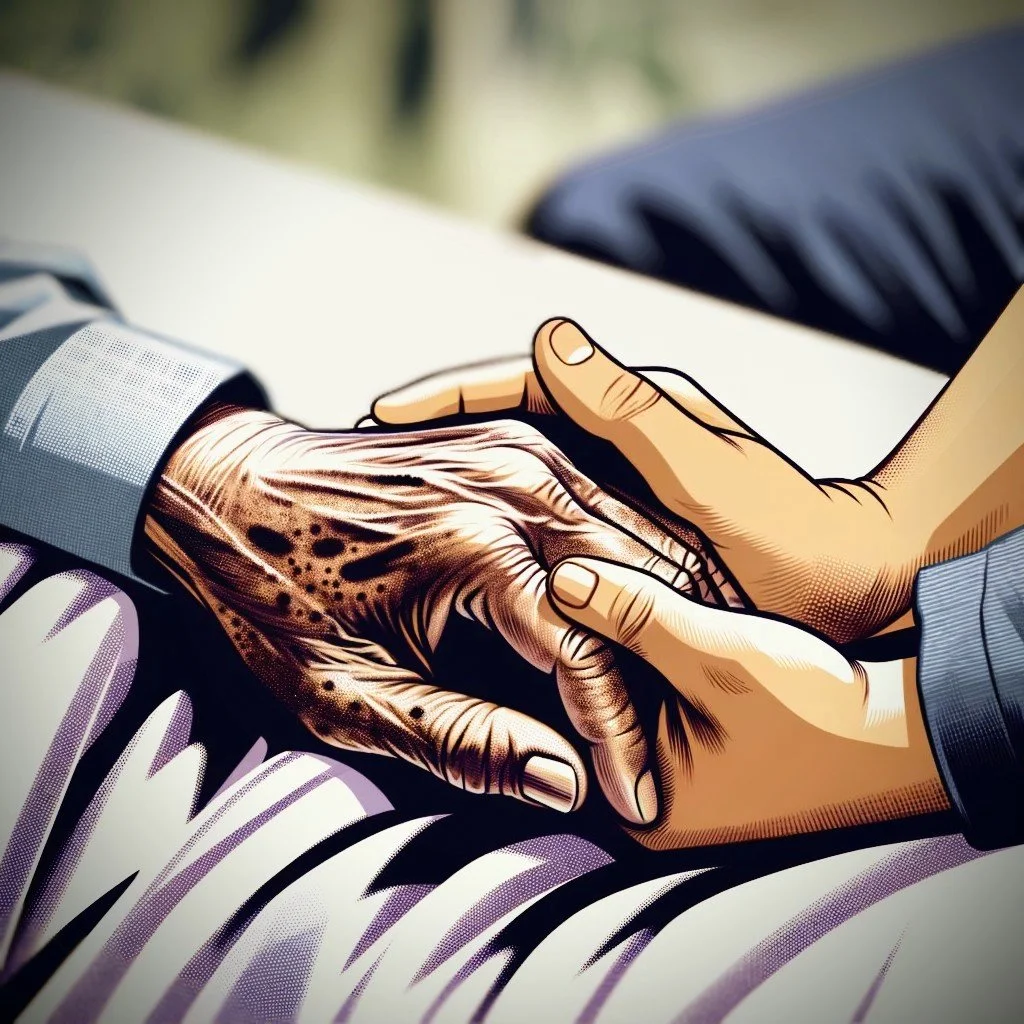
I pulled up a chair close, and held one of his hands. It was mottled in age spots, bruises, and were so thin it was a wonder there was enough flesh under the skin to bruise. In that moment, I was wishing hard he could feel I was there. I gave his hand a gentle squeeze. It didn’t squeeze back.
It's one of those truths everyone’s aware of—you’re supposed to tell people you love them and ask them to tell you their stories before you can’t. Yet somehow, we always end up dragging our feet.
When you’re a kid, life feels frozen in time. But then you grow up and get caught in your own whirlwind. Suddenly, one day, you look around and you notice the years on everyone’s face, and you’re smacked with the truth that all lives wrap up eventually. Suddenly everything seems more urgent.
Back when he had his first stroke, I was nowhere near that realization. I was in my mid-twenties, a selfish preoccupation phase in life. He no longer had the ability to speak, but sitting there holding his frail, still hand, my head was suddenly full of questions:
What was World War II like for you? The only piece I’ve gotten is that you lied about your age to join the Navy right after Pearl Harbor went down.
How was my mom as a kid? You mentioned once you could gauge her mood by how she played her piano. I loved that, it always stuck with me.
Tell me about you meeting grandma? I’ve heard her take, but I want to know yours. Everyone’s stories are so different, some aren’t even in the same genre. Grandma was still in Arkansas, right? When her best friend moved to Indiana? That friend of hers concocted a scheme, inviting her up to visit with the ulterior motive of setting her up with the boy next door, so she’d move to Indiana too. And the whole crazy idea actually worked.
What was that first meeting like? When did you figure out she was the one you’d stick with forever?
I have all these Appalachian trail stories to tell you. I hiked the whole thing, just like that lawyer you saw in the news ages ago, do you still remember that?
Every attempt at getting the words out just nudged me nearer to tears, so I just held his hand in silence. With all the unanswered questions, I would have been content to have the answer to just one. Did he know I was here for him? I knew he’d understand my feelings, if he just knew I was here.
The monitor let out another beep, and my eyes reflexively snapped to it. His eyes stayed closed.
I started to notice features in his face that he passed down to me, things I never noticed before. My mind drifted to memories of him before the strokes, before his memory started slipping—a version of him these nurses would never meet.
He was the go-to fixer. If one of our cars broke down, he’d be there faster than AAA with his toolbox and coveralls. Thinking back, I bet it made him a little happy when our cars broke down. I get that; just how there was a certain joy in being needed by Thumper. Was his eagerness to help also a way around having to put feelings into words? Maybe our similarities don’t stop at noses and hairlines.
Four days ticked by, and he was still hanging on. I went back to Kentucky, slipping back into the daily routine. Then it was four weeks, and he hadn’t gone anywhere. But soon he would be back in intensive care.
Christy’s number showed up while I was at work. I stepped into the server room for privacy.
From a drive-through line, she told me she was getting lunch for her, Mom, and my younger sister, Amanda, who were with him back at the hospital. Then, a text came in.
“Oh my God Ryan, he just died,” she blurted out. That tone in her voice, I’ll carry it with me forever.
Once more, I found myself ducking behind a server rack, seeking the solitude to let the tears flow unseen.
At the service, my cousin shared a story about grandpa getting teary over ‘The Price is Right’ when a contestant won both Showcases. A unicorn moment on that show. She caught him wiping away tears, moved by a stranger’s happiness. That, she said, made her adore him even more.
I loved this about him too, another one of his genetic hand-me-downs—I got his nose, his difficulty in voicing our feelings, letting our actions speak instead, and I’d bet my last dollar he was a mess during ‘Forrest Gump’ too.
Realizing I admired this in him made me see it differently in myself. If I cherished this quality in grandpa, so why was I trying so hard to change these things in me? I’m more than okay with being cut from the same cloth.
At funerals, people avoid words like dead or death as though not saying it keeps them alive. So, they passed on. They rest in peace. They departed, went to a better place, or are simply no longer with us. I know we do it to soften the blow, but we’re damn fortunate to feel this grief. Without sorrow, love’s just a word. There’s an eternity ahead to feel nothing, so for now embrace the hurt, lean into it, cradle it close, and count yourself lucky to have it.
Years later, Christy and I went out for a drive. I asked if she minded if I drove through the old neighborhood. I saw Nathan’s mom outside doing yard work and asked Christy if she minded if I stopped to talk to her. Of course, she didn’t.
I wasn’t sure if she’d remember me, but her face lit up when she saw me and she greeted me by name.
I asked how she had been doing, and then decided to tell her a lot of these same stories, about how her son brilliantly knew just how to guide me through those high school years in such subtle ways, and how much this had meant to me all this time. And I don’t mind saying that we had a little bit of a cry.