




Chilly puddle water seeped into my left sock. It’s bound to happen when your boot has a hole in the sole big enough for a chipmunk to crawl through. Perched on a log, I swapped my damp socks for dry ones, taking a moment to assess the damage. My boots, now bonded together with two tubes of crazy glue, had carried me over eight-hundred miles. A commendable feat, considering I tossed my first pair in a Massachusetts trash can after less than four hundred miles—and a four-hundred dollar emergency room visit.
Peering through the boot’s gaping hole, I gazed at the autumn woods. These boots only had to carry me a few more miles to the next town. Beyond that, I think they’d rightfully earn their retirement.
Hiking in such decrepit footwear was asinine, but I had two reasons for not replacing them yet. First, my sisters and brother-in-law were bringing my third pair tonight. The second reason, and honestly the real reason, was my brother-in-law’s plan to display them in his bar, like a local sports legend's memorabilia.
As a kid who was never picked last in gym class, I naively believed I was cut out for professional sports. But my crowning athletic achievements were rather modest: I was never tackled as wide receiver on my eighth-grade football team, a feat I accomplished by never catching a pass, and I made the starting line up on the ninth-grade basketball team. Never mind that I quickly warmed the bench after three games, having transformed from Dr. J. to Mr. Magoo once I was under the watchful eyes of a crowd. So, these grubby hiking boots, destined for wall-mounted glory, were as close as I’d get to that dream.
I relished the thought of them on display, with the massive hole, scuff marks, and sole peeling away. It may be amusing or provocative in a way. Stories seep into every pore of worn-out things. It’s the reason I’ve hopped fences and trespassed through muddy fields to get a picture of a dilapidated barn while barely noticing new ones. Objects worse for wear have a life story to tell. And displayed publicly, they invite countless more stories in the minds of onlookers, curious how they got all of those scrapes and scars. So, despite the foolishness of continuing to hike in them, I wanted them utterly battered up there on that wall.
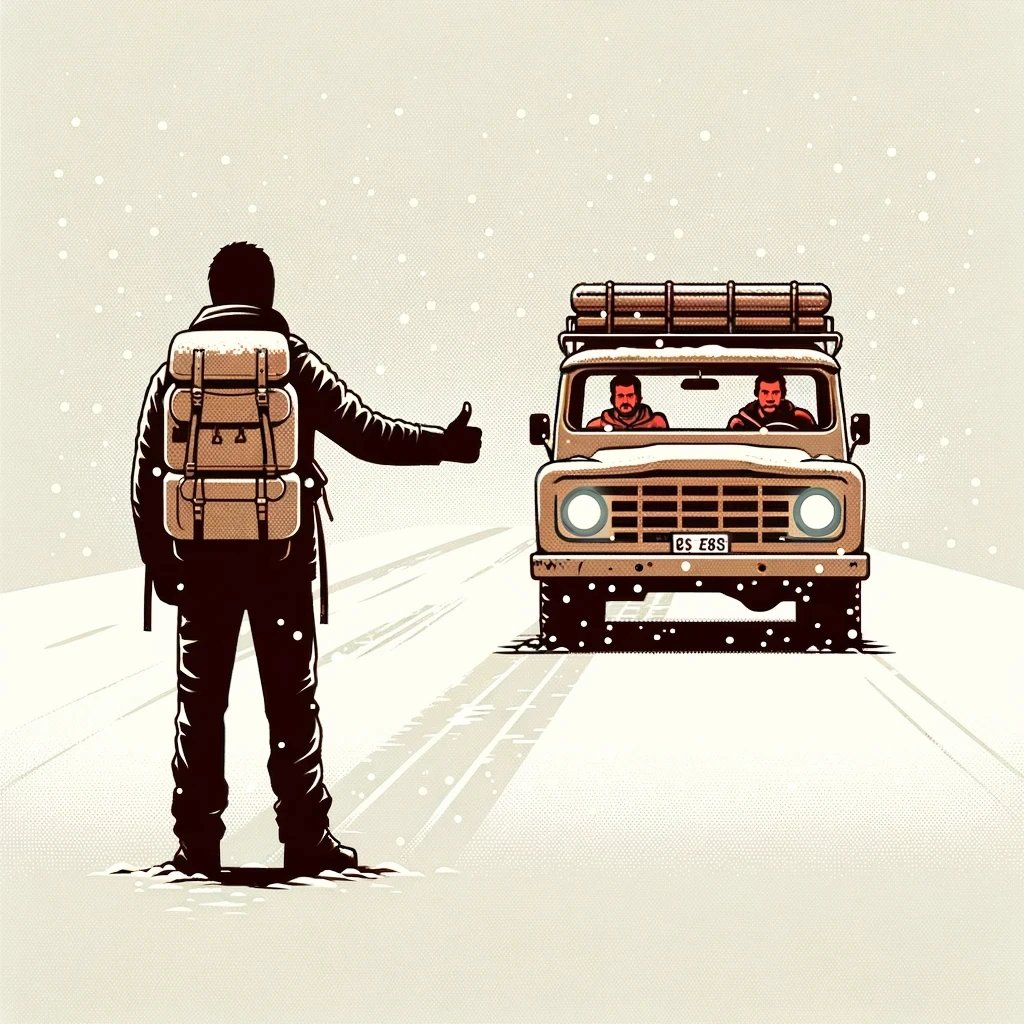
At the next road, after my boots had gallantly traversed their final stretch of the A.T., I stuck out a thumb and hitched a ride to the restaurant in Front Royal, Virginia, where I was to reunite with my sisters. What would they think when they laid eyes on their brother, now emaciated, malodorous, and sporting a shaggy vagrant beard? On the trail, the beard felt as normal as the trees. Yet at home, it was a subject of contention among friends who constantly urged me to shave it off.
It wasn’t that I disagreed with them. After a second person described it using the word “rapey,” I didn’t even try to defend it. It wasn’t the look I was going for, but I was fully aware of how I looked. Sure, it was patchy in places, and eating an ice cream cone wasn’t as clean and carefree as it used to be, but I was curious to see where my face was going with it. Besides, when enough time passed, I discovered I could twizzle my mustache into a respectable manly handlebar-shaped curl—albeit only on the left side, of course, but nothing a little mustache wax couldn’t fix.
Despite its imperfections, I had to trust that my face knew what it was doing. After all, given enough time, scraggly fields have turned into forests of mighty redwood trees. Might my chin do the same, unkempt, wild, and free?
The answer, becoming clearer with each passing day, was no. Deep down I anticipated this, so I didn’t lose much sleep over it. The real disappointment was knowing I’d never have a luxurious noble white beard one day, which I had planned to grow in my seventies to hide my turkey neck. No, in my declining years, it would be scarves for me. I just hope the Charlton Heston style scarves, make a comeback by then. They say fashion is cyclical, so I’ll keep my hopes up.
Arriving in Front Royal early, I asked the driver to drop me off at a grocery store near the restaurant. I stocked up on supplies for the next leg and waited in the restaurant parking lot.
As my brother-in-law’s massive white SUV pulled into view, I raked my fingers through my unruly beard and stood up. A moment before putting the vehicle in park, my sister, Stephanie, flung open the door and leaped out.
“Ryan!” she screamed while running toward me with open arms.
I kept my arms stiffly at my sides, as if weighed down by invisible grocery bags. Not because I didn’t want to hug back, but because I knew I must smell terrible—a multiple-shower kind of smell, a toss your dirty clothes in a trash can instead of a hamper kind of smell.
“You’re so skinny!” she said with a rising pitch.
“And look at that beard!” Christy said.
Of my five siblings, Christy was the most like me, introverted with a similar aversion to small talk and social gatherings. Being eight years older, she naturally stepped into the role of an extra guardian after our parents’ divorce, often shielding me from the bullying from my other siblings. She was the oldest, and I remained the youngest for nine years until Amanda and Kyle arrived. During those nine years, my other older siblings, Michael and Stephanie, often teased and tormented me, finding new and creative ways to exploit my childhood fears. One of their favorite ways to do this, was to back me into a corner and pretend to be zombies. They would hobble towards me, excruciatingly slow, arms outstretched, eyes wide open, and moaning about devouring my brain.
Although their chant, “Weeee are dead. Weeee died,” lacked imagination, it was effective, nonetheless.
In a high-pitched voice, I’d yell back, “You’re just faking! You’re always just faking!”
“Nu-uh, weee are serious this time.”
I would squeeze my eyes shut, not because I believed they might be serious this time, but from the discomfort of their prolonged, unsettling gaze.
Eventually, when I hit my breaking point, my shriek would summon Christy to my rescue. Back then, she was our family’s Rick Grimes, and in many ways, she still upholds that role. To this day, she remains my go-to emergency contact on forms. That might seem like a small detail, but to me, there’s no bigger compliment.
The teasing that likely inflicted the most psychological damage was the unrelenting teasing about girls. So relentless was this teasing that I guarded the secret of my crushes well into my twenties.
Though Stephanie and I developed a friendship in adulthood, the closest we came to a friendship in childhood happened when I was about five and I let her apply makeup to my face and put me in a dress. She even taught me how to smack my lips together to even out my lipstick—pop, pop, pop. While it’s hardly a skill I need as an adult, this memory resurfaces every time I apply lip balm.
I remember twirling around in my dress to watch it flare out. Having seen a girl do that once and thinking it looked like fun, I wanted to experience it for myself. In honesty, a tinge of jealousy that my clothes lacked such flair was the reason I allowed Stephanie to dress me up in the first place.
For a brief ten minutes, I was the little sister she had always wanted—until mom burst in and shouted like we had just set fire to the living room sofa. In a rush, she yanked the dress over my head, and in one fluid motion, used it to scrub the makeup off my face. At the time, I didn’t understand why this was such a big deal. Even now, it eludes me, though I suspect it was an attempt to keep homosexuality from sinking into my psyche. Between that and not seeing me with a girl until my twenties, made me wonder if my mom looked back on that day, questioning if she got to me soon enough.
Inside the restaurant, I slid into a booth and asked my brother-in-law, who has lacked a sense of smell since birth, to sit next to me. As I perused the menu, I was happy to find no instant potatoes, instant oatmeal, instant rice, instant noodles, no instant anything. The food on the menu, pizza and burgers, was fast food at best. Yet, deep down, I hoped for a slow meal, craving the opportunity to unwind and share trail stories with them. In my mind, this meal had played out like a scene in a movie, with the camera slowly panning around the dinner table, scored with some slow indie rock song, everyone laughing as I tell stories, gesturing animatedly with my hands. I didn’t know what stories I’d tell, but I did know we’d laugh together, just like we always did.
In reality, however, finding the space to share my stories proved more challenging than I’d anticipated. Clearly weary from their ten-hour drive, they were a bit on edge, leading to some bickering. Our conversation was a lively cacophony, everyone talking over each other and Stephanie incessantly texting on her phone, even while you were talking to her.
“Keep going. I’m listening. I’m just playing my turn on Words with Friends,” she said without realizing why that made it worse.
In a small experiment, I stopped telling a story mid-sentence to see if anyone would notice; nobody did. This moment was a stark reminder that our family gatherings were nothing like the idealized versions portrayed in movies. Rather, they were a tapestry of overlapping voices in a crescendo of interruptions, abrupt topic changes, and competitive story-topping. To successfully complete a story in my family, you had to master the skill of brevity or just power through at increasing volume whether anyone was listening to you or not. The crescendo of voices rises so gradually that no two psychiatrists would be able to agree on when civility ended, and the commotion began. Admittedly, I was as guilty of this as anyone else. I just never noticed it until now. Just as I became oblivious to my own body odor, you often fail to notice your own patterns over time. Having spent so much time alone recently, multiple-day stretches without uttering a word to anybody, what once seemed normal irritated me. I felt a distance between me and my family, just the slightest distance.
In all the ways that truly matter, being family has less to do with shared DNA and more to do with shared stories. And the higher the elation or the lower the misery in those stories, the deeper the familial bond becomes. This explains why I felt so close to Bambi and Thumper after just a few months together, and why my best friend since middle school feels like a brother. At that moment, the most momentous stories of my life were unfolding away from home, and my family seemed only mildly interested in hearing them. It was the slightest distance, but big enough for it to bother me, especially since it happened after only a few months apart, and since I lacked plans to return home anytime soon.
I didn’t mention these thoughts to them. I found myself wondering whether this distance would only widen in the years to come. My belief had always been that family relationships, no matter the time apart, would naturally revert to their old patterns. However, I now wondered if there might be a point of no return—a kind of divergent evolution—where a population, once geographically isolated, gradually drift apart, eventually evolving into distinct species. Such a possibility had never crossed my mind before.
They generously paid for my meal, and we drove to the nearest motel. I was desperate for a shower, eager to rid myself of the lingering scent that I jokingly described as a corn chip’s foot.
Disliking the look of the motel’s exterior, Stephanie asked to inspect a room before we committed. The manager led us to the room and unlocked the door. It appeared the room hadn’t been redecorated since 1978, judging by the Reese’s Pieces color palette, scratchy floral comforters, and thrift store artwork on the walls.
It seemed perfectly acceptable to me, however, having gotten used to sleeping in grubby old lean-tos reeking of wood rot and sweat, and sometimes finding scattered mouse poop on the floors, my standards had become quite adaptable. I’d also slept on dirt under the stars with countless creepy crawlies, behind abandoned buildings in the middle of towns, and in baseball diamond dugouts. I even slept on a stranger’s basement floor—not the cozy, carpeted kind, but a dank, concrete floor next to a rusty water heater. Kidnap victims have been given better accommodations.
On the occasions when I wasn’t sleeping outdoors, my lodgings were hostels or hotels where showering without flip-flops was unthinkable, and where using my sleeping bag on top of the mattress was compulsory to wall myself in from the microscopic wilderness on the mattress. Indeed, the past few months drastically recalibrated my standards.
Stephanie peered inside, her head crossing just past the threshold.
“Nope, not doing it. Can’t stay here,” she declared, then turned to walk back to the car shaking her head, leaving Dave and me in an awkward standstill beside the motel manager.
That slight distance stretched a little bit bigger.
At the next hotel, Stephanie went in ahead of us to inspect the room.
“Oh my god. Guys,” she said from the bathroom in a way that suggested she might have found a severed foot in the toilet. “There’s a pubic hair in the tub!”
We couldn’t help but laugh, too amused to be annoyed. We lingered in the hallway waiting for her approval to bring in the luggage.
“It's fine. I've got this, “ she said, pulling a wad of toilet paper from the roll. She gingerly picked up the hair like a spider, and flushed it down the toilet.
The rest of the evening was spent playing cards, a long-standing family favorite, a rummy-style game called 3-13.
When it was time for bed, Stephanie turned down one of the comforters.
“Oh. My. God.” Her face a picture of horror. “There’s a blood spot on the sheet!”
“Here we go,” Dave said.
“Well, I can’t sleep next to a blood stain!”
Although it was nearly midnight, we hastily packed our bags and set out to find another hotel.
On our way out, Stephanie strode up to the counter, adopting what she termed her “best mom voice” to demand a refund.
“Um, yeah, we'd like our money back, please. There’s pubic hair in the bathtub and blood on the sheets!”
“Uh… Okay,” the man said, promptly refunding our money without debate.
As we entered the third motel room, Stephanie cautiously cracked open the door, peering inside like someone might be waiting to ambush her with a lamp that was passé at best.
The expression on her face made it clear—had this been our first stop, we wouldn’t have stayed. But, as with my own, her standards had evidently lowered through the course of the night. We brought in our things and shut the door.
I then reopened the door to leave my noxious boots outside, figuring they’d require bronzing before any health inspector would allow them in the bar.
The next morning, the boots had disappeared. It was hard to imagine anyone willingly stealing them, leading me to suspect that a maid mistook them for a hobo’s or perhaps their smell disturbed the guests’ sleep, prompting a flurry of calls to the front desk. This was the final nail in the local-sports-legend coffin.
Early the next morning, Dave took us back to the same trailhead where I had caught a hitchhike the previous day. Another reason for choosing this spot was the eight-mile stretch of the A.T. that ran from road to road here. It was the perfect distance to give my sisters a taste of the trail's challenges without overwhelming them. Plus, it would be convenient for Dave to drop us off and pick us up later.
After finding suitable hiking sticks for each of them, we set off. The trail began with a steep four-hundred-foot ascent, immediately followed by a four-hundred-foot descent, so it took no time for them to get a taste of what it’s like to hike the Appalachian Trail. Rarely flat, the trail's ruggedness was tempered by the fact that there was no better time to hike through Shenandoah. The colors of autumn were at their peak, and the weather was ideal for hiking. The air was brisk and invigoratingly clean.
About one and a half miles into our hike, we encountered our first water crossing. Eagerly, Stephanie leaped over the narrow creek like she was a little girl again. She turned to see us looking at her and shouted back, “What? It’s my first adventure!”
We took the opportunity to fill our water bottles directly from the stream. While we could have easily filled them at the motel, drinking fresh from a stream offered another authentic experience I wanted them to have on their list.
As we followed the creek, the trail led us to our most formidable challenge of the day—a two-thousand-foot ascent to the scenic viewpoint on Compton Peak. I suggested Steph take the lead, so we stayed together, as she was the most, let’s say, leisurely paced among us.
"Aww, what the hill?!" Steph said, her eyes measuring yet another steep incline that lay ahead. It's a common sentiment among beginning thru-hikers that the A.T. appears to ascend more than descend, as if defying the laws of physics. However, this perception stems from the fact that novice hikers usually move two to three times slower on ascents than descents, so you actually do spend a lot more time going up.
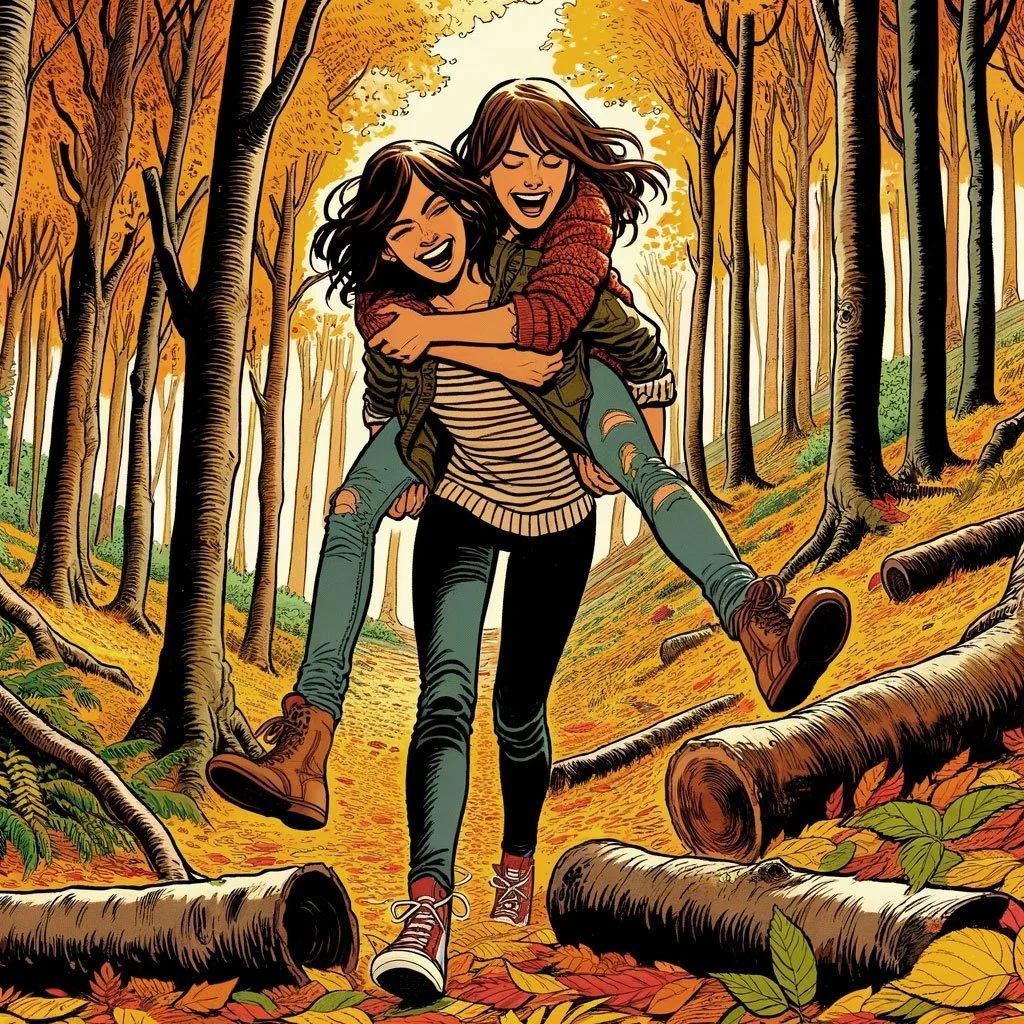
With a playful leap, Stephanie landed on Christy’s back, and said, “I’m sorry, but this is just how we’re gonna have to do this.” Christy, leaning forward to balance Stephanie’s weight, was laughing so hard that they both nearly toppled over. That slight distance began to shrink.
Three miles, 1,340 feet of elevation gain, and roughly three hours later, we reached our next stop—the Tom Floyd Wayside Shelter.
It was a three-walled shelter with a deck, built into the side of a small hill. Stephanie searched for a secluded spot to pee in the woods for the first time, while Christy and I joined two other hikers at the shelter. Suddenly, Stephanie shrieked from the woods.
“Are you alright?” we yelled.
“Yeah!” she called back. “It’s just that I’ve never peed on a mountain before! I don’t know how to do it!”
“We’ll I’m not helping,” I said. “You’ll figure it out. Peeing is just like riding a bike.”
Seeing other backpackers at the shelter was a welcome sight. The A.T. is a social trail, and mingling with fellow hikers at the shelters is a quintessential part of the journey. Moreover, I hoped that their firsthand experience of this camaraderie would ease any worries they had about their little brother hiking out here alone.
Another loud “Ahhh!” from Stephanie echoed through the woods, followed quickly by, “I’m okay!”
Among the hikers, one introduced herself as Doc and another as Hazelnut, who explained that she earned her trail name after showing a knack for spotting hazelnuts.
When Stephanie joined us, I asked, “Everything go okay?”
“Oh my gosh, I pulled my pants down to pee, but I was on such an incline that every time I’d squat, I’d start to fall backward,” she paused to catch her breath, “…so I was trying not to get pee on myself running around with my pants down to my ankles, trying to find a level spot.”
Stephanie stepped forward to introduce herself to the hikers. I quickly chimed in to explain the origin of Hazelnut’s trail name.”
"And why do they call you Doc?" Steph asked.
"Because I am one.”
"Oh perfect, I've been having this issue with my right foot. Could you—” Steph joked, playfully lifting her foot in Doc’s direction.
"Sorry, I'm off duty,” Doc replied with a smile, gently waving Stephanie's foot away.
"So, who’s all planning to sleep here tonight?" Hazelnut asked.
"That depends,” I said with a mock-serious tone. "Doc, am I going to wake up tomorrow and find that one of my kidneys has been surgically removed?"
"Hmm, now that you’ve brought it up, selling it on the black market could be lucrative," she said.
"Well, as long as you leave me one," I said. "I only need one to make it to Springer."
As some day-hikers joined us in front of the shelter, Doc added, “You know, a kidney could fetch ten thousand dollars on the black market.”
"Ten thousand dollars?" I said. "For that much, I figured you could get a whole baby on the black market, and they have two kidneys!”
The five of us burst into laughter. The newcomers, however, seemed uncomfortable, avoiding eye contact, which only made us laugh harder.
We laughed a lot, actually, my sisters and I. Making them laugh had always been one of my favorite things, not only on that day but throughout my life. From as far back as the days when I twirled around the living room in one of Stephanie’s dresses, I had been trying to make them laugh. Realizing that this aspect of our relationship hadn’t changed, that it would never change, pulled us all the way back together.
We eventually continued our hike to Compton Peak, but our frequent stops to chat meant we’d need to put on headlamps for the descent. Dave was waiting for us by the road, absorbed in the stunning views offered by the Blue Ridge Parkway.
Later, Stephanie confided that this had been one of her best days ever. “For just one day, I wasn’t just a stay-at-home mom,” she said. “I was an adventurer!”
As I said, family is defined as those who share and cherish the same stories. To remain close, that has to endure. Since they had driven here to spend a day on the trail, they will always be a part of my A.T. stories. It had taken months for that slight distance to form, but a single day on the trail was enough to dissolve it entirely.
After their return home, Dave, ever the craftsman, carved the iconic A.T. logo into their hiking sticks they had used. Those sticks now hang proudly on the walls of their homes, not just as souvenirs, but as emblems of our shared adventure and the stories we created. They might not be my battered hiking boots in a bar, but I’m happier with the story they will tell.