





Dust
By Ryan Grayson
"A good violinist keeps a hall listening. She made them forget to breathe."
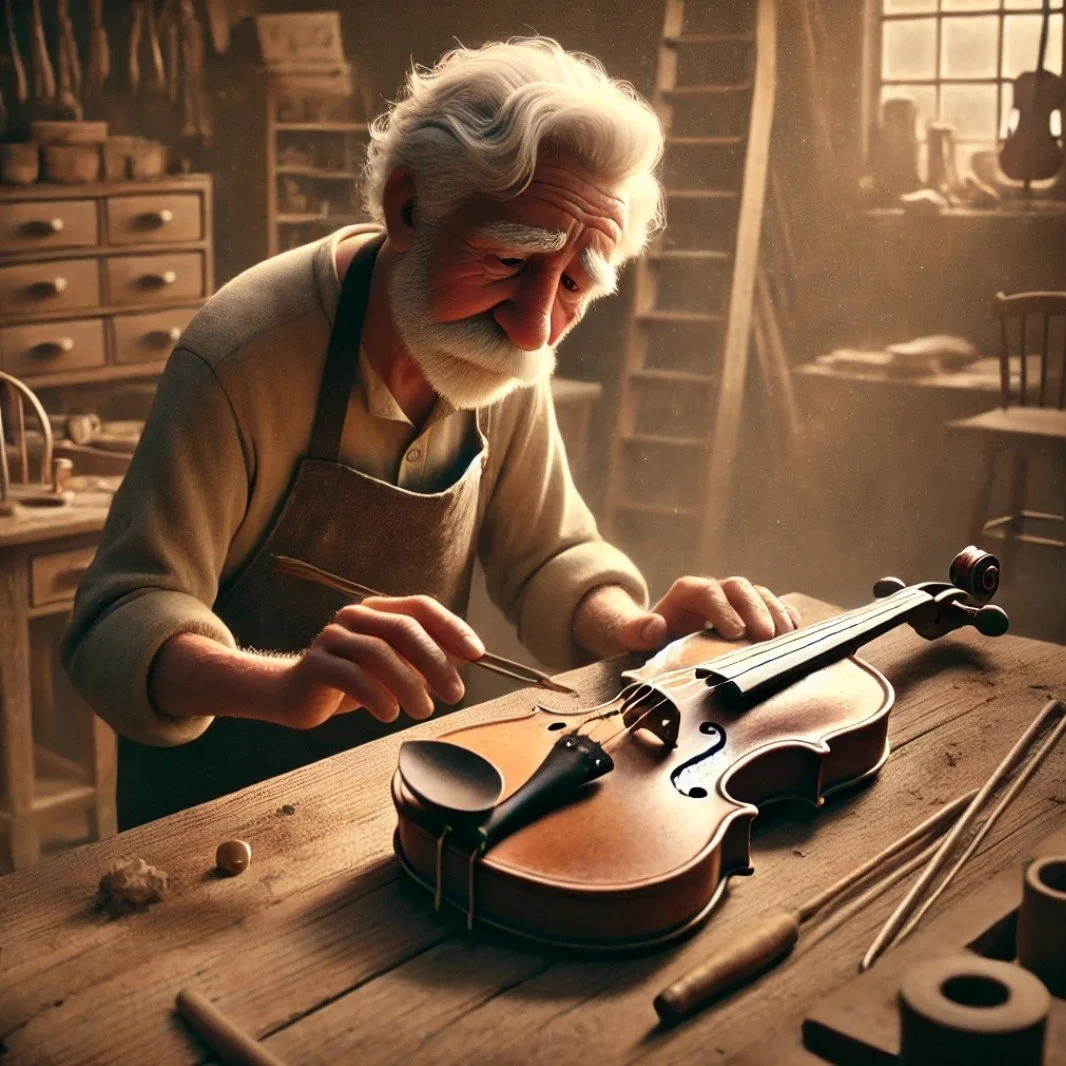
The old luthier ran a cloth over the violin to clear the dust before he declared the restoration complete.
A child leaned in, fingers hooked over the edge of the workbench. The old man only used that voice when a story was coming.
"An instrument is crafted for more than making music," he said.
He pressed his thumbs against the wooden bridge, straightening it under the tight strings.
"A violin is a vessel. A musician pours their feeling into the strings, and the wood carries it through its dark hollows and out into the room."
He plucked the highest string and let it ring out.
"And when a master like her lands the right note at the right moment, the whole hall goes still."
He set the violin down and carefully lifted a round gray clump of dust from a wooden tray.
"Most luthiers throw these away," he said with disapproval. "They clean the wood, sweep out the dust, and toss it aside. Not the Todorovas. Never."
He turned the gray ball between his fingers to study it.
"This is not just dirt. A violin keeps a piece of everyone who plays it. Skin cells, a stray eyelash, a thread from a sleeve, rosin worked off the bow. For generations it rolls inside and gathers itself together." He smiled and leaned closer, the way a man leans in for a secret. "Most see debris. We see history."
He held it up for the child to see.
"In the trade it is called a toneball, but to us it has always been Dushichka."
The child mouthed the word.
He glanced over his shoulder and lowered his voice.
"Some believe a musician leaves behind more than physical traces," he whispered. "Not just scraps, but a piece of their mind or spirit that lingers."
He rolled it gently in his palm.
"This does not happen from skill alone. Perfection never made anything come alive. It requires the kind of music that raises goosebumps, that makes you forget where you end and where the music begins."
"Some say it happened one night at La Scala, in Milan."
He set the clump down and took up the violin, holding it to the light to check for smudges.
"The master violinist stepped onto the stage beneath the great chandeliers, lifted her violin to her chin, and set her fingers on the strings."
He mirrored the motion, tucking the violin against his shoulder to feel the fit.
"She waited for the great hall to settle. A final throat cleared. She took one breath."
He drew a breath of his own, lifted the bow over the strings, and held it there, not quite touching.
"The first notes were barely there, like a thread pulled through the air. Then she took the melody higher, and higher, until the whole hall leaned forward. And just when they could bear it no longer, she resolved the melody. The hair came up on people's arms. Old men wept and did not know why."
"But no one felt it more than she did. By the end she had stopped seeing the faces below her, and the lights from above. There was nothing left to her but the sound, and she could not feel herself apart from it."
"And down in the dark of the violin, a small gray clump of dust lay as it always had. The sound moved through it, and for the first time, it stirred."
He set the violin down and took up the clump, placing it in the child's palm. The child watched it without blinking.
"Go on," he said, nodding toward the f-hole of the instrument. "Back inside its home for now. This one has not heard the note it needs just yet."
The child slipped the dust bunny into the violin and watched it disappear into the dark.
1
In the summer of 1940, a narrow alley off a crowded London street led to a pawn shop buried in shadow. Unlike the grand antique emporiums that dotted the city, this one was small, forgettable by design. It survived on being overlooked, drawing in the desperate and those needing quick, anonymous transaction with no questions asked.
Nikolai Todorova, an elderly man, a Bulgarian immigrant, and a craftsman by trade, often shuffled by the shop’s grimy windows, his gaze drawn to the hodgepodge of items inside. He had no love for the pawnbroker, but sometimes, among the dust and clutter, he found a tool worth salvaging.
Today, it wasn’t a tool that caught his eye but a weathered violin case, out of place among the usual pawned odds and ends. Its leather was worn, cracked from time and neglect, as if it had lived a hundred turbulent years. He decided to go inside for a closer look.
Nikolai held the door for a young mother clutching her daughter’s tiny hand and stepped in behind them. The pawnbroker eyed them warily, arms crossed behind his cluttered counter, making them feel as welcome as debt collectors.
The mother offered a polite smile as she greeted the pawnbroker, her gaze flicking over the grey overtaking the black in his hair and the bit of extra timber where muscle used to be.
With her daughter pressed close to her leg, she pulled a small item from her purse, holding it out carefully with both hands, as if that might make it worth more.
Nikolai used the moment to slip into the dimly lit aisles to find the violin.
The shop was cramped, packed with rusted tools and assorted dishware in need of a wash. Tarnished jewelry sat in dusty display cases, and whatever didn’t fit on the shelves was left in careless piles on the floor.
"This was my grandmother’s," the young woman said, holding the item a moment longer before offering it. “It’s a beautiful ring, isn’t it? My grandfather proposed with it. Took her on a walk through the park, she told me. He was so nervous, he dropped the ring in the snow. So he—"
"The clarity and cut here are poor, quite poor," the pawnbroker interrupted. Nikolai doubted he knew the first thing about either.
"Ten quid, love. That’s me being generous."
“But that won’t even get us through next month,” the young woman said.
Nikolai watched as the mother looked between the ring and her child. The shop was quiet. After a moment, she gave a small nod and set the ring on the counter, blinking fast.
Nikolai's dislike for the pawnbroker deepened, but his attention stayed on the violin case, now caught in a sliver of window light.
He unlatched the tarnished brass clasps and lifted the lid. The violin inside was a pitiful sight, its varnish dulled, its strings slack or missing. Worst of all, the wood was split and concaved below the bass-side f-hole.
Nikolai lifted the broken piece into place, careful not to press too hard. The damage was severe, but not beyond repair.
He peered inside and spotted a faded label: ‘Joseph Guarnerius fecit Cremonae anno 1739 HIS,’ with a small cross beside it.
“A decent forgery, all things considered,” he muttered, begrudgingly impressed.
He lifted the violin from its case and stepped closer to the sunlight. The subtle asymmetry in the f-holes was clear. The imbalance carried through the shoulders and scroll ears, a hallmark of Guarneri del Gesù’s style, fitting the name and year on the label.
Turning the violin over, he traced a split running down the back seam, then let his hand slide over the arch of the top plate. The scroll was broad, its curves less refined, rough tool marks still visible along the edges. The body felt right in his hands. Its weight, its balance. None of it was proof, but nothing had ruled it out.
Nikolai let the thought settle. This might actually be a 200-year-old Guarneri del Gesù. He realized his jaw had gone slack and closed it. Not since first seeing his late wife had something stopped him so completely.
He placed it back in the case, but as he refastened the clasps, his hands shook slightly, the clasps clicking together more than once before snapping shut.
Looking over his shoulder, he pulled the violin case closer, like he’d stumbled upon a stash of banknotes and feared someone might make a move for it. Hugging the case to his chest, he edged toward the front.
As the young mother and daughter left, he set the case on the counter. The pawnbroker flipped it open and grabbed the violin by the neck, giving it a rough shake. Nikolai winced.
The pawnbroker squinted at something inside and tried to shake it out.
"Got somethin' stashed in 'ere, have ya?" he said.
"No, sir, not to my knowing," Nikolai said, keeping his eyes down.
The pawnbroker turned the violin upside down and shook it harder. Nikolai tensed as the broken piece of wood flapped up and down like a loose tooth, but he held his tongue, trying not to reveal its true value.
A lumpy ball of dust tumbled from the broken f-hole onto the counter. They both stared at it.
"Ah, never you mind then. You seem straight, mate, but you wouldn’t be the first bloke tryna nick valuables hidden inside a hunk of junk. So I always check. Can’t be too trusting these days."
The dust bunny opened big, plaintive eyes that blinked in the light. It looked up at the old man, who locked eyes with it, not finding this strange at all.
“No offense taken, sir,” he said to the pawnbroker. “Your caution, it is a wise thing, I think.”
As the pawnbroker reached to sweep the fluff off the counter, Nikolai moved quickly to stop him.
"Oh, eh, you do not mind if I keep that?"
“What’s the bother with a bit of old fluff, mate? It’s rubbish.”
“Ah, but this is not just a bit of old fluff,” he said. “I come from a long line of luthiers, craftsmen who restore violins. My father and their fathers before them believed what gathers inside a violin is not only dust. It holds a bit of the instrument’s history. We put it back after a restoration, to keep that history with the violin.”
A flicker of hope stirred within the dust bunny. For years, it longed for a time when its existence was inseparably entwined with beautiful music.
The pawnbroker eyed him, saying nothing.
“I haven’t worked on violins for many years.” Nikolai gestured toward the case. “This one… it is not so valuable. So it is good for me to practice, to remember the skills my father gave me.”
The pawnbroker’s gaze lingered a moment longer before he pressed a lever on the register. A dull chime rang out.
Nikolai dropped a stack of tarnished coins on the counter, scooped up the dust bunny, and flicked it back into the violin before snapping the clasps shut.
2
Nikolai hurried back to his workshop. As he passed a newsstand, he slowed to read the headline on a stack of newspapers: “BRITAIN AT WAR: GERMANY IGNORES FINAL ULTIMATUM”.
“Feels like we just got outta the last war to end all wars, don’t it just?” the news vendor said. “Well let’s hope they’re right this time, yeah?”
The luthier nodded and picked up a paper.
“Got a shelter, down our way. Well, just a basement, but if you fancy stickin’ round, we could squeeze in one more if we need to. Gotta be safer than that ol’ shop of yours?
"Ah, thank you, but I think I will take my chances with the Germans," Nikolai said, then handed him a coin, and tucked the newspaper under his arm.
Raindrops began to speckle the ground as Nikolai approached his workshop, “Todorova Craftsmen” etched on the sign above. He noticed a flyer on the door, pulled it off, glanced at the ominous message of an imminent German attack, and then stuffed it into his pocket with a shake of his head.
Inside, the workshop was a haven for a craftsman and his tools. A sturdy workbench took center stage, surrounded by an array of chisels, planes, and other woodworking tools hanging from wooden pegs. Curled wood shavings littered the floor, and pieces of antique furniture in various stages of restoration were scattered about.
In one corner, a cold fireplace stood beside a lone homemade chair. The walls were bare, devoid of personal touches. A narrow, spiraling iron staircase led to a modest loft with a single twin bed.
Nikolai carefully set the violin on the workbench, lifted it from its case, and placed it beside him. His attention shifted to the dust bunny, looking up at him through the broken f-hole.
With a steady hand, he reached in with long tweezers and carefully lifted him out. The dust bunny blinked in the warm light.
Once in the open air, its fibers seemed to contract, pulling in tightly, a small, dense ball of fear until Nikolai gently placed it in the safety of a wooden dish.
3
The dust bunny's first awareness was music, a life-giving vibration from the violin that encased it.
From his place in the concertmaster's seat, he reveled in the rehearsals, soaked in the slow, sweet notes of chamber pieces, and felt the glorious thunder of grand symphonies. He watched audiences rise for standing ovations, their fashions the only thing that ever changed, the music was timeless.
For decades, this was his life, a constant, joyful immersion in sound. With each performance, he grew denser as tiny particles of rosin and dust settled into the violin.
It was a life he assumed would last forever. Then the music stopped. The world went silent and cold. He crossed the Atlantic in a crate, heard the distant, muffled clamor of an auction room, and was then locked away. His home became a mere commodity, a treasure to be owned, not played. The darkness was absolute, a dead, still quiet that lasted for years. When light finally returned, he was with a new owner, a young man’s inheritance who forced his uninterested daughter to take lessons.
The sound she made was wrong. It was a jagged, scraping screech that vibrated horribly, making the dust bunny’s fibers contract and cower.
One day, the girl, in a fit of frustration, stopped her horrible scraping. Her scream was followed by a terrifying feeling of weightlessness as the violin sailed through the air. The world cracked open with a deafening crash, and in the same instant, the dust bunny was ejected, landing on the vast, cold emptiness of a wooden floor.
He had never been outside. A shadow fell. A massive ginger cat loomed, its eyes huge. Then a soft paw batted him.
For the cat, it was just a game. For the dust bunny, it was a terrifying, helpless tumble across the floor, a blur of fur and jarring impacts that ended only when he rolled under a sofa just out of the cat’s reach.
The dust bunny tried to move, to get back to the violin, but something was wrong. Other dust bunny surrounded him. They were cold and still, but they seemed to pull at him, their lifeless fibers clinging like hands of the undead.
The father’s voice stormed into the room, screaming at the girl. Then went for the violin.
The dust bunny lay still, trapped in the dark with the lifeless clumps of dust. He would be left behind, to be swept away with the garbage.
He made one last push to propel itself to the safety of the violin. His body felt heavier now, weighed down as he clung to the edge of the broken belly of the violin just as it is lifted in the air by the angry father, who clumsily dropped it back into its case, flinging him safely inside. The case was slammed shut and he went back into darkness.
Until one day, a shaky light panned over the f-holes and shined inside. He moved towards it, and he saw the face of a man wearing a black balaclava holding a flashlight.
The robber closed the case and stuffed it in a sack. Sending the dust bunny back into darkness for hours until seeing the scowling face of a man inspecting it, and buying it for a few pence.
Then he was back into the case once more, back into darkness.
Through all these years unplayed, he barely hung onto consciousness, his purpose and energy faded. When the case opened again, he looked at the eyeball of an old man peering inside but didn’t bother to move toward the light. Instead, he lay back down, listless, nearly lifeless.
Next he was tipped upside down and fell on a counter. For the second time in his life, the dust bunny was outside, but no longer had the energy or will to move.
He opened his eyes, resigning to his fate, blinking away the bleary vision. The old man’s kind face came into view.
4
“Do not worry, little friend. She will sing again soon,” Nikolai said as he cleared a wooden dish and set the dust bunny inside with care.
He turned back to the violin, his eyes resting on it. "To think, I almost felt guilty for what I paid. But in those careless hands, she would be no more than wood and strings. She is a treasure, worth more than all I have, even more than myself.”
He leaned closer to the dust bunny and beamed. “Ah, you are quite the marvel, aren’t you? From the moment I saw you, I was absolutely certain the violin was genuine.” Nikolai laughed then eased himself onto a nearby stool, his knees creaking with the effort. He brushed his fingers against the worn fabric of his trousers.
“Let me tell you a story from when I was just a boy, no taller than this bench, back in Bulgaria. We lived above our small workshop in Plovdiv, where the city buzzed with the stirrings of revolution against Ottoman rule. In that workshop, my father, a proud Bulgarian man dedicated to his craft, taught me the art of bringing violins back to life."
Nikolai’s voice softened as he carried them both back through the years. “One evening, my father showed me a violin he had just restored. It gleamed in the firelight, its wood glowing with a fresh, polished sheen. He held up a small gray ball, much like you. ‘A toneball,’ he called it. ‘Every note played, every soul that had poured their heart into this violin leaves a trace behind,’ he said. ‘That is their legacy—rosin from their bow, flakes of skin cells, strands of hair, bits of wool from a favorite sweater. Over the years, this dust rolls around, gathering more and more. It’s literally made up of all its players, shaped by the vibrations of their music and the movement of their bodies.
“My father believed each toneball was like a symphony in itself, a budding planet in a universe of memories and melodies, growing with every performance. Some luthiers discard them, but my family… we cherished these pieces.”
Nikolai chuckled softly. “A toneball,” he said, “is more than just dust and debris. It is a silent witness to the violin’s history.
Some folks are superstitious about removing it after restoration, thinking it might hold the key to the instrument’s tone. But my father, much like myself, was a rational man. He didn’t believe in superstition. So, does a finer violin create a finer toneball, or does the toneball create a finer violin?” Nikolai lifted his shoulders. “Eh, who am I to say, but how could anyone throw away such a piece of history, such a piece of art?”
He smiled, warmth spreading across his face. “Imagine that, something so small, yet so full of meaning.” He gingerly petted the toneball with the back of his finger.
“So, my father handed me the toneball and asked me to return it to its home, inviting me into the family ritual.” Gently, Nikolai tapped the violin, his mind drifting back to that long-ago moment.
“Now that I was part of the ritual, my father leaned in, like I was ready to be let in on a family secret. He lowered his voice and said, ‘My father, your grandfather, claimed that if an instrument is truly special and the right piece of music is played, the kind that gives you goosebumps, the kind that stirs the soul, well...’” Nikolai smiled as he said, “The toneball could come to life.”
He chuckled, shaking his head. “Now, I never believed it. Just a story you tell a child when you want to make the ordinary magical. My father didn’t believe it either, a rational man like I said. But my grandfather swore on it, said he’d seen it happen. Said it wasn’t only physical pieces of themselves musicians could bequeath to a toneball, but a piece of their souls.'
“Of course, I’d believe it was another one of his old stories.” He paused, glancing at the small ball of dust looking back at him. “But here I am, talking to you now.” He let out a laugh.
“But your time to help shape beautiful music will come later," he said, waving both hands, brushing the thought away. "First, we must prepare your violin.”
5
Nikolai picked up his tools and began working on the Guarneri del Gesù. Though it had been decades since he last restored a violin, the familiar motions returned naturally.
Each day, he went to the bench, the tools laid out with purpose, working with steady precision. The dust bunny had settled on a shelf, where it could watch over and follow every movement.
As he examined the instrument, Nikolai glanced up at the dust bunny. “Patience, Nikolai. Patience is everything in this craft,” he said, his voice gentler now, like he was passing the lesson down to a son of his own, mirroring the way his father used to teach him.
He assessed the varnish, eyes tracing the worn, cracked surface. “We don’t strip it all away,” he said. “The scars, the marks—they’re part of its story.” He moved slowly, working around the damaged areas, careful not to disturb the character that had settled into the wood over time.
Days passed as Nikolai worked, gradually shifting from cleaning to the more intricate repairs.
Each morning, he heated the animal glue over a spirit lamp, the sharp, earthy scent filling the air.
"This glue recipe," he said, stirring the pot, "has been in our family for generations. My father taught me, just as his father taught him. Heat it just right, or it loses its strength."
As the warmth spread through the workshop, the dust bunny defluffed, softening and loosening its fibers, subtly shifting its form, settling into the comforting heat.
“My father once said, ‘Violins are like people, they can both be shattered—’” Nikolai worked the glue into the cracks. “—but with care and patience, they can be made whole again.”
He wafted the scent of the glue toward his nose, breathing it in deeply. “This smell takes me back to the last lesson with my father when there was a knock at the door.”
Nikolai's hands stilled for a moment. “I saw his face change before he went to answer, so even though I couldn’t hear the words, I knew. The Ottoman reprisals were coming." He exhaled slowly. "My father didn’t wait. We gathered what little we could carry. He’d get us to safety, and then he would return to the fight.”
He set down his glue brush and pressed both palms flat on the bench. “When we fled toward Serbia, unrest was everywhere. Most of it’s gone to fog now, the places we passed, where we stayed. But I remember the fear. I remember how my legs ached trying to keep up. I remember my mother, begging my father not to go back. She had always been a strong woman, so what came out didn’t sound like her. I remember that clearly. It made my stomach go hollow. Nothing around me looked the same after that.”
Nikolai retrieved his spool clamps to secure the pieces he’d carefully glued. “My father went back anyway, and we never saw him again.”
He picked up a clamp and looked at it like he’d forgotten what he meant to do with it, and then fixed it in place. He turned the screw until the wood held firm. “Too much pressure and the wood cracks,” he said. "Too little, and it won’t hold.”
Nikolai left the violin overnight to let the glue set. The next day, he removed the spool clamps and began preparing the surface. His hands moved over the wood, sanding and polishing, revealing the violin’s character.
He mixed the spirit varnish, applying thin, even coats. “The varnish shows everything,” he said. “The scars, the beauty, the history. We don’t hide the past; we let it speak.”
After weeks of work, Nikolai finally set down his tools and examined the violin, whole once again. He turned to the dust bunny, lifting it gently. “You’ve been patient, little one,” he said, placing it back inside the violin. “Back home where you belong.”
The dust bunny settled into his place inside the instrument. Nikolai stepped back, observing the restored violin. Most of the work was done.
6
Nikolai moved to the chair by the fireplace and settled in, resting the violin on his lap.
“My father put a violin in my hands when I was only four,” he said, fingers brushing over the freshly polished wood.
“He believed a luthier should know what it’s like to bring an instrument to life, to feel it as an extension of themselves.”
He picked up the strings, guiding each one through the tailpiece and over the bridge. With each threading, he worked the string around the pegs, turning them slowly to find the right tension, listening to the faint creak as they settled into place, a sound he’d forgotten he loved.
His movements grew more fluid, slipping into the familiar rhythm of the task, each step pulling him back to a place he’d left behind.
Nikolai plucked each string in turn, listening closely. He turned the pegs, coaxing each string toward the right pitch.
The dust bunny peeked up through the f-holes, watching Nikolai’s every movement, waiting quietly, eager to hear him play.
Nikolai positioned the violin under his chin, gripping the bow. He raised it, but his hand remained still.
A distant air raid siren pierced the quiet. Hearing a commotion outside, Nikolai got up, set the instrument on the chair, and went to the door.
As he opened it, the sound surged in. A man holding a small child ran past, the mother hurrying alongside them. He watched them sprint toward the makeshift bomb shelter under the newspaper vendor’s home.
Nikolai stayed in the doorway until the last of the footsteps faded.
The street was empty now, quiet except for the siren winding up slow, its hollow wail rising and falling over the rooftops.
He stood there a moment longer, listening, his mind drifting to places he’d rather not go. Then he shut the door, the latch clicking into place.
For a while, he stayed still. Then turned back. The violin waited, the dust bunny watched.
Nikolai sat down and took up the bow again. “You’ll be the first to hear me play in… I guess it’s been about twenty six years,” he said. “A long time.” He gave a brief smile. “I’ll be rusty. If you can help me sound better, I won’t mind.”
He drew the bow across the strings. The first sound scraped out dry. He kept going, adjusting his grip until the notes steadied, the rough edges easing as he found the balance.
The dust bunny closed its eyes and felt the notes send shivers through his body. He began to move with the music. He found spots where the wood carried the sound best. Pressing into the violin’s curves, he felt the resonance change, the air inside tightening or loosening around him. When he pushed near the f-holes, the notes darkened. He puffed up, catching some of the higher vibrations and dulling their edge. Shrinking back, he let the sharper tones pass clean through.
The more he tried, the more certain he became. Every slight shift had an effect. He wasn’t just a passive listener anymore. He was a part of it now. A thrill ran through him.
Each night, Nikolai played, and the dust bunny’s dance grew more deliberate. He followed the pull of each note, adjusting his movements to meet the sound. The angle of the violin guided him as much as the music, sending him rolling or drawing him higher as the body shifted.
The violin no longer stayed shut away in its case. It rested nearby, always within reach. By day, the dust bunny stretched out in the sunlight. At night, he waited by the fireplace, listening for the first note.
Over time, he grew denser, rounder, gathering shape with every song. What once had been passive listening became a careful choreographed dance, each movement timed to the music. Together, they had changed. The luthier played better than he had in years, and the dust bunny felt his part in every note. After two centuries of drifting, he finally had a reason to be.
That night, Nikolai chose a sevdah melody, slow, mournful, and full of longing. The dust bunny stilled deep inside the violin, settling low against the wood as the vibrations pressed around him. This was his favorite.
The melody pulled slow and heavy, each note dipping low before climbing just enough to ache. There was a sweetness buried in it, but it never lasted, always slipping back into something darker.
Another night, another air raid siren rose fast, winding higher until it cut through the room. Nikolai kept playing. He’d stopped for enough false alarms already.
Then the first rumble hit, low but close enough to catch in his chest. Not a warning. This was impact.
He stopped, the bow paused halfway across the string. Another rumble followed, closer.
For a moment, he stayed where he was. Then another blast, closer still, rattling the windows. He set the violin down in its case and crossed to the door.
Outside, the street had broken open, neighbors, shouting, a woman clutching a child in her arms, running toward the newspaper vendor’s house.
He looked back at the violin and the small, frightened eyes peeking out.
All this time, he’d stayed put, too proud to run. But the violin wasn’t his to lose. Two centuries of craft and care, he wouldn’t allow it to be destroyed under his watch. The violin and its occupant was all that mattered.
The rest could burn.
He shut the case, pulled it tight against his chest, and ran for the newspaper vendor’s house.
7
As Nikolai rushed toward the shelter, the rumble in the distance set his nerves on edge. His heart pounded harder with every step, and suddenly, he was no longer in London. He was back in 1914, clutching a different violin to his chest while gripping his wife Mila’s hand as they fled the Austro-Hungarian forces advancing through Serbia. The sound of shells and gunfire echoed around them.
Their escape was a frantic scramble, moving under the cover of night to avoid detection.
The Austro-Hungarian forces were relentless, shelling towns and chasing any who tried to flee. They moved quickly, never staying in one place for long, always wary of the artillery fire and soldiers that seemed to be everywhere. Then came the explosion, shrapnel tearing through the air, striking Mila. But they couldn’t stop. Not with the enemy closing in.
Nikolai did what he could to care for her wounds, but without proper supplies, the infection quickly took hold.
The chaos of war left little chance to find help. Hospitals and clinics were either overwhelmed with casualties or destroyed by shelling. Moving through fields and back roads to avoid soldiers, they saw the devastation everywhere. Burned villages, abandoned carts, and other families on the run.
For three days, they kept moving, their journey marked by the sounds of distant artillery and the fear of being caught.
With each step, Mila grew weaker, her strength slipping away as fever set in.
Finally, they found an abandoned house where they could rest with some semblance of safety.
It was barely standing, with shattered windows and partially collapsed roof, but it was shelter. He made her a bed out of old blankets and clothes he scavenged from the rooms, trying to keep her warm against the chill that seeped through the walls at night.
Despite her obvious exhaustion, her eyes found him sitting in a chair, framed by the moonlight, keeping watch out the window.
“You must be freezing,” she murmured, offering one of the blankets. “Here, take it. I’ll be fine,” she said, though the shivering in her voice betrayed her.
Nikolai looked at her, moved by how she still thought of him, even now, when she needed every bit of warmth for herself.
He hesitated for a moment, then took the blanket and settled in beside her, wrapping it around them both.
She lay in silence for a while, her breath shallow and uneven. Then, in a whisper, she made a request.
“Will you play our opera song?”
Nikolai’s throat tightened. He knew what she meant. Thaïs: Méditation. It was their song, the one that had played during their first date at the National Theatre in Belgrade, a night that belonged to another life.
He hesitated. They should stay quiet, remain hidden. If they were discovered, it could bring danger to their door. But seeing her so frail, her skin drained of color, he couldn’t refuse her, not now. He reached for the violin beside them.
He drew the bow across the strings. The first few notes were delicate, tentative. He closed his eyes, setting the fear aside so he could play unrestrained, pouring all his feeling into each note, hoping she could feel it too. He stole a glance, and for a moment, their eyes met. A soft smile touched her lips, and he knew she indeed felt it too.
With that, he played, not just for her, but for both of them, giving everything to the music as if it could take them back to that night, before everything fell apart.
The notes weaved around them, bringing back the warmth of the theater lights, their shared looks, and the way the world seemed to fall away as they were swept up in the sound. There had been no worries, no sorrow, just the heady joy of new love and that perfect moment.
“The violinist played it just like this, didn’t he?” Mila whispered. “Like he was telling the story of us, note by note.”
“Exactly like this,” Nikolai whispered back, “Like he was playing it just for us.”
And so, he played on, each note carrying the memories of their life together. The melody, delicate at first, grew fuller, like their love that had deepened over time. The final note hung in the air like a breath that neither of them wanted to let go.
When he finished, he opened his eyes, expecting to hear her soft hum she always made when she loved something he played. That quiet, contented sound that told him everything was perfect. But there was only silence, a silence that would live in him forever.
“Mila?” he whispered.
Her lips held a peaceful smile, but she didn’t answer.
The violin slipped from his hands, crashing to the floor with a hollow thud. He rushed to her, pulling her into his arms, but it was too late. She was gone, and everything around him fell away.
8
Nikolai hurried through the dark London streets, clutching the violin case as the sirens continued to wail. The newspaper vendor waved him over from the doorway, urging him inside. Nikolai gave a quick nod and descended the narrow basement steps.
A bare bulb dangled from a wire overhead, its light morphing the faces with each swing. Nikolai kept his head down, weaving through the crowd before hiding in the shadow of a wooden pillar.
The basement settled into a tense silence. Distant explosions rumbled, just enough to send slight tremors through the ground and rattle dust from the floorboards. A few children whimpered, while their parents forced calm smiles and held them close, murmuring promises they didn’t know if they could keep.
Another explosion rumbled, closer this time, shaking the floor harder beneath their feet. The children's cries grew louder. A young mother pressed her hand to her mouth, eyes wide as she drew her child close. Nikolai recognized her. The woman pawning her grandmother’s ring.
The air felt suffocating and the walls closed in. Nikolai’s breath came quick and shallow. His fingers fumbled with the clasps of the case before flipping open the lid.
He scanned the stricken faces staring back at him, then gently lifted the violin, settling it under his chin. The bow hovered over the strings for a heartbeat. Then his first notes broke through the silence.
Inside the violin, the dust bunny stirred to life, drawn into the music. The vibrations of the strings pulsed through him, as he moved in time with the melody. He shifted and swayed, responding to each note with instinct, adjusting the sound in ways that felt natural to him. Every movement brought the music closer to perfection.
Another rumble shook the room, raining dust from the floorboards above, which settled into the violin, becoming part of him as he danced.
The music washed over the basement, and for the first time, the tension cracked. An adult let out a sob—quiet, but enough to break the dam. A woman near the back wiped her eyes quickly, but the tears came faster. A man next to her bowed his head, his shoulders shaking. The others didn’t try to stop it anymore. No longer held back by the burden of holding it all together, they let go.
One by one, the tension drained away, replaced by quiet sobs and shaky breaths. Then, amidst the tears, someone laughed, soft, almost startled, like they’d forgotten they were allowed, and it spread.
The children, seeing the adults’ faces change, began to giggle and loosened their grips. Soon the whole room felt lighter, for a moment, they found something they thought was lost.
After the last note faded, the room stayed quiet. Someone cleared their throat, offering a soft "thank you." A few people shifted in their seats, still shaken, some with faces flushed from the raw emotion they’d put on display in front of neighbors and strangers.
A woman of about Nikolai’s age reached out and gently patted his arm, but saying nothing, her smile faint, her eyes still red.
From the back, a voice spoke up, "Can you play another?"
Nikolai smiled, then raised the bow again.
9
By morning, they received the all-clear. Nikolai stepped outside and drew the cool air deep into his chest, eyes scanning the sky, almost surprised to see it still there.
For a few more months, the raids came and went. Each time the sirens wailed, they’d shuffle their children into that dark space, where the walls pressed in close and the air felt stale. The nights were punctuated by distant rumbles, or nothing at all, but either way, Nikolai would take out his violin and begin to play and the dust bunny danced. Their notes didn’t chase away the fear, but they moved through it, filling the empty spaces with something other than silence.
Some nights, the tension in the room would dissolve into quiet sobs or shaky laughter. Other nights, the music gave them something to share, something to connect with, other than uncertainty.
At times, a couple would hold each other, gently swaying, or a child would stand on their father’s toes as he twirled her around in small, careful circles.
Dust hung in the air, swirling with every movement.
Inside the violin, the dust bunny was growing quietly with each note. He danced as if each performance was his last and his first, alive in the moment, taking none of it for granted.
As he grew denser with each drift of dust, the music became fuller, more textured. Nikolai could hear it. A richness in its tone that hadn’t been there on their first night.
One night, after the all-clear sounded, Nikolai felt a tap on his shoulder while latching his case. He looked up to see the young mother from the pawn shop standing there, looking tired. Her little girl was hiding behind her leg, peeking out with one wide eye.
“Sorry to bother you,” the mother whispered, shifting her purse. “We’re heading up, but she won’t leave me be. She keeps asking to see the singing box.”
“The what?” Nikolai asked.
“The singing box, that’s what she calls it. She’s got a bit of poet in her, that one. She said it was crying.” She smoothed the hair at the back of the girl's head.
Nikolai unlatched the case and lifted the instrument. “It is not crying,” he said gently. “It is just telling a story about a long journey.”
The girl stepped out from behind her mother’s leg. She didn’t look at his face; she stared at the wood. She reached out a small finger and pressed the faint, jagged line running down the belly, the crack he had glued weeks ago.
"It has an owie," she said.
The mother moved to pull her hand away, but Nikolai shook his head. "It is okay," he said. He looked at the girl. "It did have an owie. But look." He knocked on the spot. "The wood holds together tight now. The broken parts... sometimes they become the strongest parts, if you give them time to set."
The girl nodded, as if this made perfect sense.
"I'm Nikolai," he said.
"I'm Pearl," the girl said.
Nikolai smiled, a faint, genuine thing. "Pearl," he repeated. "A fitting name. A pearl starts as just a spec of grit, did you know that? But with time, it becomes a treasure."
10
“This doesn’t happen from skill alone. It doesn’t come from playing perfectly. Perfection alone never made anything come alive. It has to be the kind of music that raises goosebumps, a performance that makes you forget where you end and the sound begins.”
He placed the round dust bunny in Pearl’s palm. Her eyes widened, locked on it, not blinking. “Go on,” he said, nodding to the violin. “Back inside its home for now. This one hasn’t heard the note it needs just yet.”
She slipped the round dust bunny into the violin, watching as it disappeared into the dark.
Nikolai set the restored violin into Pearl's hands.
"Now show me," he said.
Pearl tucked it under her chin.
He lowered her shoulder with two fingers and nudged her thumb along the neck.
"Better," he said.
"Will you play the opera song again? I want to see it again," she said. "That’s my most favorite."
Nikolai smiled. "Mine too.”
He lifted his del Gesu, set the bow, and drew out the opening note of the Meditation from Thais.
Inside, the dust bunny danced.
Copyright © 2026 Ryan Grayson. All rights reserved.